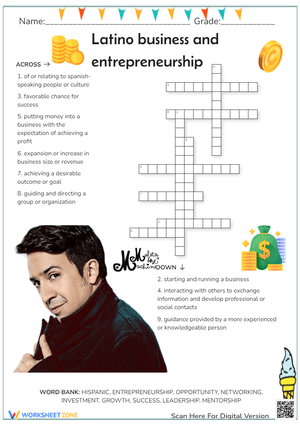
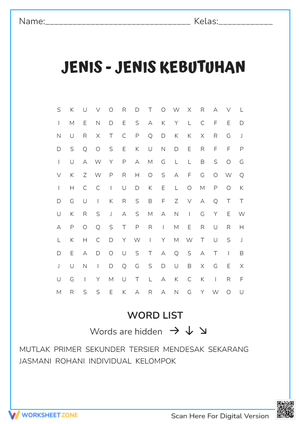
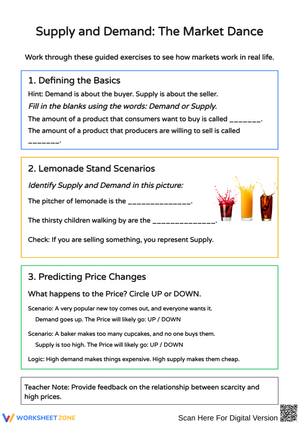
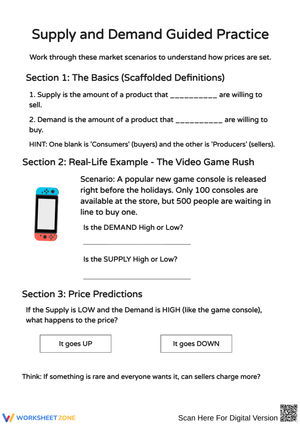
These economics pdf worksheets for 7th grade give social studies teachers ready-to-print practice across the core ideas in a middle school economics unit — scarcity, opportunity cost, supply and demand, trade, and the economic roles of producers and consumers. Each worksheet targets a distinct skill so students work with one concept at a time rather than juggling several at once. The set covers vocabulary introduction, short informational reading with text-based questions, labeled graph interpretation, and scenario-based reasoning tasks.
Concepts These Worksheets Build
Seventh grade is where students are expected to move past memorizing definitions and start explaining how economic concepts connect to real decisions. The worksheets push that shift: students underline evidence in short passages, label parts of supply and demand diagrams, compare two scenarios and name the specific alternative given up, and write brief justifications for why a producer might specialize rather than diversify. The tasks ask for reasoning, not just recognition.
- Scarcity and unlimited wants — students identify what is limited, what is wanted, and why choices follow from that tension
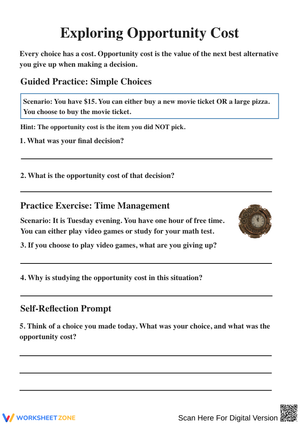
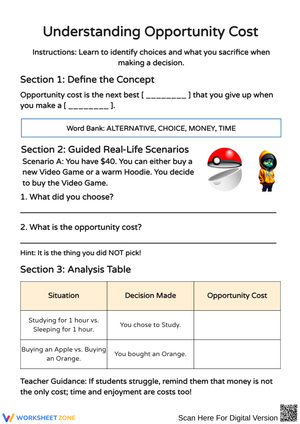
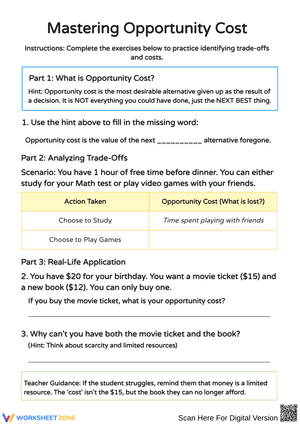
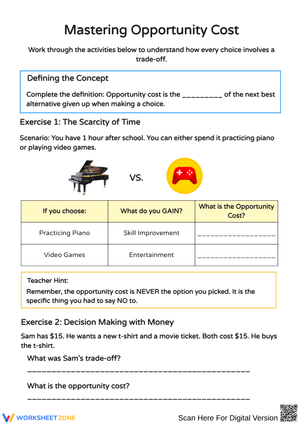
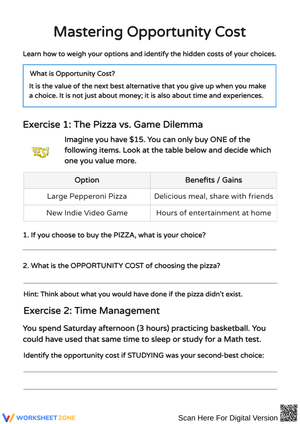
- Opportunity cost — scenario questions require students to name the specific alternative forgone, not simply note that a choice was made
- Goods, services, producers, and consumers — sorting and classification tasks built around examples students already encounter
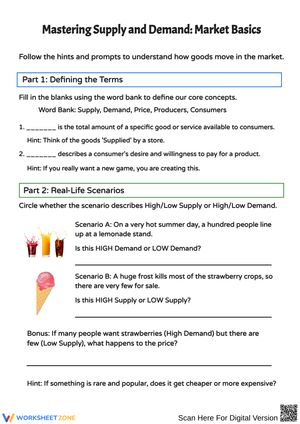
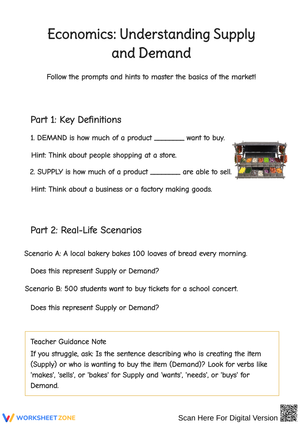
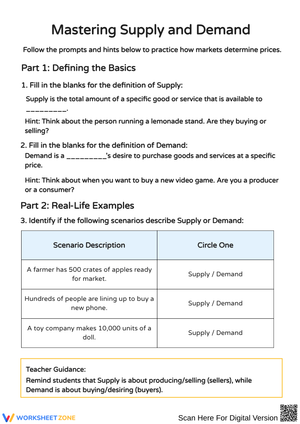
- Supply and demand — labeled graph reading paired with written explanation of what happens when price or availability changes
- Specialization and trade — short passages followed by comparison questions about why regions or businesses concentrate on particular products
- Personal finance basics — saving, spending, and budgeting scenarios that connect market concepts to household decisions
The graph interpretation work goes further than basic labeling. A student who can recite "when demand rises, price rises" often cannot trace that relationship on an actual diagram. Each supply-and-demand worksheet asks students to read a labeled graph and then put the same relationship into their own words — two separate cognitive tasks that together reveal whether understanding is real or just memorized phrasing.
Common Student Errors These Worksheets Help You Catch
The most persistent error in 7th grade economics is conflating opportunity cost with monetary price. A student who chooses an activity and then writes "the opportunity cost is $10" is describing the money spent, not the alternative forgone. These worksheets address that directly by asking students to name the specific option given up — "the opportunity cost of choosing soccer practice is missing the study group" — which makes the distinction concrete without requiring a full reteach.
Scarcity brings its own misconception. Students almost universally read scarcity as "running out completely," which produces answers like "water is not scarce in our town because we have plenty at home." The reading passages in this set define scarcity as wants exceeding available supply at a given time and place — not absolute absence — and the follow-up questions test that distinction using examples where a resource is limited but still present.
Graph reading has a third predictable failure. Students often swap which axis carries price and which carries quantity, then arrive at a wrong interpretation that looks plausible on paper. Others confuse a movement along a demand curve with a shift of the curve. The graph worksheets ask students to explain what caused a change before interpreting the result — which surfaces axis confusion and conceptual misunderstanding as separate, fixable problems rather than hiding both under a correct-looking final answer.
How to Work These Worksheets Into Your Lesson Planning
A structure that holds up week after week: Monday warm-up is the vocabulary worksheet — five to eight minutes, no prep, students start immediately when they sit down. After direct instruction mid-week, assign the reading comprehension and graph worksheets as independent practice. On Thursday or Friday, use a scenario worksheet as a quick formative check. That rhythm gives students multiple exposures to the same core ideas in different formats, which does more for retention than one long review session the night before a test.
The scenario worksheets work best when teachers spend two minutes before students begin connecting the premise to something at school. If the worksheet covers supply and demand, reference cafeteria snack prices or ticket availability for a school event. Students who can anchor an abstract concept to a familiar situation spend less time re-reading directions and more time reasoning through the task. Sub plans built around economics pdf worksheets for 7th grade require almost no verbal setup from a substitute — a vocabulary review, a reading task, and a scenario question fill a full class period with directions built directly into each worksheet.
Standard Alignment
These worksheets address the Council for Economic Education's Voluntary National Content Standards in Economics — specifically Standard 1 (scarcity and choice), Standard 2 (opportunity costs and trade-offs), Standard 6 (specialization and voluntary exchange), and Standard 7 (markets and prices). Most state social studies frameworks place these standards at Grade 7 because students at this level have enough reading stamina for short informational text and enough abstract reasoning capacity to move from a concrete example — a household choice, a local business decision — toward a broader market principle. The graph interpretation tasks also connect to data literacy expectations common in 7th grade math and ELA frameworks, making cross-curricular coordination possible without additional planning overhead.
Adjusting These Worksheets Across Ability Levels
For students who need more support, the vocabulary and classification worksheets are the right entry point: the tasks are concrete, correct answers are identifiable rather than interpretive, and students build familiarity with economic terminology before encountering it in reading passages. Adding a word bank to scenario questions helps students who stall when asked to produce academic vocabulary from memory — that adjustment removes a retrieval barrier without reducing the reasoning demand of the task itself.
For students working above grade level, removing answer choices and requiring written justification on every item raises the challenge substantially. A student who can explain in two sentences why a shift in supply — not a price movement — produced a new market outcome is showing understanding that a multiple-choice answer cannot capture. These economics pdf worksheets for 7th grade also work as small-group discussion starters at this level: pairs or groups can debate which choice in a scenario carries the greater opportunity cost, and that conversation surfaces reasoning that individual written responses rarely reveal on their own.
Frequently Asked Questions
Which economic topics should 7th graders practice with worksheets?
The core topics for Grade 7 are scarcity, opportunity cost, goods and services, producers and consumers, supply and demand, specialization, and trade. Most teachers also include personal finance basics — saving, spending, and simple budgeting — because those examples make broader market concepts feel connected to students' actual lives rather than to an abstract economic system.
How do these worksheets hold up as sub plans or end-of-unit review materials?
Sub plans using these worksheets require almost no verbal explanation because directions and examples are built directly into each worksheet. A typical plan might pair one vocabulary organizer with a short reading and one scenario task — that combination fills a standard class period and leaves students with meaningful practice rather than busywork. For unit review, the scenario and graph worksheets are most useful because they require students to apply concepts, not simply recall them.
Are these resources appropriate for students reading below grade level?
The economics pdf worksheets for 7th grade in this set use short reading passages — typically one to two paragraphs — so the reading length does not overwhelm the economics thinking. Students reading below grade level still encounter academic vocabulary, but within a text brief enough to get through and focus on the concept. Teachers working with stronger readers can raise the demand by removing vocabulary provided in the passage and asking students to define terms in their own words after reading.
What separates a useful economics worksheet from one students fill in without thinking?
The difference almost always comes down to whether the task requires an explanation. Matching and fill-in-the-blank activities confirm recognition but do not confirm understanding. The strongest worksheets in this set ask students to explain a choice, describe what changed in a graph, or justify why one option carries a higher opportunity cost — tasks where copying a word from a word bank produces a wrong answer and parroting a neighbor's response still exposes a gap when the teacher reads it.












 Interactive Worksheet Maker
 Quiz Maker
 Word Search Maker
 Crossword Puzzle Maker
 Word Scramble Generator
 Sentence Scramble Generator
 Handwriting Worksheet Generator
 Name Tracing Generator
 Fill In The Blank Generator