7th Grade Christopher Columbus Worksheets PDF for World History
These 7th grade christopher columbus worksheets pdf give teachers the specific tools a Grade 7 world history unit on exploration actually needs — map analysis, timeline sequencing, primary source close reading, and evidence-based writing — without lumping all of it into a single unwieldy packet. Grade 7 is typically the first point in US social studies where students are expected to move beyond a celebratory account of Columbus and examine the encounter critically, and each worksheet reflects that shift in what the course demands.
What's Inside the Set
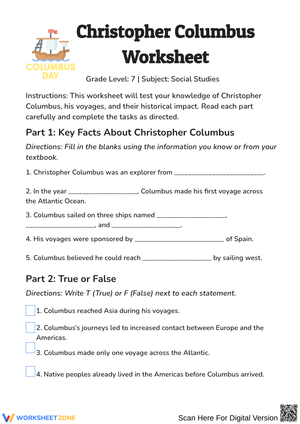
Each worksheet targets a distinct skill, which matters for teachers who need flexibility across a unit. Some days call for a warm-up map exercise; others need a reading with source questions. The standalone format makes it easy to slot individual worksheets into bell-ringers, station rotations, homework, or substitute plans without pulling apart a larger packet.
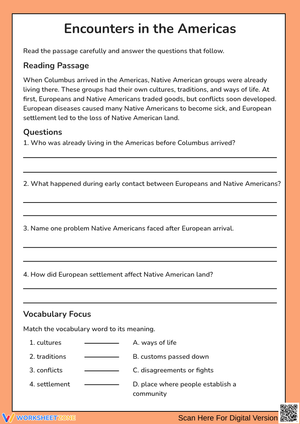
- Vocabulary practice using terms such as expedition, navigation, Indigenous, colony, Columbian Exchange, and consequence — with context sentences that show how each word functions in historical writing, not just isolated definitions
- Map analysis tracing Columbus's four Atlantic routes and placing them in relation to Spain, the Caribbean islands, and the continental coast
- Timeline sequencing covering events from 1492 through the later voyages, asking students to order events and distinguish which outcomes were immediate versus long-term
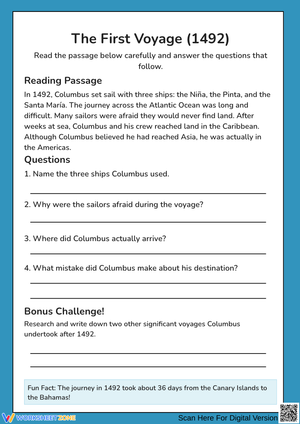
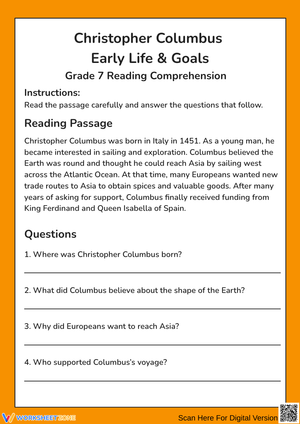
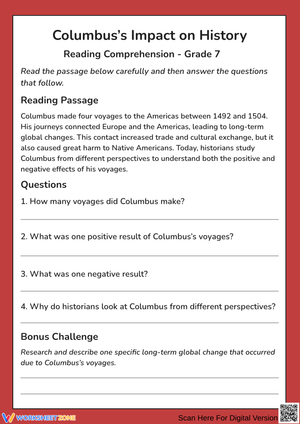
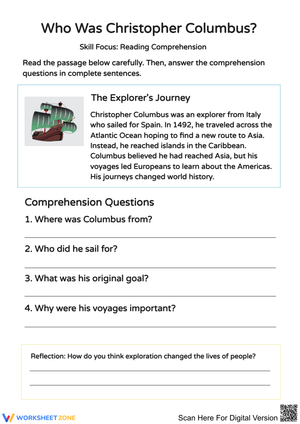
- Reading comprehension using a passage that covers Spanish sponsorship, the navigation challenges of the Atlantic crossing, and the initial encounter with the Taíno
- Primary source analysis built around a short Columbus journal excerpt with margin questions on word choice, purpose, and what the account omits
- Written response asking students to state a claim about the consequences of Columbus's voyages and support it with at least two pieces of evidence from the materials they've read
A strong 7th grade christopher columbus worksheets pdf set does not treat the written response as optional or as an enrichment task for fast finishers. At this grade level, writing is where students demonstrate whether they can actually use evidence — and the other worksheets in the sequence build toward that task.
Misconceptions Students Carry Into the Unit
The flat-Earth myth needs direct correction on day one. Students consistently arrive believing Columbus proved the Earth was round — some state it with complete confidence in opening discussions and write it without hesitation on the first warm-up. The historical record is different: educated Europeans already understood Earth was spherical. The actual dispute with the Spanish court centered on Columbus's estimate of Earth's circumference, which he significantly underestimated. That's why he believed Asia was reachable in the distance he had planned. Teachers who don't name this error explicitly will find it recurring in student writing throughout the unit.
The word "discovered" is a second persistent problem. Students write "Columbus discovered America" without registering what that phrase erases. One classroom move that works: ask students to write that sentence and then identify whose knowledge the word "discovered" assumes. That question opens a productive discussion about perspective and sourcing without requiring a lengthy historiography lecture. The primary source worksheet builds directly on this, asking students to identify whose voice shapes the account they're reading.
In Columbian Exchange tasks, students default to a gains-only reading — new crops, expanded trade — and routinely underweight disease, population collapse, and forced labor as consequences. Sorting tasks that ask students to record outcomes by group (Who gained? Who lost? Who experienced both?) catch that oversimplification early enough to address before the written response.
Fitting These Worksheets Into Your Lesson Planning
A practical sequence starts with the vocabulary and map worksheets as a two-day opener. Use the map for ten minutes on day one to activate prior knowledge and surface what students already believe about the routes — including any flat-Earth assumptions. Assign the vocabulary worksheet before introducing the reading, not after. Students who encounter "expedition," "Indigenous," and "consequence" in context before tackling the passage engage differently with the text than students who meet those words mid-sentence for the first time.
The primary source worksheet works best mid-unit, after students have enough background to notice gaps in Columbus's account. Running the exit ticket format — one claim, two pieces of evidence — three separate times during the unit (after the reading, after the source analysis, and after the Columbian Exchange discussion) builds familiarity with the structure and reduces the cognitive load of the final written response. By the third time, students are not learning a new task; they're applying a familiar one to new content.
These 7th grade christopher columbus worksheets pdf work particularly well in station rotations. One station runs map and timeline work; another handles the primary source excerpt and margin questions; a third asks students to draft the evidence paragraph. That format keeps a 45-minute class moving and gives the teacher real-time information about where students are struggling before the unit ends.
Adjusting These Worksheets for Different Student Levels
For students who need additional support, the vocabulary and map worksheets make the best entry point — and that order matters. Completing the vocabulary worksheet before reading the passage removes one source of friction from the reading experience. Students who understand what "expedition" and "Indigenous" mean before they encounter those words in a dense historical paragraph are better positioned to focus on the argument being made rather than decoding individual terms.
For students ready for more challenge, the primary source excerpt extends naturally into a corroboration task: ask them to write two or three sentences comparing Columbus's journal account with the secondary source reading, noting where the accounts align and where they diverge. That is a genuine historical thinking task at the upper range of 7th grade work, and it does not require finding additional materials.
One honest limitation: the written-response worksheet frustrates students who freeze in front of open-ended prompts, especially when it is assigned before they have completed the reading and source work. It works as the final step in a sequence, once students have the evidence in front of them and a clear sense of what claim the evidence supports. Assigning it early tends to produce unsupported opinion statements — a grading problem and a missed instructional opportunity.
Standard Alignment
The primary source worksheet addresses CCSS.ELA-LITERACY.RH.6-8.6, which asks 6th through 8th grade students to identify an author's point of view or purpose in a historical text and analyze how the author distinguishes their position from others. Columbus's journal provides a concrete case: students read a short excerpt, mark language that reveals Columbus's assumptions and goals, and explain what the account excludes. That task maps directly to what RH.6-8.6 describes and produces a written artifact teachers can use for formative documentation.
Most state social studies standards for Grade 7 address early European exploration and cross-cultural contact under a world history strand. The timeline and map worksheets support those content standards by grounding students in the geographic and chronological scope of the voyages before asking them to analyze consequences. The Columbian Exchange material connects to standards on long-term effects of contact across the Eastern and Western Hemispheres — a thread that continues into units on colonization and the Atlantic world.
Frequently Asked Questions
Do these worksheets address Indigenous perspectives, or only Columbus's account?
The set includes content on the Taíno and on the consequences of contact for Indigenous communities — not only Columbus's motivations and route. The primary source worksheet asks students to identify what Columbus's journal omits, which is an accessible way to introduce multiple perspectives within a short unit. The written response also asks students to consider consequences across different groups rather than only through a European exploration frame.
What order works best when building these into a unit sequence?
Vocabulary and map first, then the reading comprehension worksheet, then the primary source analysis, and finally the written response. That sequence ensures students have enough background knowledge to notice what's missing from Columbus's account and enough practice with evidence before the final writing task. Reversing the order — or assigning the written response early — tends to produce general opinion statements rather than evidence-based claims.
Can these supplement an existing textbook chapter rather than replace it?
Yes, and that's how most teachers use them. The primary source and written response worksheets add historical thinking tasks that standard textbook question sets typically don't include. Teachers who already have a 7th grade christopher columbus worksheets pdf resource from their curriculum often find the source analysis and written response worksheets fill the gaps their existing materials leave without requiring a full unit overhaul.
How do these work with students at different reading levels in the same class?
The reading passage is written at an upper-6th to mid-7th grade level. The map, timeline, and vocabulary worksheets carry a lighter reading load and can be assigned independently for students who need more time with background content before tackling the passage. For students reading well above grade level, the corroboration extension on the primary source worksheet adds genuine challenge without requiring separate materials.
Clear All