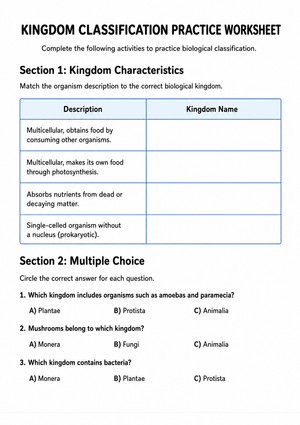
Kingdom Classification Worksheets for 7th Grade
These kingdom classification worksheets for 7th grade give life science teachers a focused set of resources for one of the bigger conceptual demands in middle school biology: sorting living things not by surface appearance but by cell structure, cellular organization, and mode of obtaining energy. The six-kingdom model asks students to hold multiple traits in mind simultaneously and apply them to organisms they may never have encountered before. Each worksheet in the set turns that cognitive demand into repeatable, structured practice.
The Traits Students Need to Compare
Classification at this grade level depends on a short list of comparison criteria. Students who can answer three questions about any organism — what kind of cells does it have, how many, and how does it get energy — can classify successfully even when their vocabulary is still developing. Each worksheet targets those questions directly, building toward the kind of applied reasoning a unit assessment will require.
- Cell type: distinguishing prokaryotic from eukaryotic cells and knowing which kingdoms fall into each category
- Unicellular versus multicellular: sorting organisms by cellular organization, including recognizing that Protista contains both types — a consistent source of confusion in student work
- Nutrition mode: labeling autotrophs and heterotrophs, with attention to Fungi as heterotrophs that absorb nutrients rather than ingest them
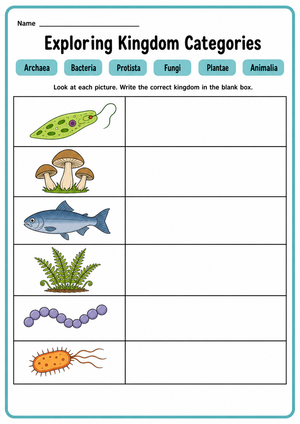
- Organism placement: assigning familiar organisms — bread mold, Paramecium, E. coli, a fern, a sea sponge — to kingdoms using trait evidence rather than recall alone
- Vocabulary in context: using terms like eukaryote, autotroph, and multicellular accurately in short written responses
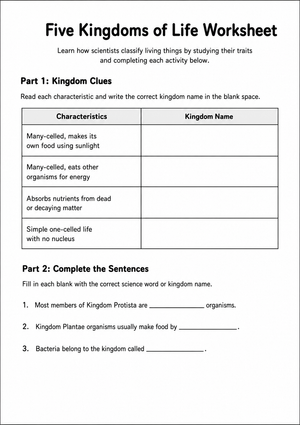
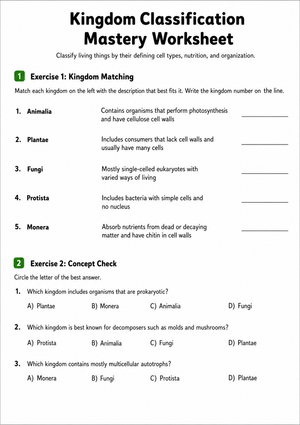
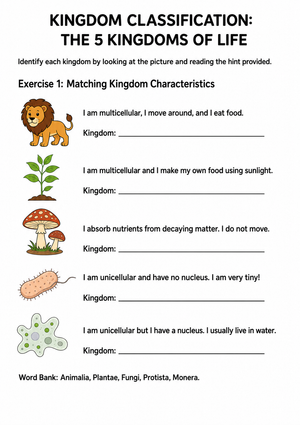
Students work through those skills on kingdom classification worksheets for 7th grade in multiple formats — charts, matching tasks, sorting activities, and scenario-based items — which is exactly the kind of repetition that makes terms like prokaryote hold past Friday's quiz.
Frequent Student Errors These Worksheets Help Surface
The most consistent confusion in student work is between Fungi and Plantae. Students who know that mushrooms grow from the ground and have cell walls assume they must be plants. The actual distinction — fungi absorb nutrients from their environment while plants photosynthesize — needs explicit attention, not just a line in lecture notes. A worksheet that presents a heterotrophic, multicellular organism with cell walls and asks students to choose between the two kingdoms is more diagnostic than any straightforward identification task.
Protista is the other kingdom that generates wrong answers with regularity. Students grasp unicellular fairly quickly, but when they discover that some protists are multicellular or photosynthetic, the category starts to feel inconsistent. Being honest with students — that Protista functions partly as a historical catch-all for organisms that resist clean categorization — is more useful than presenting it as a tidy group with sharp edges.
A subtler error: students who correctly learn that bacteria are prokaryotes will sometimes mark Archaebacteria as eukaryotic because they associate the prefix archae with something advanced or complex. A direct question on the worksheet — "What type of cells do Archaebacteria have?" — catches this misconception before the unit test rather than during it.
Standard Alignment
These worksheets connect to NGSS MS-LS4-2, which calls on students to apply scientific ideas when explaining similarities and differences among modern organisms. In instructional terms, kingdom classification fits early in a life science taxonomy unit — before the class moves into evolutionary relationships — because grouping organisms by shared traits is the groundwork for understanding why those groupings matter scientifically. Most Grade 7 state science frameworks also include explicit classification benchmarks, and the trait comparison tasks in these worksheets address those benchmarks directly.
The written justification tasks also support CCSS.ELA-LITERACY.RST.6-8.4, which targets accurate use of domain-specific vocabulary. Terms like prokaryote, autotroph, and heterotroph appear repeatedly across the chart and scenario items — exactly the kind of repeated application that builds lasting vocabulary retention rather than short-term memorization.
Fitting the Set Into Your Lesson Plan Across the Unit
The most practical sequence runs across three class periods. On day one, after direct instruction on cell type and nutrition mode, assign the comparison chart worksheet as guided practice. Students complete the table while notes are still available — this is a retrieval-plus-reference task that builds accuracy before independent work is expected.
Day two moves to sorting. Give students an organism description worksheet where each item names a familiar creature and lists two or three traits. Students write the kingdom assignment plus one sentence of justification. That sentence requirement matters — it is where you see whether students are reasoning or guessing.
Day three is for scenario-based application: unfamiliar organisms described by traits only, no names given. This is also when kingdom classification worksheets for 7th grade earn their value as formative tools. Pull the two hardest items for an exit ticket and you have an immediate read on who needs reteaching before the assessment.
For sub plans or homework, the matching and chart worksheets work without setup or explanation. The scenario questions are better reserved for class time when students can ask for clarification on phrasing.
Adapting the Worksheets Across Readiness Levels
Students still building vocabulary do better when the comparison chart includes the six kingdom names and asks only for trait identification — not open recall. Give those students a word bank. Remove it for students who are ready to retrieve terms without support. That single adjustment shifts the difficulty of the same worksheet without requiring a separate assignment.
For students who finish early or need extension, the elimination strategy is worth teaching explicitly. If an organism is multicellular and produces its own food, they can cross out Archaebacteria, Eubacteria, Animalia, and Fungi before writing a single answer. Classification becomes deductive reasoning rather than a memory exercise, and stronger students find that approach more engaging than filling in another chart row.
Students who freeze at written justification tasks benefit from a sentence frame: "This organism belongs in _____ because it has _____ cells and gets energy by _____." The frame does not do the thinking for them — students still need correct trait knowledge — but it removes the paralysis of a blank line for students who understand the concept but struggle to start writing.
Frequently Asked Questions
Do these worksheets use the six-kingdom model or the three-domain system?
The set focuses on the six-kingdom model — Archaebacteria, Eubacteria, Protista, Fungi, Plantae, and Animalia — which is the framework most Grade 7 state standards and textbooks use at this level. Domain-level vocabulary (Bacteria, Archaea, Eukarya) appears in context where relevant but is not the primary organizing structure for the tasks.
Where in a taxonomy unit do these worksheets fit best?
The chart and matching worksheets belong in the first half of the unit, after direct instruction and before independent assessment. The scenario-based and sorting worksheets work better in the second half, when students are ready to apply traits to unfamiliar organisms. Kingdom classification worksheets for 7th grade are most effective when teachers sequence them by task type — moving from recognition to application — rather than assigning the full set in one sitting.
How long does each worksheet take to complete?
The chart and matching worksheets typically run 15 to 20 minutes. The scenario application worksheets run closer to 25 to 30 minutes, especially when written justification is required. Most teachers reserve those longer worksheets for a full class period rather than using them as warm-ups or bell ringers.
Are answer keys included with each worksheet?
Yes. Each worksheet comes with an answer key. For short written responses, the key provides a model answer and identifies which traits are essential for credit — which keeps grading consistent when multiple teachers or a co-teacher uses the same materials across class periods.
Clear All