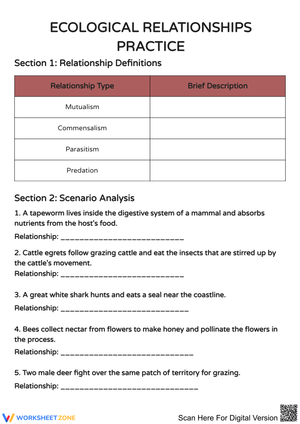
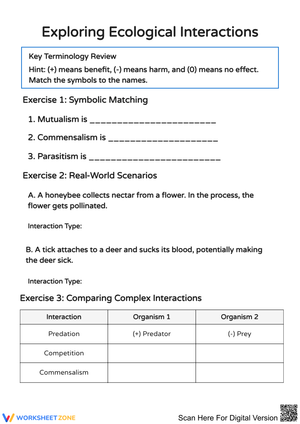
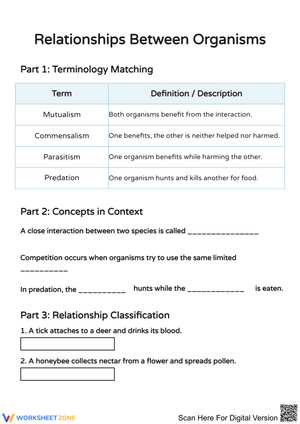
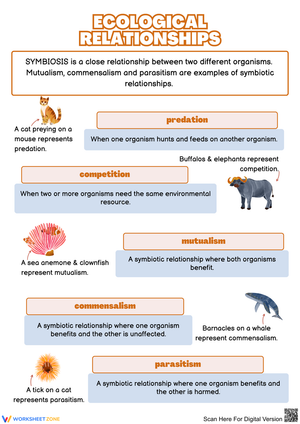
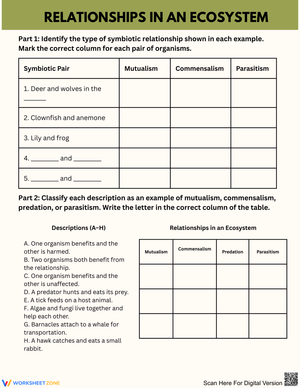
These mutualism commensalism parasitism predation competition worksheets for 7th grade give teachers a ready-made set of classification activities built around scenario analysis — the format that actually moves students from memorizing definitions to applying them. Each worksheet presents ecological relationships as short, organism-specific passages that students read, annotate, and classify, rather than match from a vocabulary list.
What Each Worksheet Targets
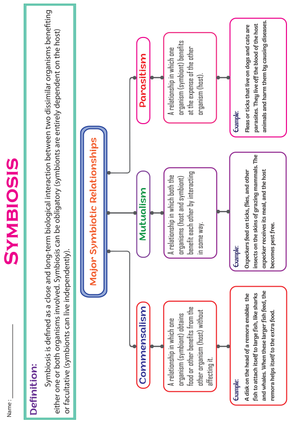
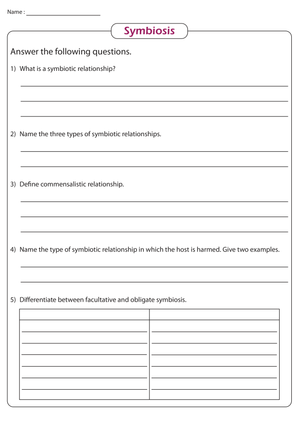
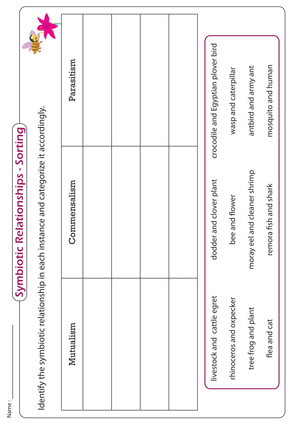
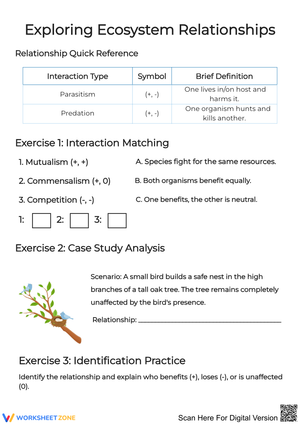
The set covers all five symbiotic and ecological relationship types that appear in 7th grade life science. Scenario-based worksheets ask students to read two-organism passages and identify which organism benefits, which is harmed, and which is unaffected — then assign the correct term. Compare-and-contrast organizers place parasitism alongside predation, or commensalism alongside mutualism, and ask students to articulate the specific difference rather than just name it. Ecosystem case studies embed multiple interactions inside a single habitat description — a coral reef passage, for example, might contain commensalism, mutualism, and predation occurring simultaneously — and ask students to locate and label each one. The annotation-focused worksheets prompt students to mark each organism in a scenario with a plus, minus, or zero before writing their final classification, which prevents guessing by forcing students to resolve the biological impact on each party first.
Standard Alignment
These worksheets address NGSS MS-LS2-1, which asks students to analyze data to explain how resource availability affects organism populations, and MS-LS2-2, which asks students to construct explanations predicting interaction patterns across ecosystems. In classroom terms, MS-LS2-1 shows up most directly in competition scenarios — students reading about lions and hyenas competing over the same prey can connect limited prey availability to population pressure on both predators. MS-LS2-2 is what the ecosystem case study worksheets are built around: students can't predict patterns across ecosystems until they can reliably identify all five relationship types within one.
Mistakes Students Make That These Worksheets Help You Catch
The most persistent error isn't confusing predation with parasitism — it's misclassifying parasitism as predation because students see "one organism harmed" and stop thinking. The distinction that actually sticks is temporal: a tick doesn't kill the dog today because a dead dog is a useless host. Getting students to ask "is the host still alive and being used?" separates the two reliably. Worksheets that include both types in the same activity force that comparison.
Commensalism produces its own consistent problem. Students assume every interaction has to matter to both organisms, so they invent a benefit or harm for the neutral party rather than accepting a zero. The barnacle-on-whale example works, but the bird-in-a-tree example often works better in the classroom because students can reason through it from their own experience: a robin's nest adds no measurable load to a mature oak. Worksheets that give students multiple commensalism scenarios — including some where the neutral organism is a plant — reduce the tendency to force a second effect into the relationship.
On mutualism, the common failure is listing only one organism's benefit. Students will correctly name what the clownfish gets from the anemone and then write a vague second sentence about the anemone "being helped." Worksheets that require a complete, organism-specific statement for each party ("the anemone benefits because the clownfish removes ectoparasites from its surface") produce much more precise written responses than open-ended ones.
Building These Worksheets Into Your Lesson Plans
The annotation worksheets work well as guided practice immediately after initial instruction — walk through the first scenario together, model writing the plus/minus/zero over each organism before naming the relationship, then release students to complete the next two in pairs. That gradual release structure keeps cognitive load manageable on day one.
The compare-and-contrast organizers belong later in the sequence, once students have seen all five terms at least once. Placing them right after initial vocabulary instruction creates confusion; placing them after a day or two of scenario practice gives students enough schema to notice the genuine structural differences rather than making surface-level guesses.
The ecosystem case study worksheets work best as a culminating task or as a Monday review activity after a weekend break — the kind of spaced retrieval that forces students to reconstruct their understanding rather than just rehearse it. They also make good small-group discussion drivers: three students reading the same coral reef passage will often disagree on whether a particular relationship is commensalism or mutualism, and that argument is exactly the reasoning you want them doing out loud.
Exit-ticket use is straightforward. A single worksheet with five short scenarios — one per relationship type — takes about eight minutes and gives you clean formative data before students leave. Students who collapse on the commensalism item consistently are usually the same students who conflated it with mutualism earlier in the lesson, and you can plan the next day's warm-up accordingly.
Adjusting the Worksheets for a Range of Learners
For students who struggle with the reading load, the scenario passages can be paired with a reference card listing each relationship type, its effect on organism A, its effect on organism B, and one anchoring example. That scaffold removes the retrieval burden and lets the student focus on the analysis task. Remove the card once the student is consistently accurate.
For students who are ready to go further, the case study worksheets can be extended by asking them to sketch a simple diagram showing which relationships are present, label the direction of benefit or harm with arrows, and explain what would happen to each organism if one species were removed. That last question — the removal prediction — moves students into MS-LS2-2 territory and is a genuine stretch task rather than just more of the same.
The annotation system itself is a built-in accommodation. Students who freeze when shown an open-ended paragraph have a concrete first step: mark every organism before you name anything. That procedural anchor reduces blank-page paralysis in a way that re-reading instructions rarely does.
Frequently Asked Questions
What's the most reliable way to help students stop confusing parasitism and predation?
Ask students to identify whether the "victim" organism is still alive and functional after the interaction begins. If yes, it's almost certainly parasitism. The temporal dimension — a parasite needs a living host, a predator needs a dead one — is more concrete than abstract explanations about harm gradations, and students in 7th grade can apply it consistently once they've practiced it on two or three worksheet scenarios.
Can these worksheets be used for test review, or are they better suited for instruction?
Both. The scenario classification worksheets work during instruction because students are building the skill in real time. The ecosystem case study worksheets work for review because they require students to retrieve and apply all five terms under one task. The short five-scenario worksheet is the one most teachers use as a pre-test or exit ticket since it covers the full range of relationships in a compact format.












 Interactive Worksheet Maker
 Quiz Maker
 Word Search Maker
 Crossword Puzzle Maker
 Word Scramble Generator
 Sentence Scramble Generator
 Handwriting Worksheet Generator
 Name Tracing Generator
 Fill In The Blank Generator




 BACK TOSCHOOL