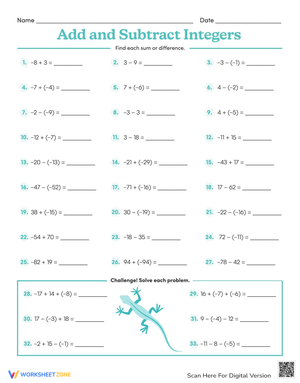
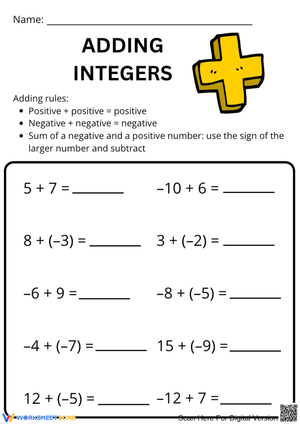
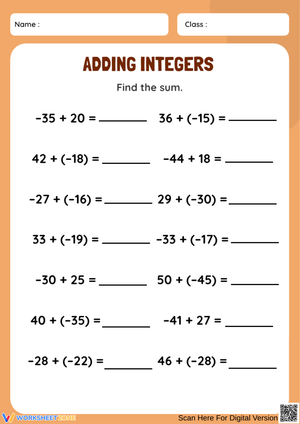
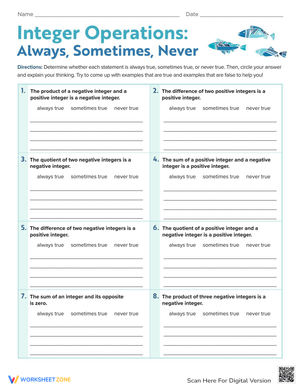
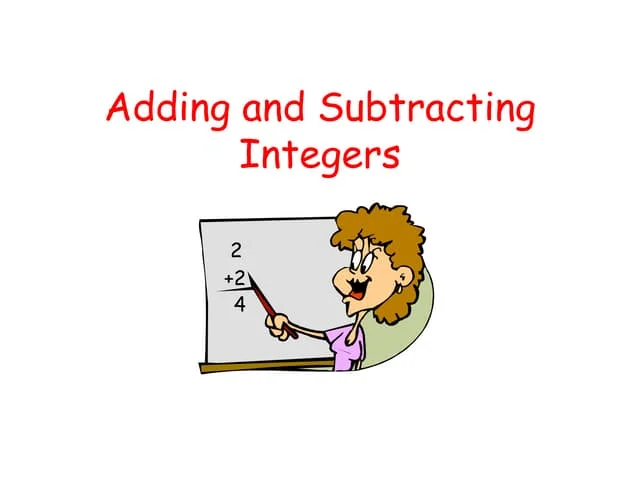
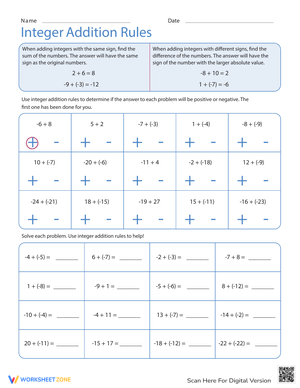
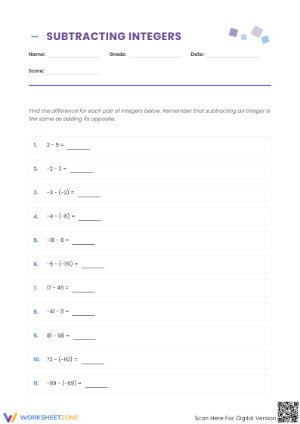
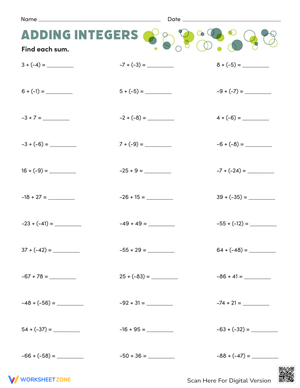
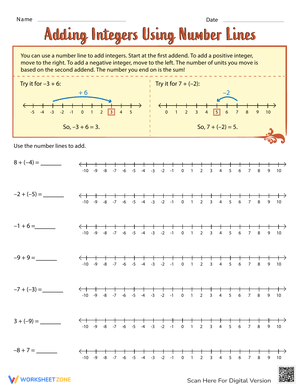
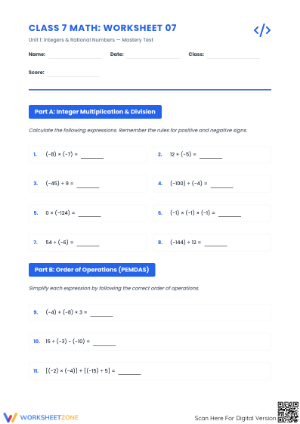
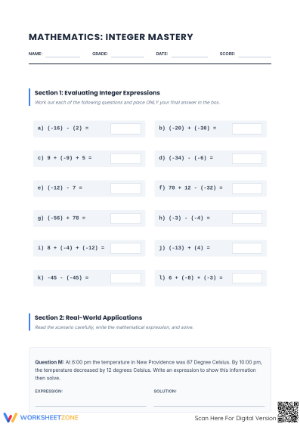
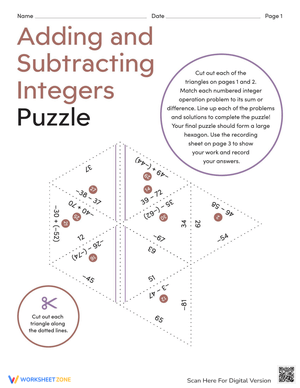
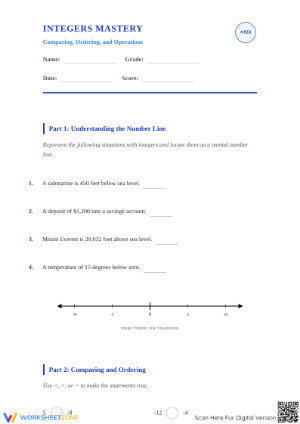
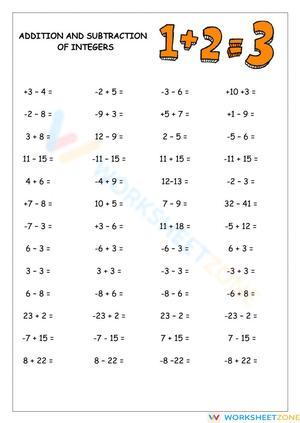
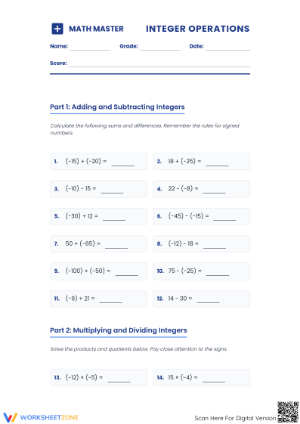
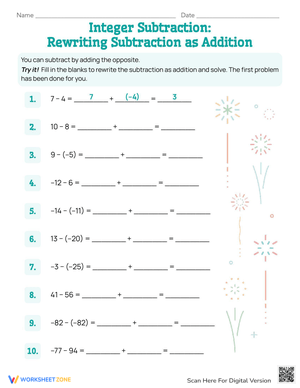
These operations with integers printable worksheets for 7th grade give teachers a ready-made progression through all four integer operations — addition, subtraction, multiplication, and division of positive and negative numbers — moving from single-skill practice into the mixed review that shows whether students have genuinely internalized sign rules or are just copying patterns. Each worksheet is formatted for quick printing and fits where teachers actually need it: warm-ups, direct-instruction follow-ups, small-group intervention, homework, or pre-quiz review.
The Specific Skills Targeted
The set separates the four operations before combining them, which matters more than it sounds. Students who practice only one operation at a time can appear fluent long before they actually are. When they hit a mixed worksheet and have to decide whether to add the opposite, apply a sign pattern, or interpret a real-world context, the real understanding gaps surface.
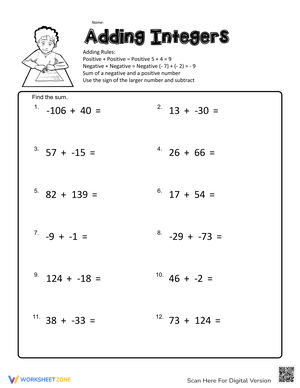
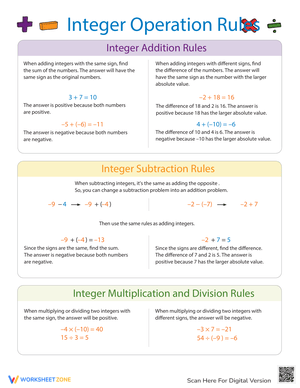
- Adding integers: problems that distinguish same-sign from different-sign situations, with and without number-line reference.
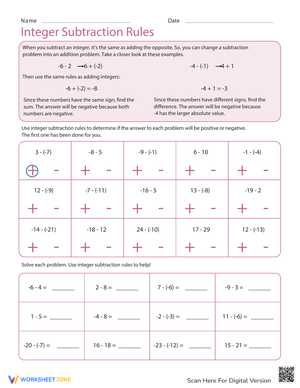
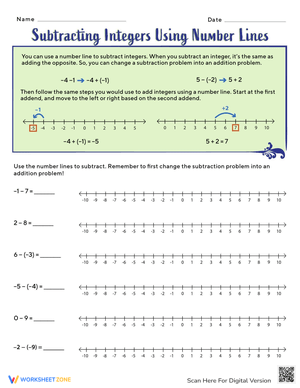
- Subtracting integers: exercises that reframe subtraction as adding the opposite, building toward abstract computation without visual support.
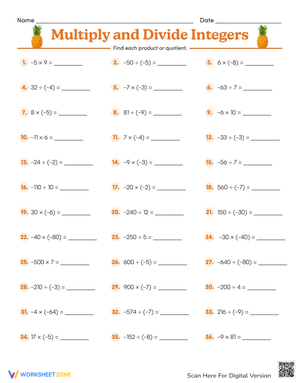
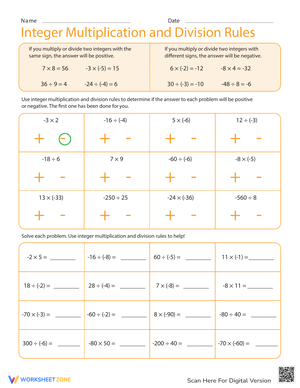
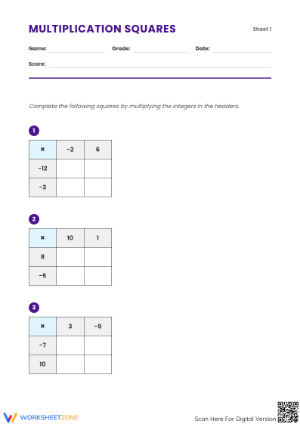
- Multiplying integers: sign-pattern practice starting with simple factor pairs, then extending into multi-step expressions.
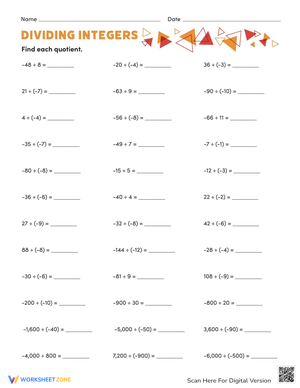
- Dividing integers: worksheets placed in parallel with multiplication so students see the consistent sign behavior across both operations.
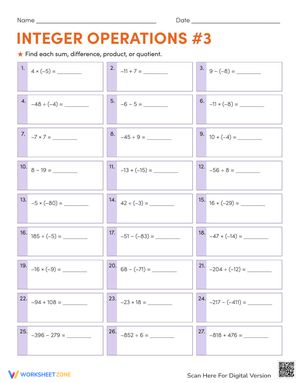
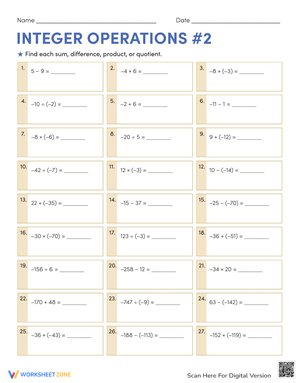
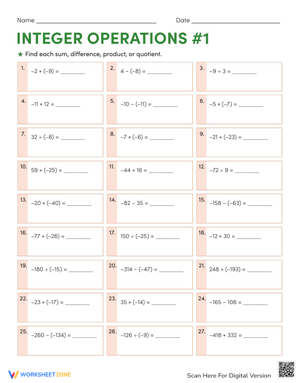
- Mixed operations: problems that blend all four, requiring students to read carefully and choose before computing.
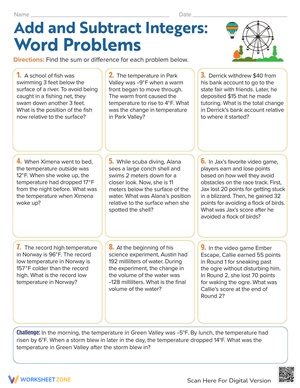
- Word problems: short real-world contexts — temperature drops, elevation changes, account balances — that give negative signs a meaning beyond classroom convention.
Frequent Student Errors Worth Anticipating Before You Assign These Worksheets
The most persistent error in 7th grade integer work is not a computation mistake — it is a reasoning breakdown about what subtraction means when both numbers carry a sign. Students who correctly handle -4 + (-3) = -7 will still write -4 - (-3) = -7, treating the subtraction symbol and the negative sign as a single instruction rather than two separate operations. The "keep, change, flip" phrase helps some students, but without a mental image of moving right on a number line when subtracting a negative, the rule collapses as soon as an unfamiliar arrangement appears.
Multiplication and division bring a different confusion. Students hear "two negatives make a positive" and start misapplying it to addition — writing -5 + (-3) = 8 because they count two negative signs and assume the result flips positive. Mixed-operation worksheets catch this error almost immediately, which is one reason to include them earlier in the unit rather than saving them only for pre-test review.
How to Sequence These Worksheets Through the Unit
The most effective classroom pattern is using single-operation worksheets as direct-instruction follow-ups and mixed-operation worksheets as the spiral review tool. After a lesson on subtracting integers, assign the subtraction-focused worksheet the same day while the method is still fresh. The next morning, pull five problems from a mixed worksheet into the warm-up block — that brief return visit provides immediate formative data on whether students retained what they practiced or whether it needs a second look before the lesson moves on.
- Bell ringers: three to five mixed problems at the start of class, collected as a quick informal check.
- Post-lesson practice: one single-operation worksheet assigned immediately after direct instruction.
- Small-group intervention: worksheets with number-line support for students who still need a concrete reference alongside abstract problems.
- Math workshop stations: pair a printable worksheet at one station with two-color integer counters for hands-on reinforcement.
- Pre-assessment review: a full mixed-operation worksheet assigned one to two days before a quiz so students can self-identify gaps while there is still time to address them.
One technique that consistently improves accuracy: ask students to annotate each problem before solving — marking it as "same-sign combine," "different-sign compare," or "sign pattern apply." That pause interrupts impulsive computing and tells teachers at a glance whether errors are coming from operation confusion or from arithmetic. It takes about ninety seconds to explain the first time and pays off across the rest of the unit.
Standard Alignment
These resources address CCSS 7.NS.A.1 (addition and subtraction of rational numbers on a number line and in real-world contexts) and 7.NS.A.2 (multiplication and division of rational numbers, including negative integers). In practice, that means operations with integers printable worksheets for 7th grade are not supplemental enrichment — they address the exact fluency standards students need before 7.EE work on expressions and equations with signed coefficients becomes viable. Teachers who frame the integer unit as prerequisite knowledge for algebraic reasoning tend to use these worksheets more intentionally, connecting sign rules back to the math as soon as equations with negative coefficients appear.
Differentiating Across Readiness Levels in the Same Classroom
Integer units tend to expose gaps that other units can hide. Some 7th graders still count backward on a number line to subtract; others are ready to work with multi-step expressions involving both positive and negative values. The right set of operations with integers printable worksheets for 7th grade handles that range if teachers sort and assign deliberately rather than handing the same worksheet to every student.
For students who need more support, trim the problem count before restoring it incrementally — twelve problems completed accurately builds more understanding than thirty problems completed with repeated unchecked errors. Pair those worksheets with a number-line reference at the top of each worksheet so students have something to anchor sign reasoning while they work. On-level students can move through standard mixed-operation worksheets without visual aids. For students ready for extension, the word-problem and multi-step expression worksheets offer the right challenge, especially when paired with a written explanation requirement: after solving, students write one sentence justifying why their answer is positive or negative. That sentence reveals conceptual depth in a way that correct answers alone cannot.
The same mathematical objective — fluent integer computation — runs through all three groups. The difference is the amount of built-in support and the complexity of the problems, not the learning target.
Frequently Asked Questions
Do these worksheets separate the four operations or mix them together?
Both. Each worksheet in the set either targets a single operation or mixes all four. Teachers typically use single-operation worksheets during initial instruction and shift to mixed worksheets for review, warm-ups, and assessment prep. The progression is built in — teachers can follow it in order or pull individual worksheets as needed for reteaching or extension.
When should mixed-operation worksheets replace single-skill practice?
Once students show reasonable accuracy on each operation separately — not perfection, but consistent enough that errors in mixed practice come from operation selection rather than basic computation. In most 7th grade classrooms, that crossover happens within a week of covering all four operations. Assigning a mixed worksheet too early, before single-operation accuracy is established, tends to produce noisy data that is hard to act on.
Are these resources useful after the integer unit ends?
Yes. A set of operations with integers printable worksheets for 7th grade stays relevant well past the unit itself. Students encounter negative coefficients in one-step equations, signed values in rational number work, and integer coordinates in graphing — each of those is a natural moment to pull a short mixed-operation worksheet for a five-minute refresher. Having the set accessible past the unit saves planning time because there is nothing to rebuild from scratch when students need a quick review before a benchmark.
What is the best response when a student finishes quickly but makes several errors?
Return the worksheet with three or four errors marked but not corrected, and ask the student to locate the reasoning mistake before reattempting those problems. That step is more useful than reassigning the full worksheet, because it requires the student to distinguish between "I computed wrong" and "I chose the wrong operation" — a distinction that determines whether the fix is additional practice or direct reteaching of a concept.













 Interactive Worksheet Maker
 Quiz Maker
 Word Search Maker
 Crossword Puzzle Maker
 Word Scramble Generator
 Sentence Scramble Generator
 Handwriting Worksheet Generator
 Name Tracing Generator
 Fill In The Blank Generator