


























Views
Downloads
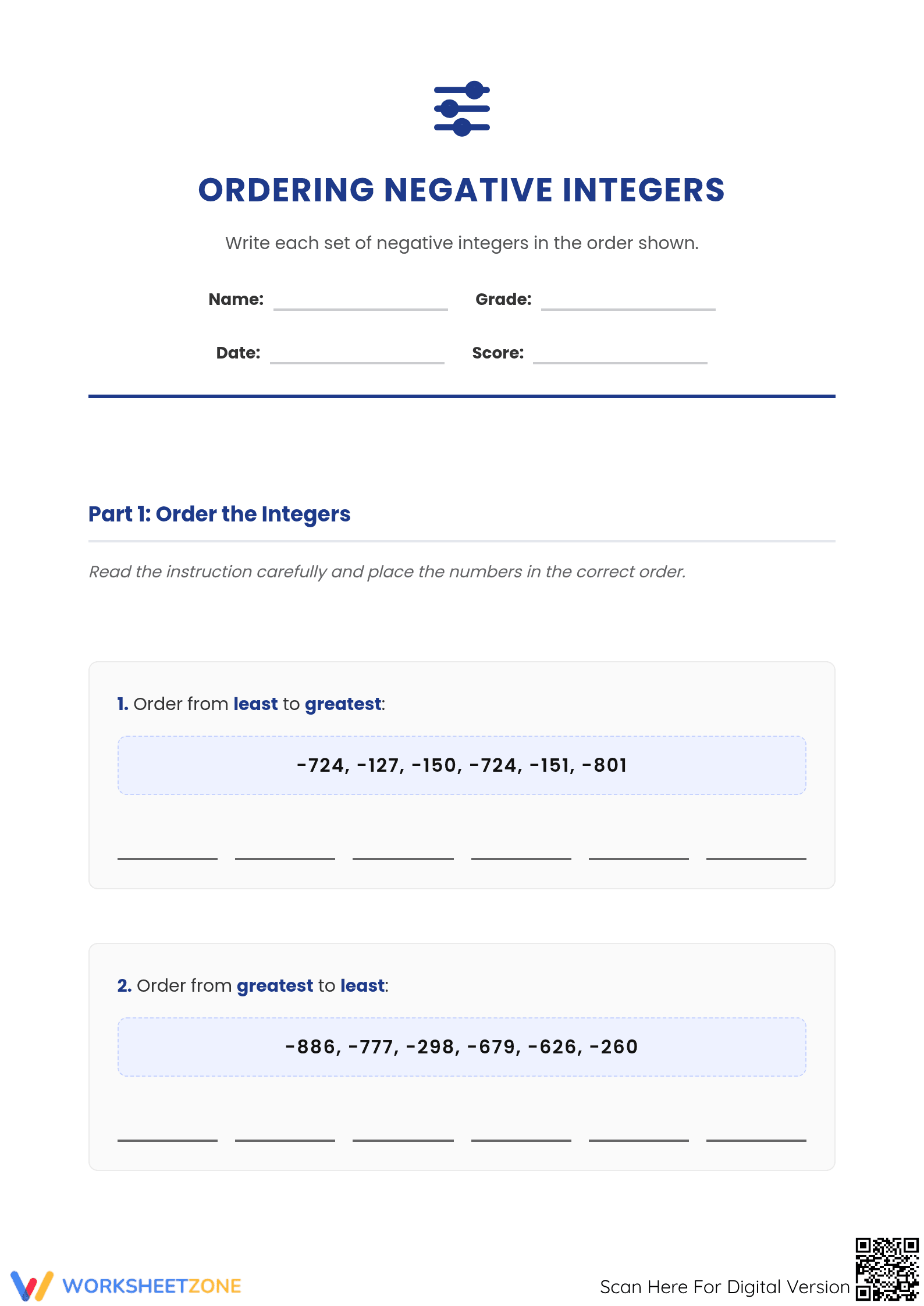
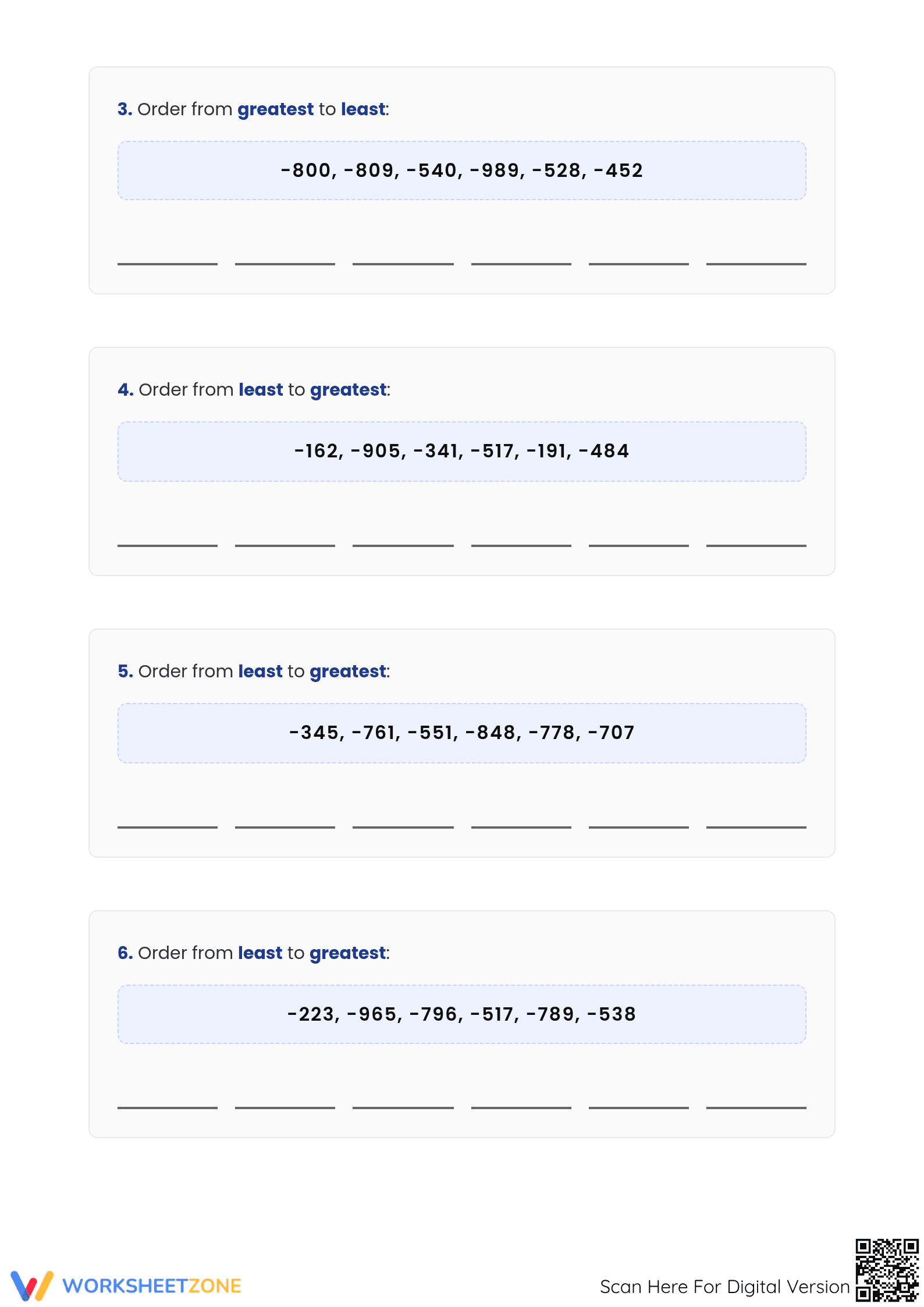
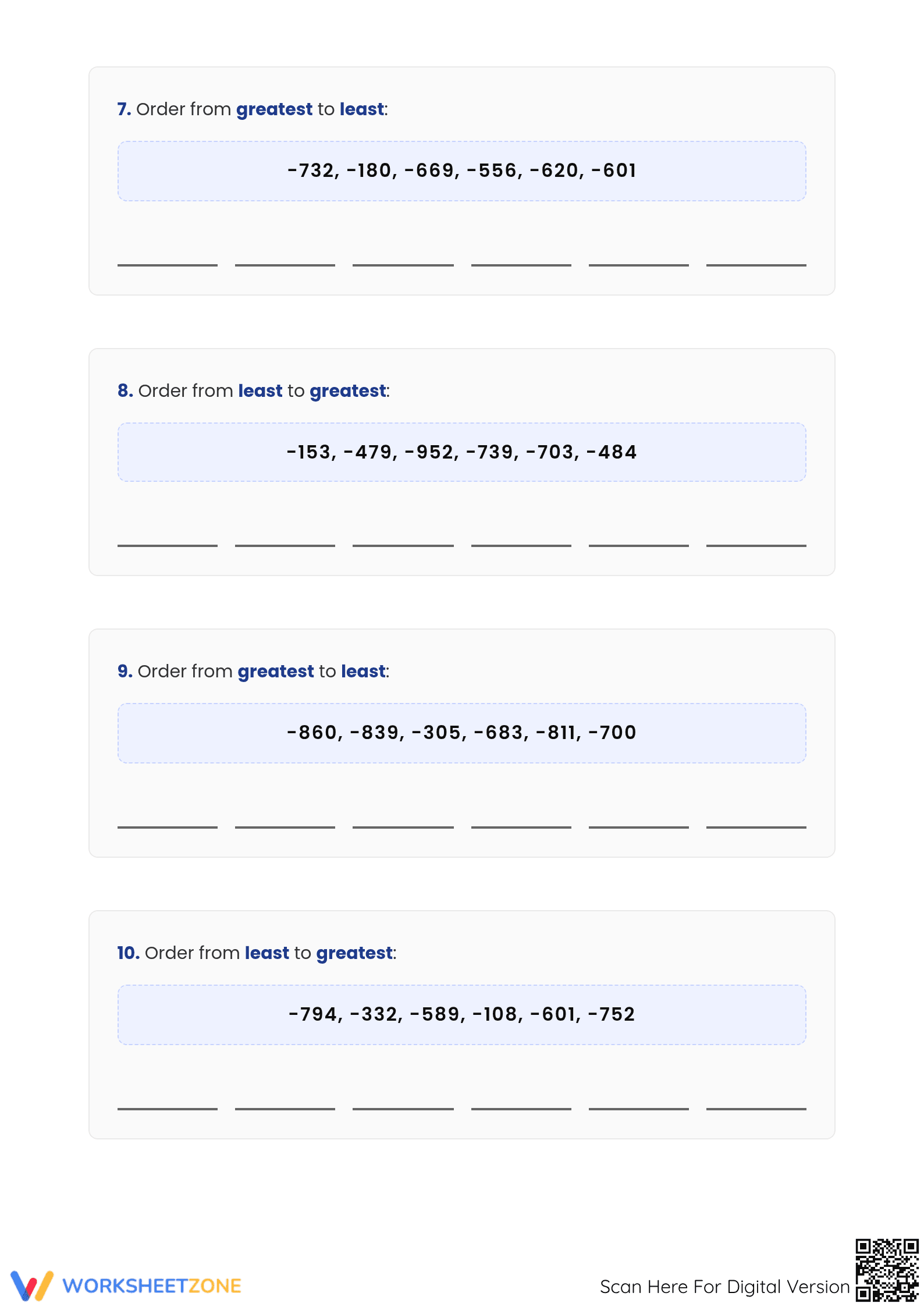
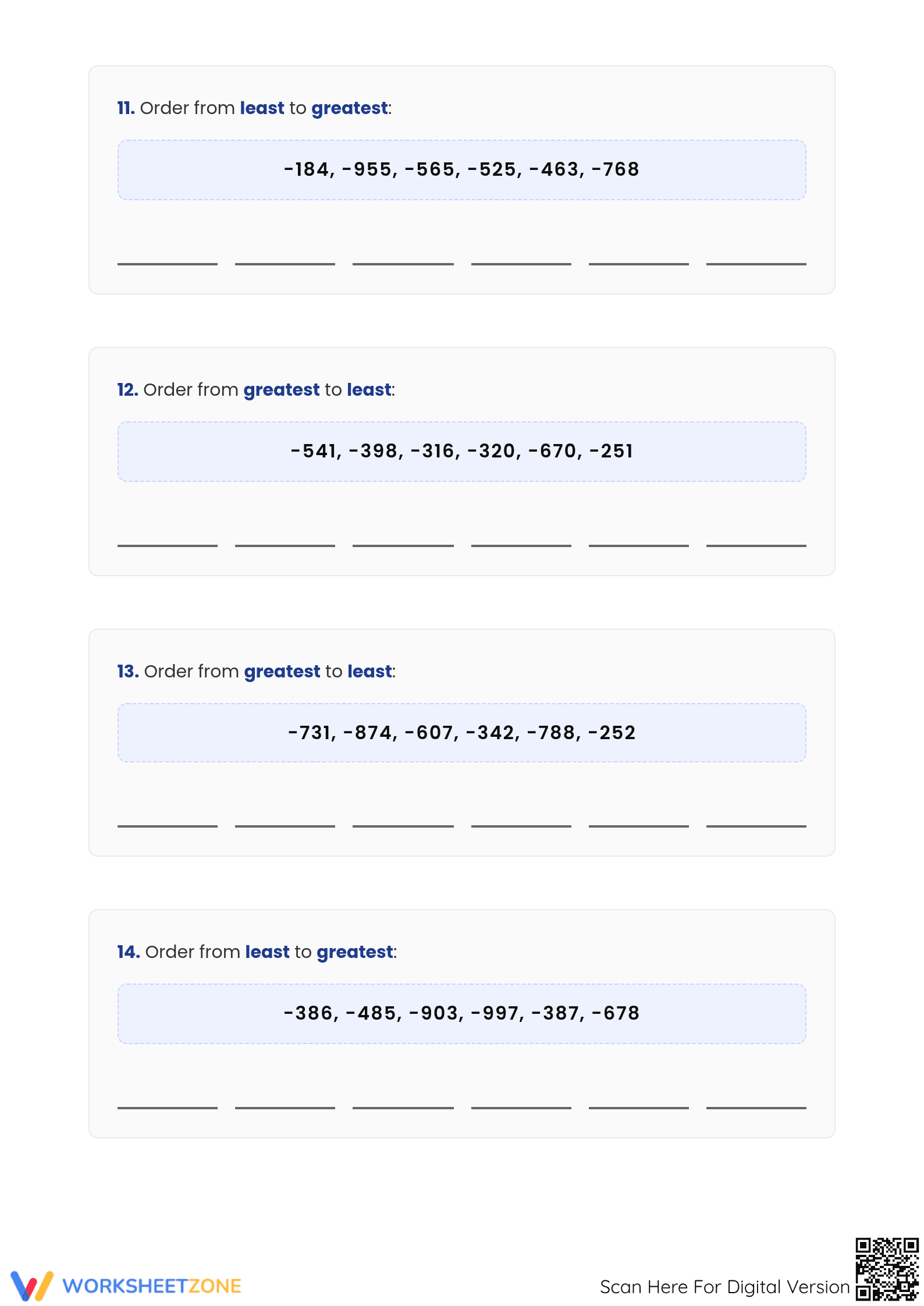

Printable Guide: Ordering Negative Integers - Grade 6 Math
Paste this activity's link or code into your existing LMS (Google Classroom, Canvas, Teams, Schoology, Moodle, etc.).
Students can open and work on the activity right away, with no student login required.
You'll still be able to track student progress and results from your teacher account.
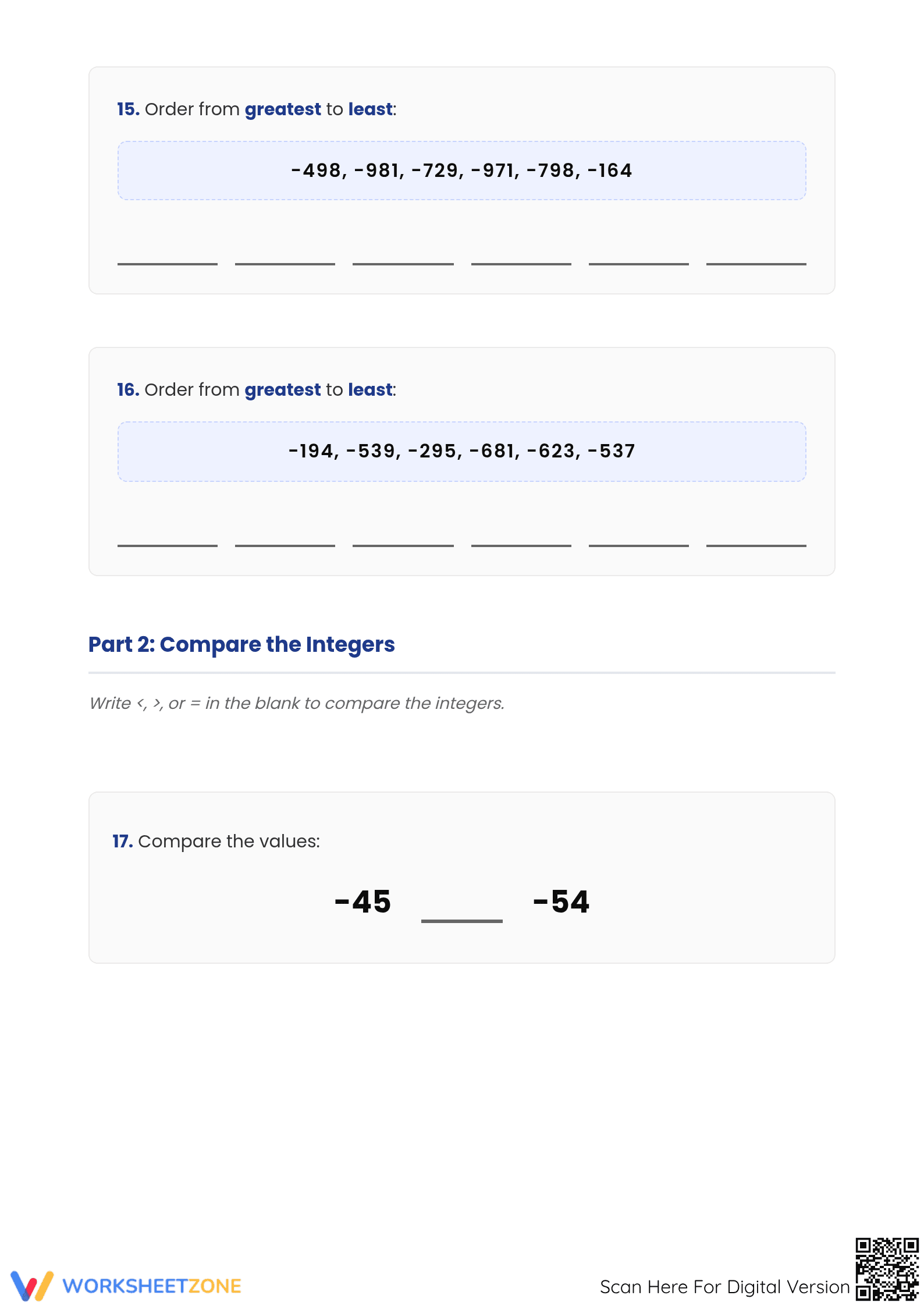
This Grade 6 math worksheet provides essential practice for students learning to sequence and compare negative integers. By focusing on 3-digit values, the resource challenges learners to look beyond absolute values and understand the true directional nature of the number line. Students will successfully master the logic required to arrange negative digits from least to greatest and vice-versa.
At a Glance
- Grade: 6 · Subject: Math
- Standard:
6.NS.C.7— Understand ordering and absolute value of rational numbers on a number line- Skill Focus: Ordering negative 3-digit integers
- Format: 5 pages · 17 problems · Answer key included · PDF
- Best For: Independent practice or homework
- Time: 25–35 minutes
This comprehensive 5-page PDF contains 16 sets of 3-digit negative integers for ordering, alongside a final comparison task. Each ordering problem features six distinct values, requiring students to carefully analyze hundreds, tens, and ones places while maintaining negative logic. A full answer key is provided for immediate feedback and grading.
Skill Progression
- Guided practice: The first two problems introduce the alternating concepts of least-to-greatest and greatest-to-least ordering to establish fundamental logic.
- Supported practice: Tasks 3 through 10 provide repeated sets of 6 integers, allowing students to build fluency in comparing values across the number line.
- Independent practice: Final ordering sets and the comparison problem at the end require students to apply their knowledge without scaffolding, demonstrating total mastery.
This gradual-release approach ensures students move from initial understanding to automaticity through the "I Do, We Do, You Do" instructional model.
Standards Alignment
The primary alignment for this resource is `6.NS.C.7`: "Understand ordering and absolute value of rational numbers." Specifically, it addresses sub-standard 7.A, where students interpret statements of inequality as statements about the relative position of two numbers on a number line diagram. The standard code can be copied directly into lesson plans, IEP goals, or district curriculum mapping tools.
How to Use It
Use this worksheet as a mid-lesson check for understanding during a unit on the number system. Teachers can observe students as they work through the first page to identify common misconceptions, such as assuming -801 is greater than -127. It also serves as an excellent formative assessment tool for small-group intervention and data collection.
Who It's For
This resource is designed for Grade 6 students but is equally effective for Grade 7 and 8 learners requiring remediation in integer operations. It pairs naturally with a number line anchor chart or a digital graphing tool to help visualize the movement away from zero toward smaller values.
According to Fisher & Frey (2014), the use of intentional, focused practice on negative integers is vital for developing the conceptual foundations required for later algebraic success. Middle school students often struggle with the "inverse" logic of negative numbers, where a larger absolute value signifies a smaller total value. This worksheet provides 17 targeted opportunities to overcome this common hurdle, ensuring students can accurately translate abstract number concepts into concrete sequences. By utilizing 3-digit integers, the resource prevents students from relying on simple digit recognition and forces deep engagement with place value. Research from ScienceDirect TpT Analysis suggests that repetitive, structured practice with `6.NS.C.7` skills significantly reduces error rates in multi-step equations involving negative signs. Educators can utilize these findings to justify the inclusion of this printable in their standard curriculum, knowing that fluency with negative integer ordering is a prerequisite for higher-order mathematics and real-world data interpretation.


