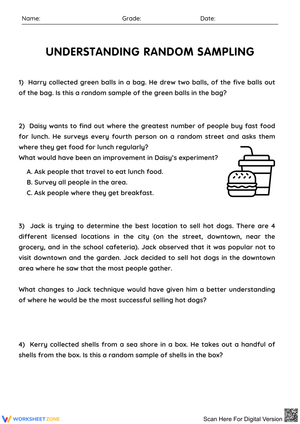
Random Sampling printable worksheets for 7th Grade
These random sampling worksheets for 7th grade move students through the full arc of statistical reasoning — identifying a population, evaluating how a sample was selected, spotting bias, and drawing a defensible inference about a larger group. That arc matters because 7th graders often arrive knowing what a sample is in a surface sense without being able to judge whether one is trustworthy. These worksheets close that gap.
The Specific Skills Targeted
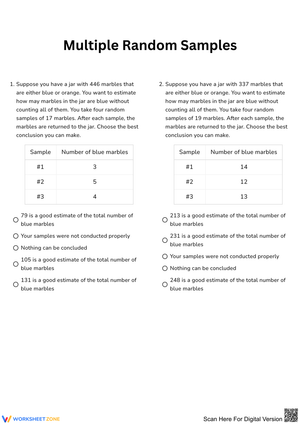
Each worksheet targets a distinct stage of the sampling process rather than cycling through the same identification task. Across the set, students practice distinguishing the population from the sample in realistic scenarios, evaluating whether a selection method gives every member of the group an equal chance, analyzing how convenience or timing can introduce bias even when the surveyor had no intent to skew results, using sample proportions to estimate a characteristic of the full population, and writing brief justifications that explain why a conclusion holds or falls apart.
Written justification appears throughout the set because it surfaces what identification items cannot — whether a student understands the reasoning or is pattern-matching to an answer. A student who can circle "biased" on a multiple-choice item may still write "the sample was bad because it was too small" when the real problem was selection method, not sample size. Short written prompts catch that confusion early.
Standard Alignment
These worksheets align to CCSS 7.SP.A.1 and 7.SP.A.2. Standard 7.SP.A.1 asks students to understand that statistics can be used to gain information about a population by examining a sample, and to recognize that random sampling tends to produce representative samples and support valid inferences. Standard 7.SP.A.2 extends that reasoning into inference: students use data from a random sample to draw inferences about a population and gauge how variable estimates might be. In classroom terms, 7.SP.A.1 maps to the identification and bias-analysis worksheets, while 7.SP.A.2 maps to the inference and estimation worksheets. Both standards sit at the opening of the 7th-grade statistics strand, which means this set works as foundational material that later work on comparing populations depends on.
Frequent Student Errors Worth Watching For
The error that causes the most sustained confusion is treating sample size as a proxy for randomness. Students frequently write that a survey of 200 students is more random than a survey of 30, even when the larger group was drawn entirely from one after-school club. They associate "more people" with "more fair," which is intuitive but wrong. Any worksheet scenario that uses a large convenience sample alongside a small but genuinely random sample will surface this misconception quickly — and the contrast is worth discussing aloud before students work independently.
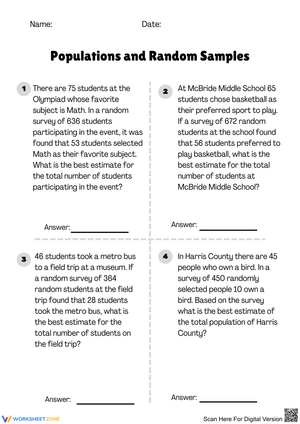
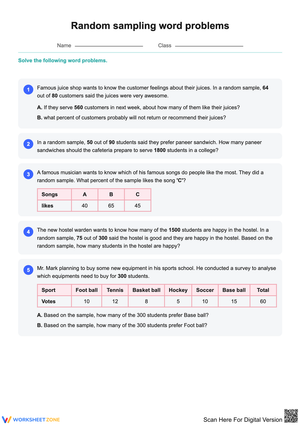
A second predictable error involves inference direction. When asked to use a sample result to estimate a population total, some students flip the ratio, others round in ways that ignore the sample fraction, and a few restate the sample data as if it already answers the population question. These are three different problems that look similar on a completed worksheet, which is why the written justification prompt matters — it lets you see which step broke down.
There is also a subtler error worth anticipating: students sometimes judge a sample as valid based on the surveyor's intentions rather than the method. A scenario where a student "politely asked everyone they saw" at lunch reads as fair to many 7th graders because the surveyor wasn't trying to be unfair. Including at least one scenario where the method seems considerate but is still location-biased pushes students to evaluate process, not motive.
Adjusting the Worksheets for a Range of Learners
The scaffolded worksheets in the set include sentence frames — The population in this scenario is..., This sample is not random because... — that reduce the production demand for students who understand the reasoning but struggle to translate it into written form. Those frames work best as a temporary structure; pull them once students can consistently identify the population and explain a bias without prompting.
For students who are moving through the material quickly, the most productive extension is revision: take a scenario that uses a convenience sample and rewrite the selection method so that it becomes genuinely random. That task requires understanding both what went wrong and what would constitute an improvement, which is a meaningfully harder cognitive move than identification alone. It also tends to generate good discussion when shared with the class, since students' revised methods often differ from each other in interesting ways.
For students who are still working on ratio and proportion, the inference worksheets may need additional scaffolding around the calculation step itself — specifically setting up the proportion before solving it. A brief worked example at the top of the worksheet, showing how sample fraction translates to a population estimate, prevents the math from obscuring the statistics concept you actually want to assess.
Frequently Asked Questions
Do these worksheets include answer keys?
Yes. Each worksheet includes a key with sample answers for the written-response items, not just the multiple-choice and calculation items. Written-response keys note what reasoning a complete answer should include, which makes them useful for grading consistently across a team.
Are the scenarios realistic enough for 7th graders to engage with?
The scenarios use school-based contexts — lunch preferences, extracurricular surveys, schoolwide elections, reading habits — that students can picture without needing background knowledge. Those contexts also make bias easier to spot: a student knows intuitively that surveying only athletes about the school's favorite sport would skew results, and that intuition makes the statistical concept easier to build on.
Can these be used for intervention after a quiz?
Yes, and that is one of the strongest uses of the set. After a statistics quiz, sort student errors by type — confusion about randomness, inference errors, or bias analysis — and assign the worksheet that targets that specific gap rather than a general review page. That targeted approach is more efficient than reteaching the full concept to students who only need to correct one part of their reasoning.
How many worksheets are in the set, and how long does each one take?
The set includes eight worksheets, each designed to run 10–20 minutes depending on how many written-response items are assigned. Shorter worksheets work well for bell-ringers or exit tickets; longer ones fit a guided practice block or a Friday review segment.
Clear All