


























Views
Downloads


Printable Exponents Worksheet | Grade 6-8 Math
Paste this activity's link or code into your existing LMS (Google Classroom, Canvas, Teams, Schoology, Moodle, etc.).
Students can open and work on the activity right away, with no student login required.
You'll still be able to track student progress and results from your teacher account.
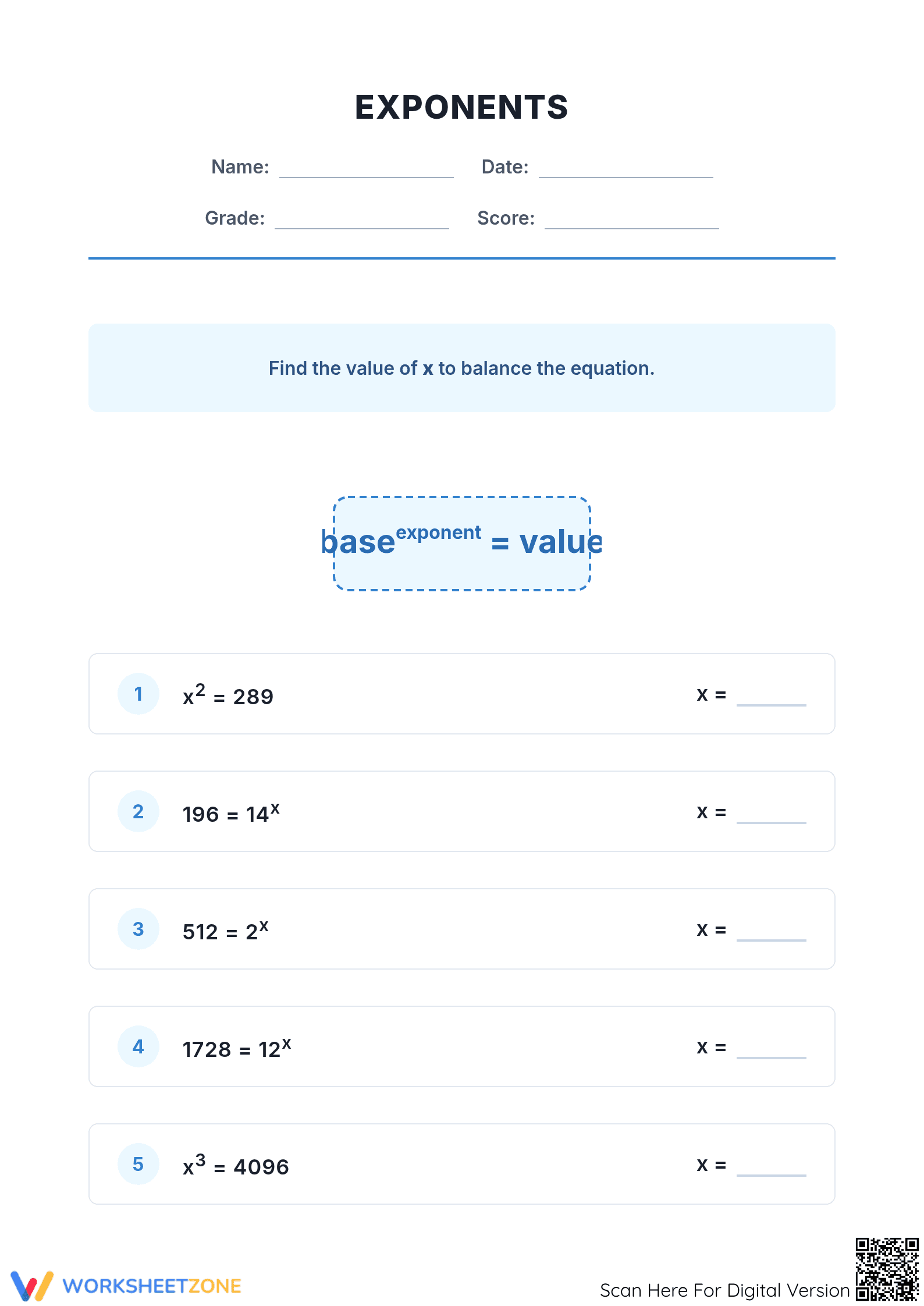
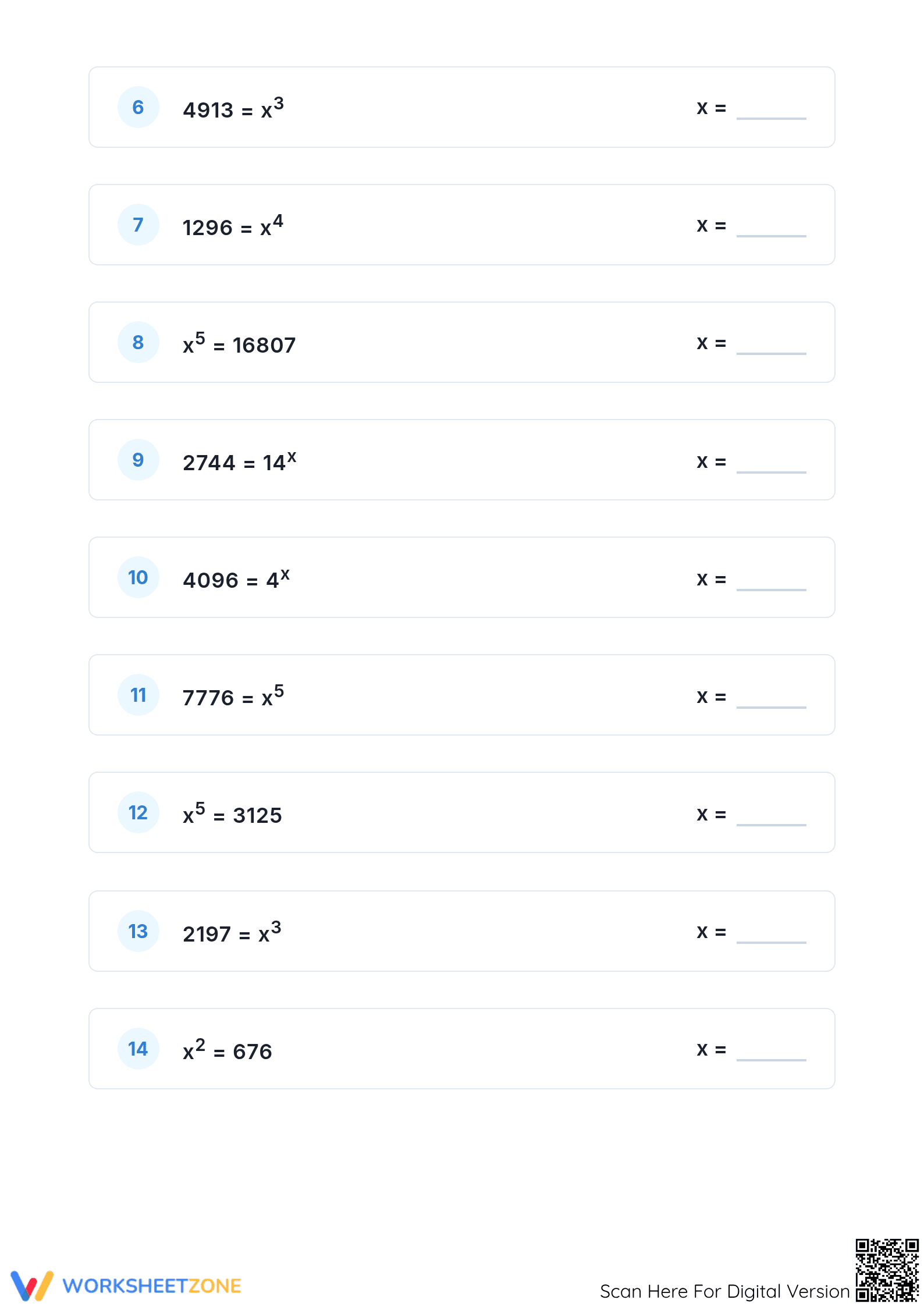
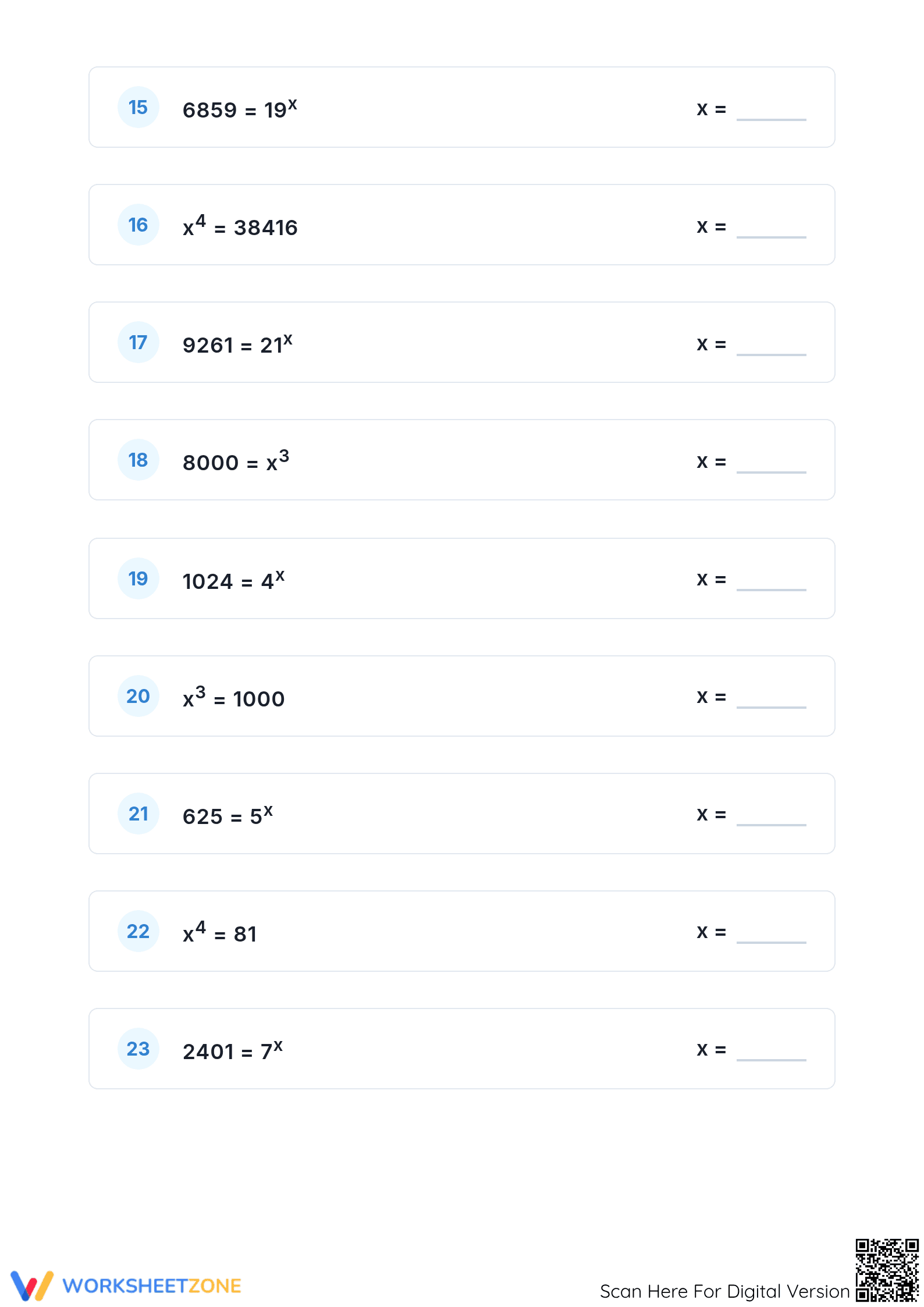
Strengthening algebraic foundations requires consistent practice with exponential relationships. This comprehensive math worksheet challenges middle school students to determine the missing base or exponent in twenty-four distinct equations. By solving for variables in diverse positions, learners move beyond simple calculation to a deeper understanding of inverse operations and numerical structure.
At a Glance
- Grade: 6-8 · Subject: Math
- Standard:
8.EE.A.2— Use square and cube roots to represent and solve exponential equations- Skill Focus: Exponential Equations & Variable Solving
- Format: 4 pages · 24 problems · Answer key included · PDF
- Best For: Independent practice, homework, or sub plans
- Time: 25–40 minutes
This four-page resource provides a focused set of exercises designed to build confidence with integer exponents. The worksheet is organized into twenty-four clear tasks, each presenting an equation where either the base or the exponent is unknown. Students utilize mental math, perfect square recognition, and cube root identification to find the value of "X". The clean layout minimizes visual distraction, while the inclusion of a full answer key ensures immediate feedback for both students and instructors.
- Print: Select the desired pages and print enough copies for your class in under sixty seconds.
- Distribute: Hand out the worksheets at the start of the period with a brief reminder of the base-exponent relationship.
- Review: Use the provided answer key to conduct a quick peer-review or whole-class check in the final five minutes of the session.
Total teacher preparation time is less than two minutes, making it an ideal choice for busy instructional days or unexpected absences.
This resource aligns primarily with 8.EE.A.2, which requires students to use square root and cube root symbols to represent solutions to equations of the form x^2 = p and x^3 = p. By practicing with equations like x^2 = 289 or x^3 = 4096, students develop the fluency needed for high-school level algebra. This standard code can be copied directly into lesson plans, IEP goals, or district curriculum mapping tools.
Use this worksheet as a targeted exit ticket after a lesson on roots and exponents to gauge individual student mastery. Alternatively, it serves as an excellent bell-ringer activity to refresh prior knowledge before introducing more complex logarithmic concepts. For a formative assessment tip, observe students as they solve higher-power problems (like x^5 = 3125) to see if they are utilizing prime factorization or trial-and-error strategies.
This collection is tailored for middle school students in grades six through eight who are refining their algebraic skills. It is particularly effective for learners who benefit from repetitive, structured practice to internalize number patterns. The worksheet pairs naturally with a classroom anchor chart detailing perfect squares and cubes, providing a supportive scaffold for students working toward independent proficiency.
Effective mathematics instruction in middle school emphasizes the transition from arithmetic to algebraic thinking. Research from EdReports 2024 highlights that high-quality instructional materials must provide students with ample opportunities to engage with the structural properties of numbers, specifically exponential growth and roots. This worksheet directly supports this goal by isolating the variable within the 8.EE.A.2 framework, allowing students to practice the specific skill of balancing exponential equations. By solving for missing bases and powers, students build the numerical fluency necessary for more advanced topics in the CCSS math trajectory. The structured repetition found in these 24 problems aligns with evidence-based practices for distributed practice, which has been shown to improve long-term retention of mathematical procedures. Teachers can confidently integrate this resource into their curriculum as a validated tool for assessing student readiness for quadratic functions and scientific notation.


