7th grade analyzing story structure printable worksheets give ELA teachers a concrete tool for one of the trickier transitions in middle school reading: moving students from retelling events to explaining how those events function within a text. These worksheets ask students to cite textual evidence, place scenes precisely within the narrative arc, and articulate why a turning point matters — not just that one occurred. For teachers who need independent practice that surfaces real student thinking, the set delivers that without requiring whole-class time.
The Specific Skills Targeted in Each Worksheet
Story structure work in 7th grade covers more than the five-part plot diagram most students encountered in elementary school. Each worksheet in this set asks students to perform a different analytical task, which keeps the skill from becoming routine. The tasks include:
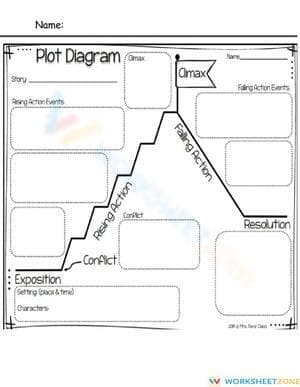
- Identifying plot stages — students label exposition, rising action, climax, falling action, and resolution in a given passage, then justify each choice with a quoted detail
- Sequencing significant events — students order key moments and explain how each event creates the conditions for the next
- Locating conflict and complication — students identify what the central conflict is, where it first appears, and what forces it forward
- Analyzing the turning point — students explain not just what changes at the climax but why that change matters to the character or theme
- Comparing structural choices — students examine how two different authors handle the same story stage, such as how each signals the shift from rising to falling action
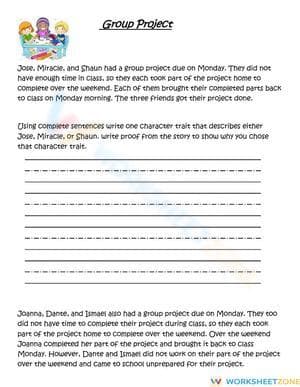
- Short analytical writing — students write a focused response explaining how one structural element contributes to mood, character development, or theme
That last task — the short written response — is where teachers most clearly see the gap between students who understand the text and students who are still summarizing it.
Errors Students Make That These Worksheets Surface
The most persistent confusion in 7th grade story structure work is between the climax and the most dramatically intense scene. Students routinely mark the moment of highest tension — a chase, a confrontation, a physical danger — rather than the moment of irreversible decision. In a survival story, they'll mark the point where the character is most at risk rather than the point where the character makes a choice that cannot be undone. These worksheets press students to explain the function of whatever scene they choose, which surfaces that error immediately and gives teachers a clear opening for reteaching.
A second pattern worth watching: students who treat "rising action" as a label for everything between the opening scene and the climax. They're not wrong that rising action spans the middle of the story, but they miss that rising action involves escalation — each complication raising the stakes further. When asked to sequence events and explain how one leads to the next, many students list scenes accurately but describe them in isolation rather than as a building chain. That's a reasoning gap, not a reading gap, and the open-response items make it visible.
A third error is subtler. Students often confuse exposition with any background information in the text, including flashbacks that appear mid-story. A student will mark a memory sequence in chapter three as "exposition" because it provides backstory — not understanding that exposition refers to how the story opens, not to any passage that reveals context. This confusion tends to hide in fill-in-the-blank formats. Worksheets that ask students to place a quoted line within the plot structure and then defend that placement in a sentence force students to apply the term precisely rather than loosely.
Building These Worksheets Into Your Instructional Sequence
These worksheets fit cleanly into three distinct moments in a reading unit. Early on, a shorter worksheet with a contained passage works well as a pre-reading diagnostic — it shows whether students can apply structural terms to an unfamiliar text before the anchor novel begins. During reading, students can complete a tracking worksheet after each major section, noting where the conflict intensifies and what conditions change with each new complication. After reading, the comparison and analytical-writing worksheets are the strongest choice because students have full context and can examine structural choices rather than just name plot stages.
They also hold up in less planned moments. The Monday morning warm-up after students have had time to finish independent reading, the ten minutes after a small group finishes before the full-class debrief, or the Friday review block before a unit quiz — a focused worksheet handles all of these without requiring teacher setup during the lesson itself. Sub plans built around a short story and one of these worksheets consistently produce usable work because the directions are self-contained and the tasks are specific enough that students can't fill in one-word answers and be done.
Adjusting These Worksheets for Different Student Levels
7th grade analyzing story structure printable worksheets work across a range of reading levels when teachers make a few targeted adjustments. The core analytical skill stays constant; what changes is the amount of structure around the task. Students who need more support benefit from a partially completed graphic organizer — one where two or three events are already placed in the plot diagram and the student fills in the remaining stages. That preserves the analytical work without adding the burden of starting from nothing. Including a brief word bank with plot terms also reduces the cognitive load of vocabulary retrieval so students can focus on applying the concepts rather than trying to recall the names.
For students who are ready for more challenge, replace identification tasks with explanation tasks. Instead of "Where does the climax occur?" ask "How does the climax moment shift the reader's expectations for the resolution?" Comparison tasks — where students analyze structural choices across two passages — extend higher-level readers without requiring different source texts. Sentence stems offer a useful middle ground: stems like "This event belongs in the rising action because the conflict has not yet reached its peak — specifically…" give students a starting point for analytical writing without reducing the thinking to a checklist.
Standard Alignment
Beyond individual tasks, 7th grade analyzing story structure printable worksheets address two related standards: CCSS.ELA-LITERACY.RL.7.3, which asks students to analyze how particular elements of a story or drama interact — specifically how setting, plot, and character develop and influence each other — and RL.7.5, which focuses on how a story's form or structure contributes to its meaning. In classroom terms, RL.7.3 is where teachers typically begin a unit, asking students to identify elements and trace how they interact. RL.7.5 is where the work deepens once students can discuss structural choices rather than just label them. The worksheets move through both standards across the set, so teachers can sequence them to match that instructional progression.
Frequently Asked Questions
How do these worksheets differ from a basic plot diagram assignment?
A plot diagram asks students to name plot stages. These worksheets ask students to justify each placement with evidence and explain the effect of key structural choices. The analytical short-response items push well beyond identification, which is where 7th grade standards actually sit.
Can these worksheets be used with any story, or do they require specific texts?
The worksheets include their own passages, so they work independently of a class novel. Teachers also use them alongside anchor texts by having students apply the same analytical tasks to sections of the novel they are currently reading — the two approaches are compatible.
What does strong student work look like on these worksheets?
Strong responses cite a specific line or detail from the text, place it accurately within the plot structure, and explain its function — not just its content. A student writing "The climax occurs when Marcus decides to leave, because that decision makes the earlier conflict permanent and removes any chance of reconciliation" is doing the right analytical work. A student writing "The climax is when Marcus leaves" is summarizing, not analyzing. The tasks on these worksheets are built to make that distinction visible.
Are these worksheets appropriate for students still working on basic reading comprehension?
For students who struggle significantly with comprehension, 7th grade analyzing story structure printable worksheets are most effective when paired with a short, accessible text and used after a shared reading of the passage. That way, comprehension is secured before students move into structural analysis, and the step-by-step format — identify the event, place it in the arc, explain its function — keeps the task from becoming overwhelming.















 Interactive Worksheet Maker
 Quiz Maker
 Word Search Maker
 Crossword Puzzle Maker
 Word Scramble Generator
 Sentence Scramble Generator
 Handwriting Worksheet Generator
 Name Tracing Generator
 Fill In The Blank Generator