These commas with nonrestrictive elements worksheets for 7th grade give teachers focused, printable practice on one of the harder punctuation decisions in middle school grammar — a rule that turns on meaning rather than position or sentence length, which is exactly what makes it harder to teach than other comma conventions at this level. Students work through identification tasks, correction exercises, sentence combining, and short passage editing, building toward a judgment process they can carry into their own writing.
What Each Worksheet in the Set Targets
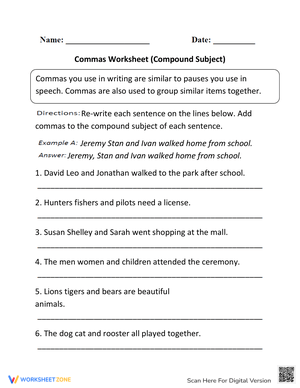
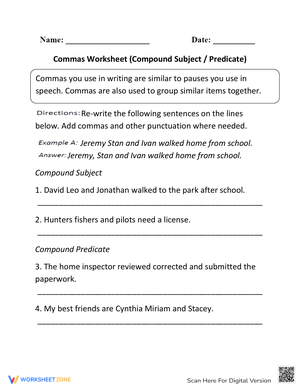
The set stays tightly focused on nonrestrictive elements rather than mixing in unrelated comma rules, which makes it easier to diagnose exactly what students understand. Each worksheet addresses a distinct task type:
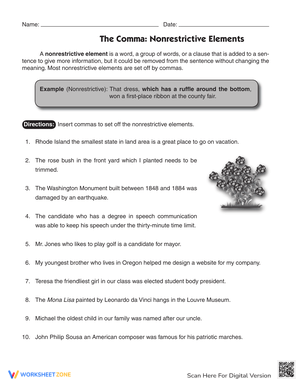
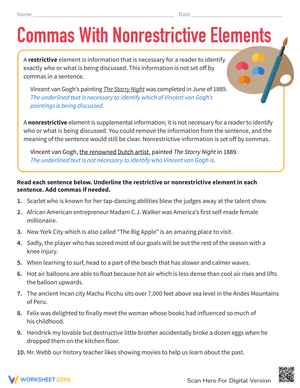
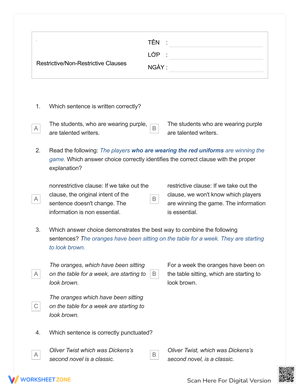
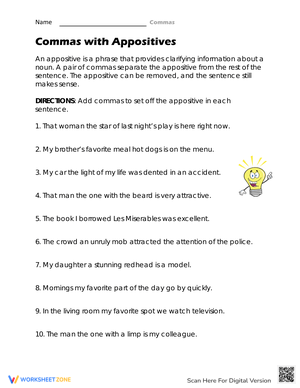
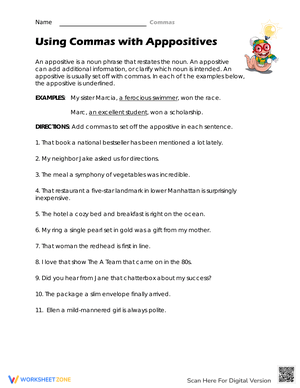
- Identification: students underline the nonrestrictive element and mark where commas belong, building recognition before moving to correction.
- Restrictive vs. nonrestrictive comparison: side-by-side sentence pairs show how the same additional words can function differently depending on whether a reader needs them to identify the noun.
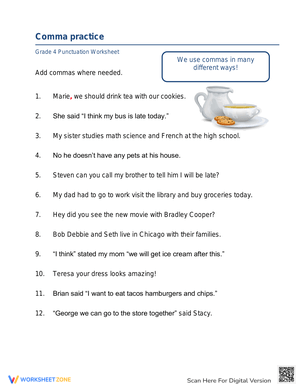
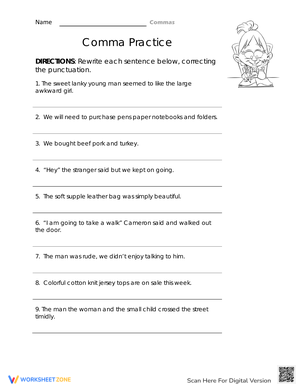
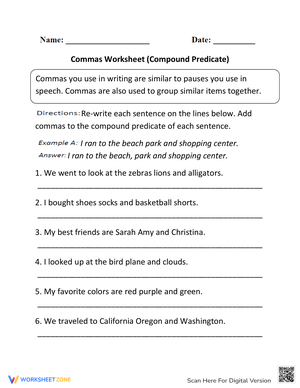
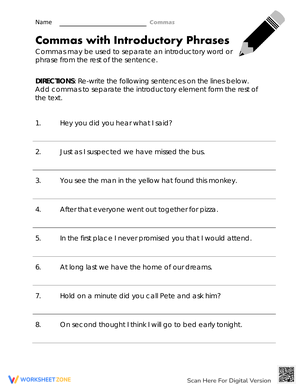
- Sentence correction: students add missing commas, remove unnecessary ones, or confirm that existing punctuation is already correct — all three options reinforce the rule from a different angle.
- Sentence combining: students merge two related ideas into one sentence using a nonrestrictive phrase or appositive, reinforcing that these structures are writing tools, not just grammar targets.
- Passage editing: short paragraphs give students practice applying the rule in context rather than only in isolated sentence drills.
Every worksheet includes an answer key, which removes prep time when the set runs in stations, peer review, or homework correction.
What Student Papers Reveal About This Punctuation Rule
The most consistent pattern in seventh-grade work with this skill is not that students forget the rule — it's that they pattern-match instead of analyze meaning. A student who correctly punctuates My teacher, Ms. Rivera, assigns reading every night will often add commas around the clause in The student who sits near the window forgot his homework because the clause is long or "sounds like extra information." Whether it is extra depends entirely on context: if only one student fits that description, the clause could be nonrestrictive; if the teacher needs it to specify which student, it is restrictive and stays comma-free. Length signals nothing about necessity.
Two mechanical errors appear in nearly every class. First, students drop the closing comma on a mid-sentence nonrestrictive element — they write My cousin, who plays guitar practices on Sundays and consider the punctuation done after the first comma. Second, students who learn to flag clauses introduced by who or which often miss appositives entirely, because appositives carry no relative pronoun to announce themselves. A student who handles The principal, who made the announcement, left early correctly will write My dog Rex bit the mailman without pausing to consider whether Rex functions as a nonrestrictive appositive. That gap — confident with relative clauses, blind to noun phrases — is exactly where side-by-side comparison practice with both structure types earns its time in the lesson.
How to Build These Worksheets Into Your Lesson Plans
A 15- to 20-minute block handles direct instruction plus guided practice on any single worksheet comfortably. The sequence that holds up in most classrooms: state the rule, model two examples at the board, complete one correction item together, then move students into independent work. Because the comma decision is a meaning judgment, partner discussion during practice surfaces misconceptions faster than silent work alone — asking two students to justify their punctuation choices out loud exposes more errors in five minutes than checking answers together after the fact.
One routine worth building into the lesson: have students lightly cross out the suspected nonrestrictive element before deciding on commas. If the sentence still identifies the correct person, place, or thing and keeps its main idea intact, the crossed-out words are almost certainly nonrestrictive. That small testing step turns punctuation from guessing into sentence analysis, and students who develop the habit carry it into drafting without being reminded. For stations work, a three-part rotation runs cleanly — identification at one station, sentence correction at a second, and passage editing at a third. The consistent PDF format keeps layout uniform across the set, which matters when printing for 30 students or leaving materials for a substitute.
Standard Alignment
These resources align to CCSS.ELA-LITERACY.L.7.2a, which asks seventh graders to use a comma to separate nonrestrictive or parenthetical elements. The standard belongs to the Language strand, but its real instructional payoff surfaces during writing revision, when students need to punctuate the appositives and relative clauses they naturally produce in informational and descriptive writing. Pairing commas with nonrestrictive elements worksheets for 7th grade with a revision day — rather than treating them as standalone grammar drills — gives L.7.2a more instructional traction than practice alone delivers.
How to Adjust the Set When Student Levels Vary
For students still building basic comma fluency, the commas with nonrestrictive elements worksheets for 7th grade in this set offer a clear starting point: begin with appositives in short, simple sentences before moving to relative clauses. My cat, a tabby, sleeps all day is a more direct entry than a complex who-clause, because students can remove the appositive, read what remains, and hear immediately whether the sentence still makes sense. That auditory check works better for developing learners than leading with a grammar explanation of subordinate clauses.
Advanced students benefit from passage-level editing that mixes nonrestrictive elements with other punctuation decisions, and from writing tasks that ask them to deliberately embed nonrestrictive phrases into sentences about content from science or social studies. That cross-curricular move reinforces that this is a writing skill, not an isolated exercise. In intervention groups, two structural patterns per session is the practical ceiling — working through appositives, mid-sentence clauses, and end-of-sentence phrases all in one lesson overloads working memory past the point where students make reliable decisions.
Frequently Asked Questions
What is a nonrestrictive element?
A nonrestrictive element is a word group — a phrase, clause, or appositive — that adds detail about a noun without being necessary to identify which specific person or thing the sentence means. Because it is removable without changing the sentence's core meaning, it gets set off with commas.
How can students learn to tell restrictive and nonrestrictive elements apart?
The most reliable method is the removal test: cross out the added words and reread the sentence. If the sentence still clearly identifies the noun and keeps its main idea, the element is nonrestrictive. If removing the words makes the sentence vague or shifts its meaning, the information is restrictive and should stay comma-free. Repeated practice with contrast pairs — two nearly identical sentences with different punctuation — makes the test feel automatic rather than effortful over time.
Where do commas go when the nonrestrictive element appears mid-sentence?
Mid-sentence nonrestrictive elements need two commas — one before the element opens and one after it closes. End-of-sentence placement requires only the opening comma. The two-comma rule for mid-sentence elements is the single most frequently missed pattern in seventh-grade editing, and several correction items across the set are built specifically to push students to make that second-comma decision consciously.
Can these worksheets serve as formative assessment tools?
Yes. A correction task or passage-editing worksheet shows quickly whether a student can apply the rule, making individual worksheets practical as exit tickets or pre-assessment checks before a writing assignment. For teachers searching for commas with nonrestrictive elements worksheets for 7th grade that include answer keys, these resources work efficiently as quick formative checks without adding grading time — and they give a cleaner picture of what students need before moving toward summative evidence in actual writing samples.
Do these worksheets cover appositives or only relative clauses?
Both structure types appear across the set. Students who handle who and which clauses correctly often miss noun-phrase appositives entirely, so exposing students to both within the same practice sequence closes that gap before it shows up in their writing.












 Interactive Worksheet Maker
 Quiz Maker
 Word Search Maker
 Crossword Puzzle Maker
 Word Scramble Generator
 Sentence Scramble Generator
 Handwriting Worksheet Generator
 Name Tracing Generator
 Fill In The Blank Generator