Punctuation printable worksheets for 7th grade cover ground that separates middle school writing from the comma-and-period work of earlier grades. Students at this level are expected to manage semicolons, colons, dialogue formatting, possessive plurals, and coordinate adjective commas — often in the same paragraph. This set gives teachers ready-to-print practice for each of those marks, with answer keys that make grading and reteaching straightforward.
The Specific Skills Targeted in the Set
The skills in these worksheets reflect what 7th grade writing actually demands. Students at this level produce longer argumentative responses, personal narratives with dialogue, and research paragraphs — all of which require punctuation well beyond end marks.
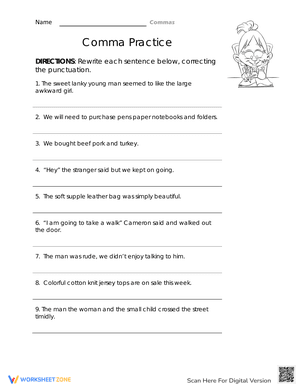
- Commas in multiple roles: series items, coordinate adjectives, introductory clauses, and nonrestrictive interrupters
- Quotation marks and dialogue: placement of end punctuation inside quotation marks, punctuating speaker tags, and formatting two-part dialogue correctly
- Apostrophes: contractions, singular possessives, and plural possessives — the ones where students must decide whether the apostrophe comes before or after the s
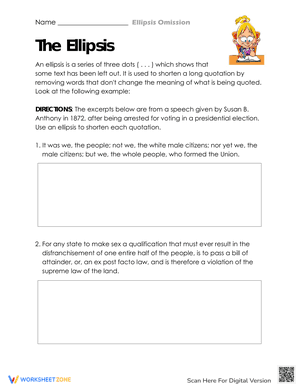
- Semicolons and colons: joining independent clauses without a conjunction and introducing lists or formal explanations
- End punctuation: choosing between period, question mark, and exclamation point based on sentence type and intended tone
- Mixed passage editing: identifying and correcting several error types within one short connected paragraph
Each worksheet isolates one punctuation skill before moving into mixed practice, which keeps cognitive demand manageable without making the task feel trivial.
Common Misconceptions to Watch For and Address
Comma splices are among the most frequent errors at this level. Students who have learned that commas separate ideas will write "The team practiced for hours, they still lost" and believe the sentence is correct. These worksheets ask students to identify that construction, name why it fails, and rewrite it using a semicolon or a coordinating conjunction — not just swap the comma for a period.
Apostrophe errors almost always come down to confusion between plurals and possessives. "The students' essays" becomes "the student's essays" or "the students essays" depending on the day. What students rarely do on their own is stop and ask whether the owner is singular or plural before placing the apostrophe. The sentence-correction tasks make that decision point visible and force students to work through it deliberately.
Dialogue punctuation produces a third predictable cluster of errors. Many 7th graders consistently place the period outside the closing quotation mark — likely from reading digital text where punctuation conventions vary. Catching that habit early, before it gets reinforced across an entire narrative unit, is worth a focused practice session on its own.
Fitting These Worksheets Into the Week
The most reliable use for punctuation printable worksheets for 7th grade is the short warm-up slot — the first five to eight minutes of class, before the day's main task begins. Students complete a few items independently, then compare with a partner, then hear the class reason through the correct answer together. That sequence keeps the focus on why a mark belongs there, not just which mark to insert.
Centers and stations are another strong fit. While one group meets with the teacher for writing conferences, a second group works through a focused punctuation worksheet independently. Because the task format is consistent, students need minimal redirection and can self-check against the answer key when they finish.
For sub plans, a passage-editing worksheet paired with a short written reflection — "explain two corrections you made and why" — gives substitutes something structured to facilitate and gives teachers usable information when they return. For quick formative assessment after a mini-lesson, a ten-item edit reveals which students are applying the rule in isolation and which still need another round of direct instruction before encountering the skill in a full draft.
One practice worth building into any worksheet session: after students finish correcting the given sentences, ask them to write one original sentence using the same punctuation pattern. That extra step turns passive error-finding into active sentence construction, and the quality of those sentences tells you more about genuine understanding than a perfect correction score does.
Standard Alignment
These worksheets address CCSS.ELA-LITERACY.L.7.2, which asks students to demonstrate command of standard English punctuation in writing, and L.7.2.a specifically, which targets comma use with coordinate adjectives. In most 7th grade ELA pacing guides, language conventions instruction runs alongside writing units rather than in a standalone grammar block at the start of the year. These worksheets fit that integrated model because every editing task uses sentence structures students are actually writing in their argumentative and narrative assignments.
Adjusting for a Range of Learners
Students who struggle with grammar conventions often freeze when they see a passage dense with errors. For those learners, assign fewer items per session, target one punctuation mark at a time, and model one example aloud before students begin. Sentence frames also help when students write their own examples — "Although _____, _____." gives them a structure to punctuate rather than requiring them to generate both the content and the grammar at once.
On-level students handle a full worksheet covering one skill with a mix of direct practice and sentence correction. Push their thinking slightly by asking them to write a brief written justification for one choice: "I used a semicolon here because..." That kind of explanation surfaces understanding that correct answers alone do not reveal.
For students ready for more challenge, move beyond correction and into revision. Give them a paragraph written entirely in simple sentences and ask them to combine ideas using semicolons, add introductory phrases and punctuate them correctly, or rewrite flat narration as formatted dialogue. The punctuation printable worksheets for 7th grade in this set include mixed-editing tasks that work as a natural starting point for these extension moves without requiring a separate resource.
Frequently Asked Questions
What punctuation marks are most important to cover at 7th grade?
Commas in their multiple roles are the biggest area — series, introductory clauses, coordinate adjectives, and interrupters each follow different logic, and students need practice with each one separately before handling them in combination. Apostrophes (especially plural possessives), semicolons, colons, and dialogue formatting round out the marks 7th graders most frequently misuse in their own writing.
How much class time does each worksheet take?
A focused single-skill worksheet runs five to ten minutes as a warm-up. Mixed editing or passage correction tasks may take twelve to fifteen minutes when students discuss their corrections afterward — which is time well spent because the reasoning conversation does more work than the silent filling-in did. Each worksheet stays sized for a short practice block, not a full period.
Can these be used for homework?
Yes, though single-skill tasks travel home better than mixed-review ones. Pair the assignment with an instruction to mark any item the student was unsure about. That gives the next day's review a concrete starting point and prevents students from guessing without thinking through the rule.
How do I connect worksheet practice to what students are actually writing?
After completing punctuation printable worksheets for 7th grade, ask students to open a current draft and apply the same rule in one place. If the lesson covered introductory commas, they add two opening phrases to a response paragraph they are already writing and punctuate them. If the worksheet focused on dialogue, they revise one exchange in a narrative piece. That transfer task takes fewer than five minutes and closes the gap between isolated correction practice and real writing control.















 Interactive Worksheet Maker
 Quiz Maker
 Word Search Maker
 Crossword Puzzle Maker
 Word Scramble Generator
 Sentence Scramble Generator
 Handwriting Worksheet Generator
 Name Tracing Generator
 Fill In The Blank Generator