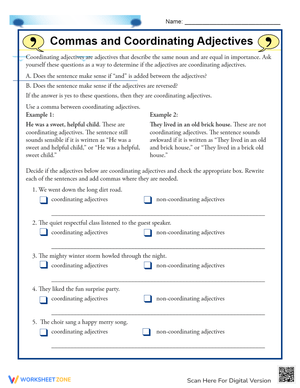
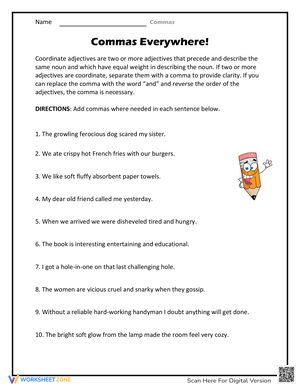
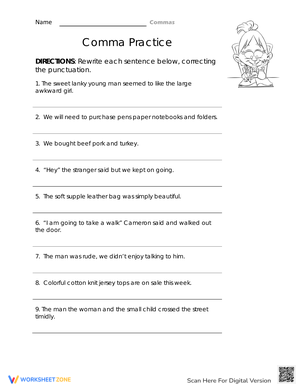
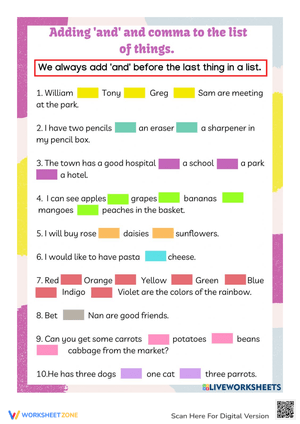
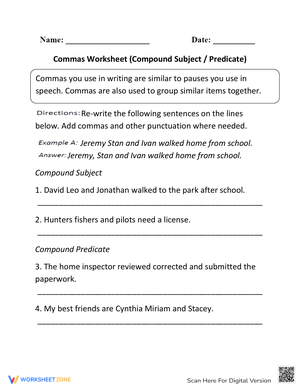
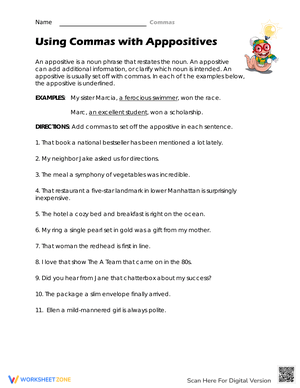
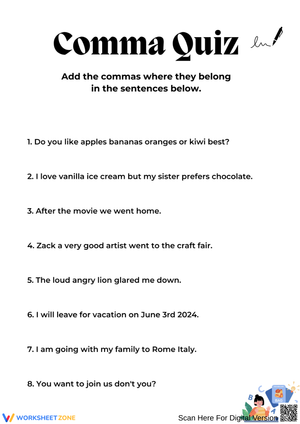
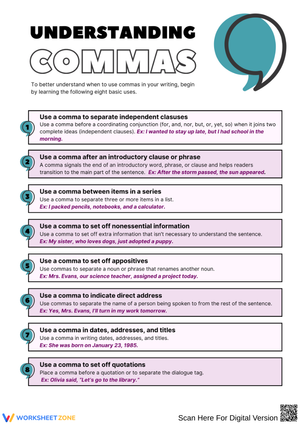
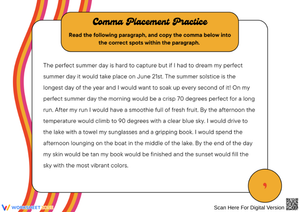
These 7th grade commas printable worksheets resources give teachers something specific: focused practice on the five comma patterns that middle schoolers most consistently confuse, with enough variation in task type to carry a lesson from guided work through independent practice without repeating the same exercise. The set covers commas in a series, after introductory elements, in compound sentences, between coordinate adjectives, and around nonessential information — including mixed-review exercises that drop the rule labels and ask students to make punctuation decisions without structural hints.
What's Inside the Set
Comma instruction at grade 7 does not begin from scratch. Students arrive having practiced list commas and basic compound sentence punctuation since fourth grade. What shifts at this level is the expectation that students can identify the structural reason a comma belongs in a sentence — not just retrieve a familiar rule and apply it by feel. Sentences grow more complex, patterns start appearing in combination, and the old strategy of punctuating wherever a spoken pause sounds right begins producing consistent errors.
Each worksheet isolates one or two patterns before later exercises in the set combine rules without labeling which one applies. Skills covered include:
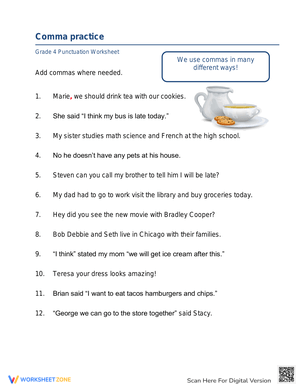
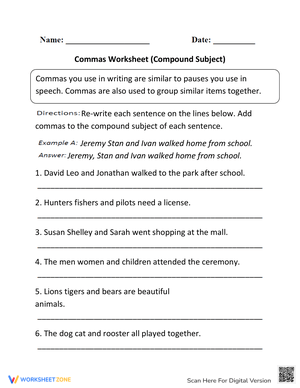
- Commas in a series, including lists embedded inside longer sentences with multiple clauses
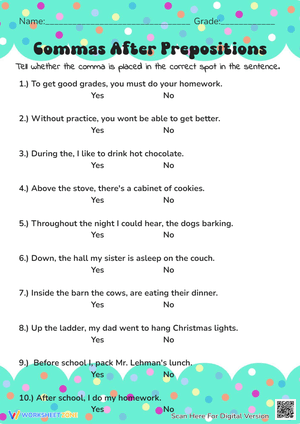
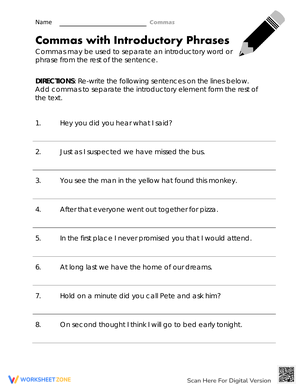
- Commas after introductory words, prepositional phrases, and subordinate clauses of varying lengths
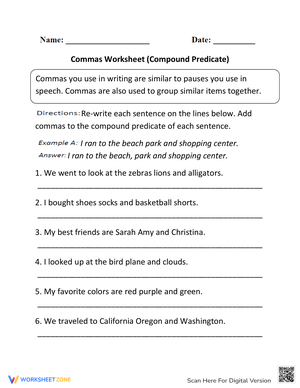
- Commas before coordinating conjunctions joining two independent clauses — and why compound predicates do not receive one
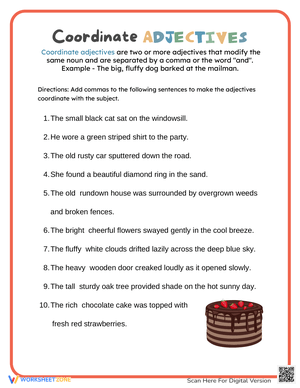
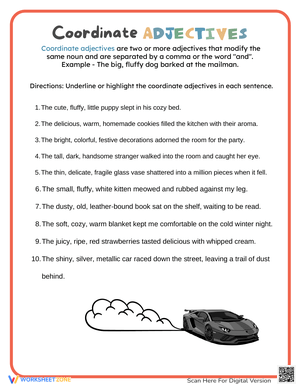
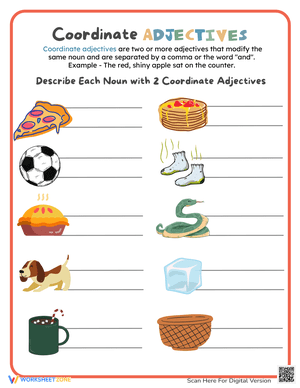
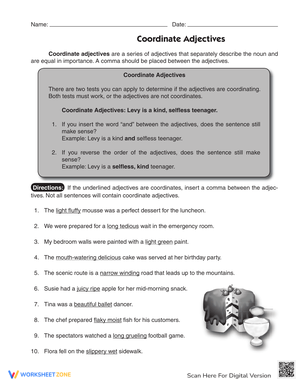
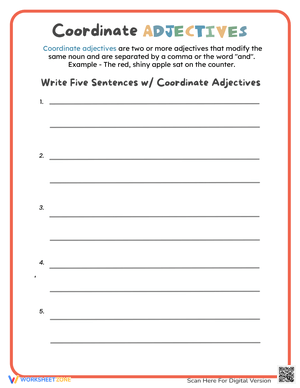
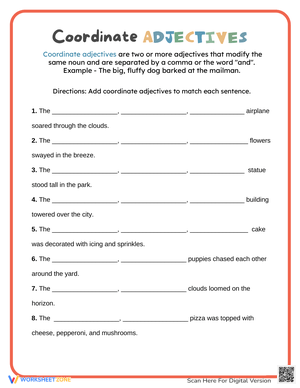
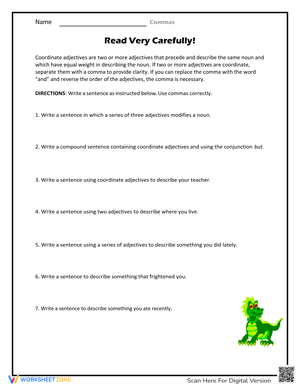
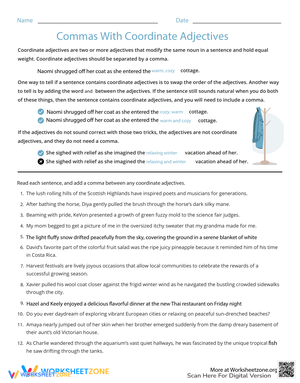
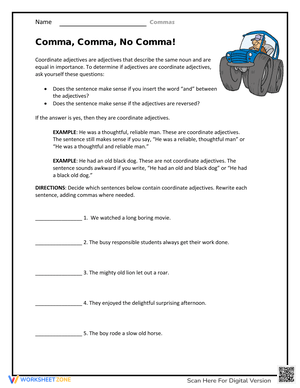
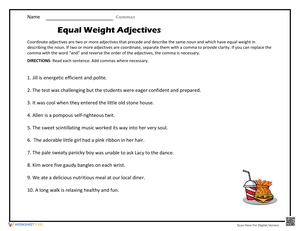
- Commas between coordinate adjectives, practiced through both the "and test" and the reversal method
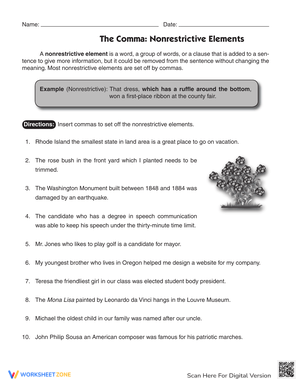
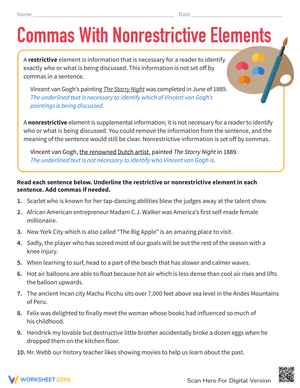
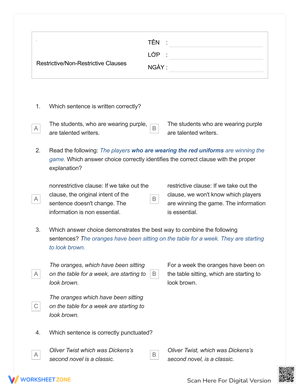
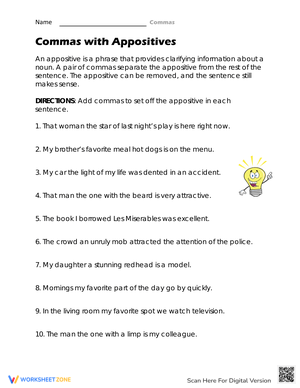
- Commas around nonessential appositives and interruptive phrases, where removing the phrase leaves a complete sentence intact
Mistakes Students Make That These Worksheets Help You Catch
The coordinate adjective comma generates a specific error that appears after instruction, not before. Students who correctly omit the comma in "a big red barn" start overcorrecting once they learn the rule — writing "a talented, young athlete" with the comma in because two adjectives precede a noun. The reversal test resolves this: if "a young talented athlete" sounds equally natural (it does), the adjectives are not coordinate and no comma belongs. These worksheets present both the "and test" and the reversal method side by side before students practice independently, which catches this confusion more reliably than teaching only one test.
Introductory elements generate a different problem. Students who handle single-word transitions without trouble — adding a comma after "However," without hesitation — will still miss it after a full subordinate clause: "When the final bell rang students rushed to the buses." The clause reads as part of the sentence rather than a distinct opener. The most effective exercise is asking students to bracket the introductory element before inserting the comma. Making that boundary physical on the worksheet produces better results than restating the rule.
The compound sentence comma is the error that persists longest across grade 7 classrooms. Students either drop it everywhere or insert one before every conjunction regardless of what follows. The clearest corrective is asking students to underline the subject and main verb in each clause before deciding. One subject carrying two verbs — no comma. Two subjects, each with its own verb — comma before the conjunction. The editing tasks in this set build that procedural habit rather than asking students to apply an abstraction they cannot yet visualize.
Lesson-Planning Ideas to Get the Most From These Worksheets
The sequence that holds up best in a grade 7 ELA block: brief direct instruction on one rule, a guided worksheet while students can still ask questions, a short independent editing task, then a sentence-writing prompt where students produce original examples of the target pattern. That progression fits inside 35 to 40 minutes and gives students three distinct exposures to the rule without any single activity running too long.
Within shorter classroom windows, the single-rule worksheets work as bell ringers — three to five sentences to edit before the lesson opens. The mixed-review worksheets fit the ten minutes before a unit assessment, when a fast read on which patterns held is more useful than new instruction. For sub plans, worksheets with rule reminders at the top need no prior explanation to run cleanly without a teacher present.
One note on grading: resist collecting everything for a score. Having students self-check against the answer key and circle missed items tells you more about reteaching needs than a percentage does. The 7th grade commas printable worksheets set includes answer keys because that self-correction step is a real part of the learning process — students who immediately revise an error consolidate the pattern far more reliably than students who wait for marked-up work to come back.
Standard Alignment
The set addresses CCSS.ELA-LITERACY.L.7.2, which requires students to demonstrate command of standard English punctuation in writing, and specifically L.7.2.A, which identifies commas between coordinate adjectives as a grade 7 expectation. In classroom terms, L.7.2.A is the one comma rule students encounter for the first time at grade 7 — it does not appear in the L.5 or L.6 standards — which means it needs deliberate direct instruction, not just a review exercise. Finding 7th grade commas printable worksheets resources that give L.7.2.A the same depth of coverage as series commas or introductory element practice is harder than it should be, and this set addresses it proportionally rather than tucking it into a single item at the end of a mixed drill.
Differentiating These Worksheets Across Ability Levels
For students who shut down when they see a long column of unformatted sentences, the immediate adjustment is volume. Assign the first five items rather than the full worksheet, review those together, then have students continue. That change alone — without altering any sentence content — reduces the cognitive load enough that students who were guessing begin making actual structural decisions.
Students who need more support with introductory elements benefit from having the clause boundary marked for them on the first two or three items, with that cue removed on the remaining items. They identify the structure themselves by the end of the worksheet, which prepares them for the unmarked sentences they encounter in their own writing. This works better than either providing the cue on every item or removing it entirely from the start.
For students who work quickly and accurately, the most productive extension is a transformation task: take a correctly punctuated sentence and rewrite it in a structure that changes whether the comma is needed. Converting "Although she was exhausted, she finished the essay" into a version with the subordinate clause at the end — and explaining why the comma disappears — reveals whether a student understands the underlying structure or is simply pattern-matching on surface features. No additional materials required.
Frequently Asked Questions
Which comma skills are covered in the set?
The worksheets address five patterns: commas in a series, after introductory elements, in compound sentences, between coordinate adjectives, and around nonessential information. Later exercises combine all five without labeling which rule applies to each sentence.
Can I use individual worksheets without assigning the entire set?
Yes. Each worksheet stands alone. If a class needs targeted practice on compound sentence commas but the other patterns are solid, pull only those worksheets. The set is built for selective use, not sequential completion.
Are answer keys included?
Answer keys come with every worksheet. In classrooms where students self-check their corrections, having the key available immediately is what makes the revision step useful. Without it, errors sit uncorrected until the teacher can reach each student individually, and that delay costs instructional time.
How do these worksheets work for students who are significantly behind in comma skills?
Start with the series and introductory element worksheets before moving to coordinate adjectives or nonessential information. Those two patterns require more structural understanding, and moving to them before students are ready tends to produce guessing rather than learning. When choosing 7th grade commas printable worksheets resources for intervention use, look for exercises that ask students to identify and mark sentence elements before inserting punctuation — that identification step slows students down productively and tends to produce better results than straight error-correction tasks alone.












 Interactive Worksheet Maker
 Quiz Maker
 Word Search Maker
 Crossword Puzzle Maker
 Word Scramble Generator
 Sentence Scramble Generator
 Handwriting Worksheet Generator
 Name Tracing Generator
 Fill In The Blank Generator