


























Views
Downloads

Ellipsis Omission Worksheet | Essential Grade 8 Grammar
Paste this activity's link or code into your existing LMS (Google Classroom, Canvas, Teams, Schoology, Moodle, etc.).
Students can open and work on the activity right away, with no student login required.
You'll still be able to track student progress and results from your teacher account.
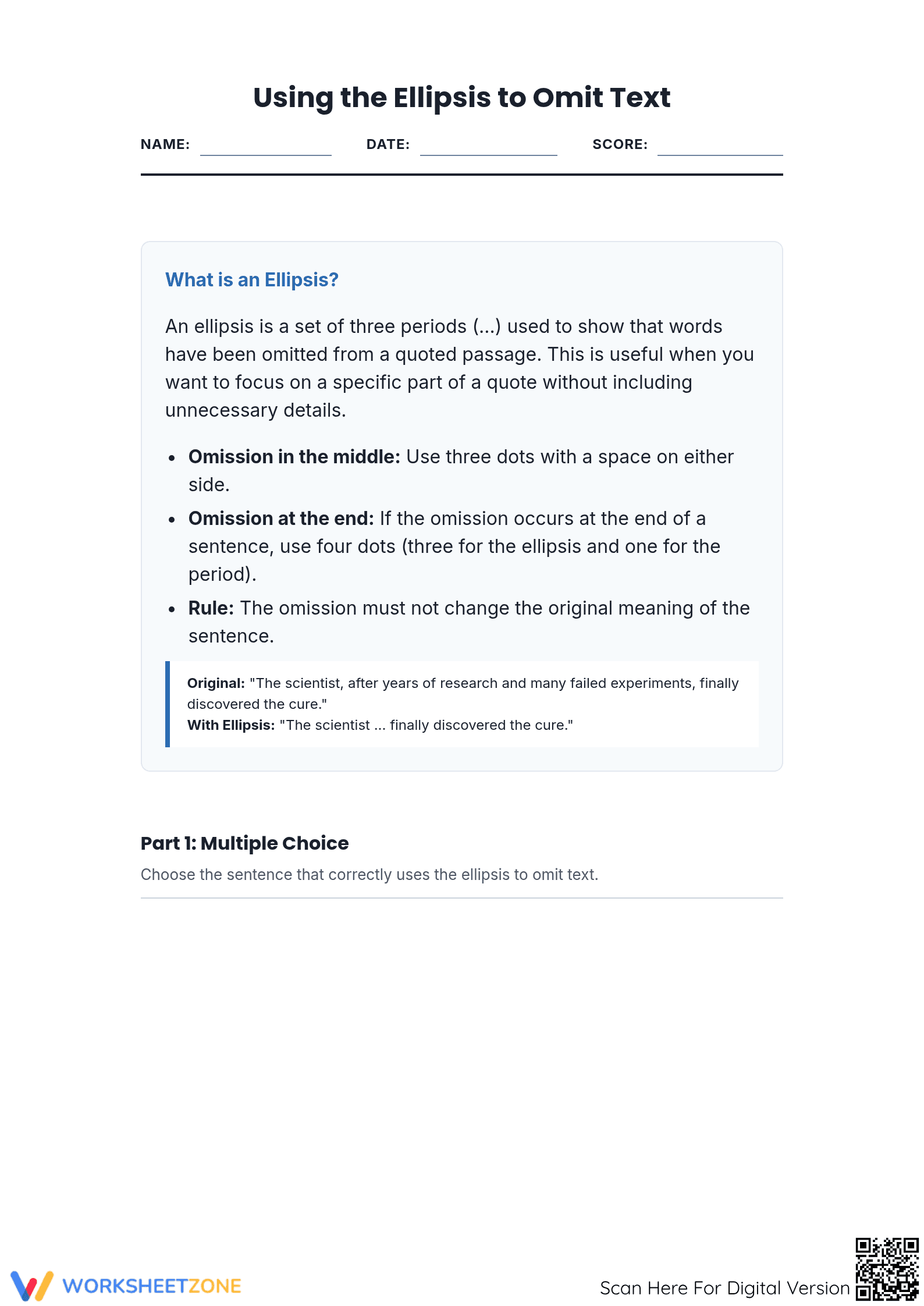
This Grade 8 grammar worksheet provides targeted practice for using ellipses to omit text from quoted passages. Students learn the technical rules for spacing and punctuation while ensuring the original meaning remains intact. By completing these 10 structured exercises, learners gain the precision needed for academic writing and formal citations.
At a Glance
- Grade: 8 · Subject: ELA
- Standard:
CCSS.ELA-LITERACY.L.8.2.B— Use an ellipsis to indicate an omission in quoted text- Skill Focus: Punctuation and Omission
- Format: 4 pages · 10 problems · Answer key included · PDF
- Best For: Middle school grammar and mechanics practice
- Time: 20–30 minutes
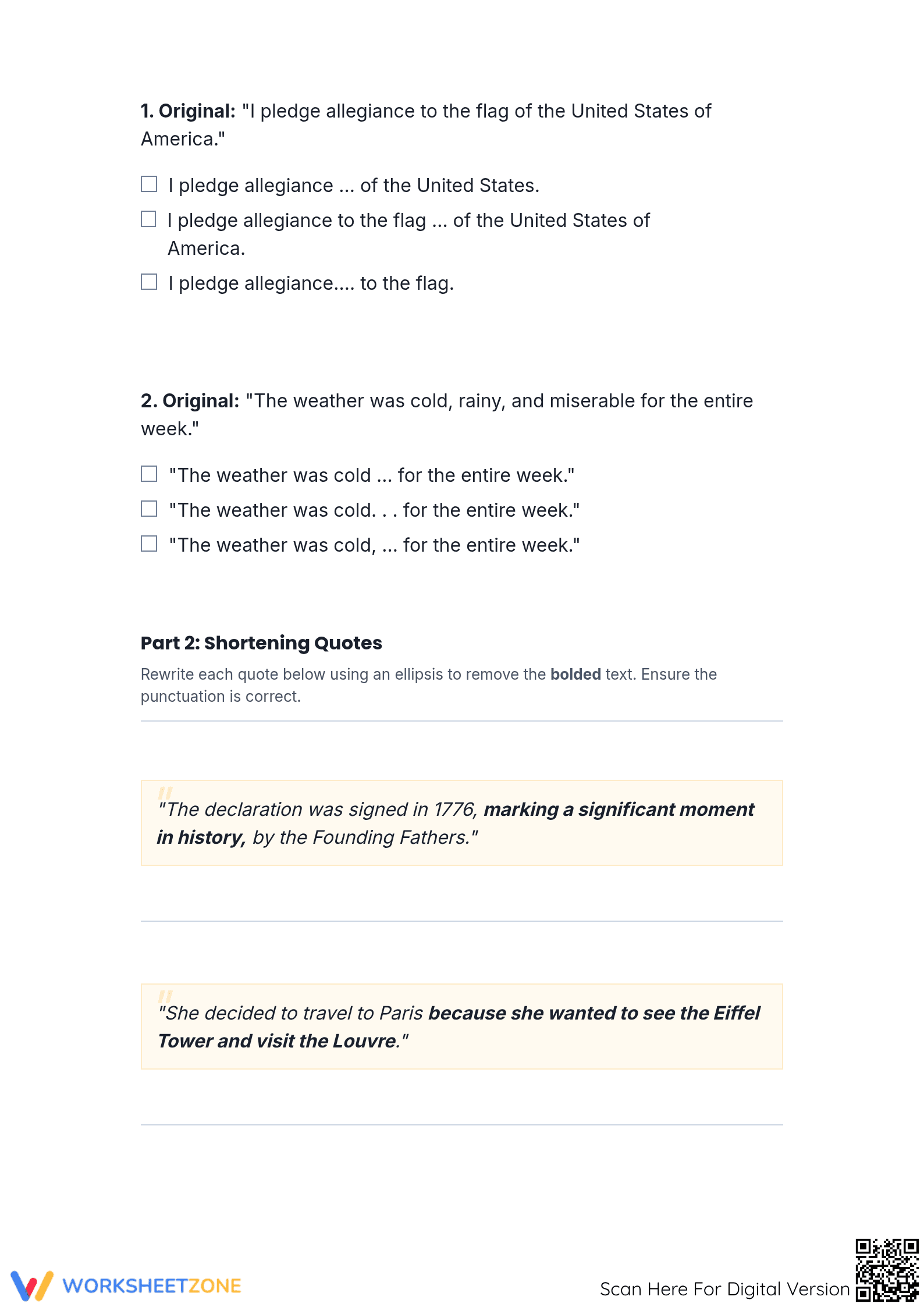
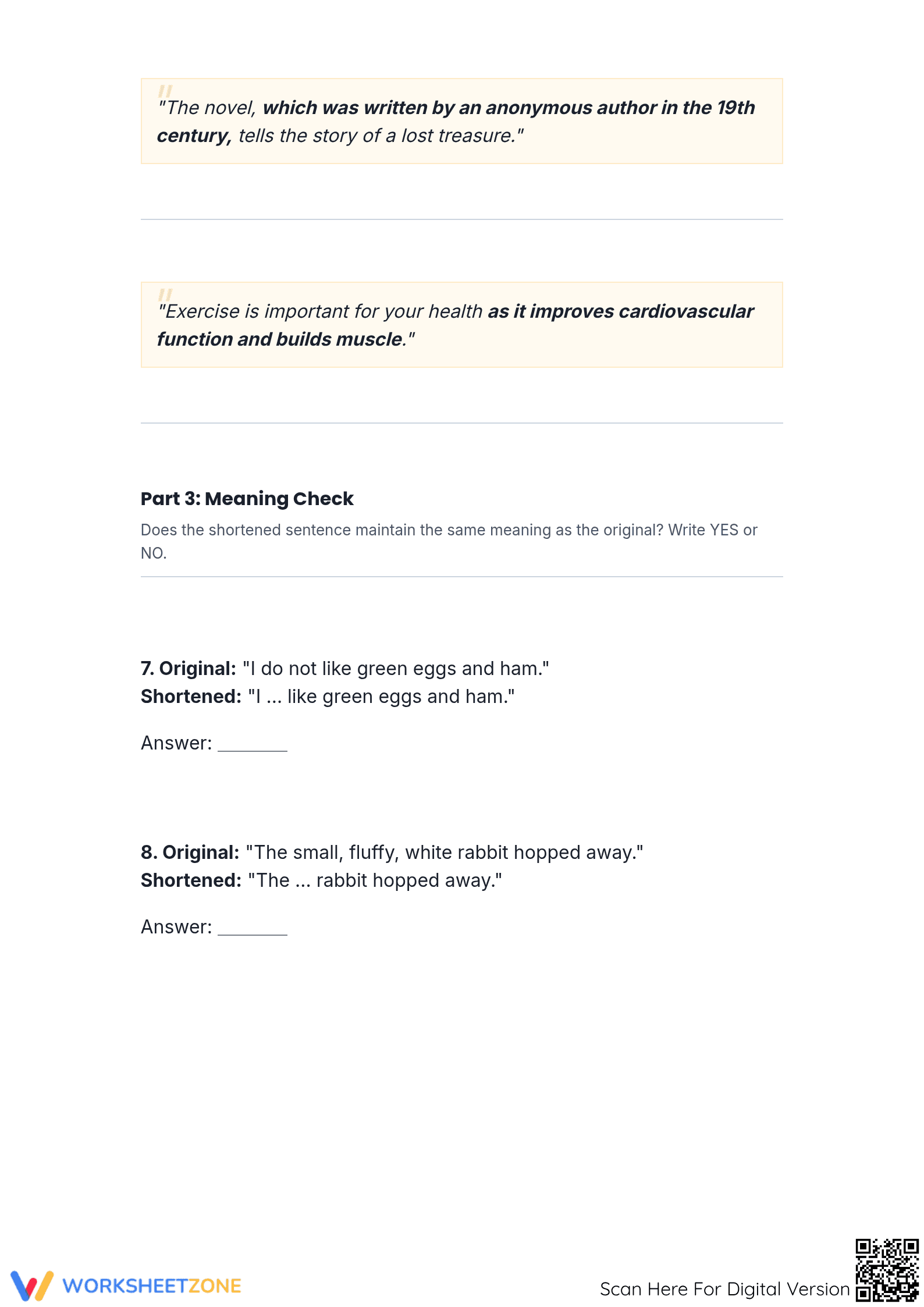
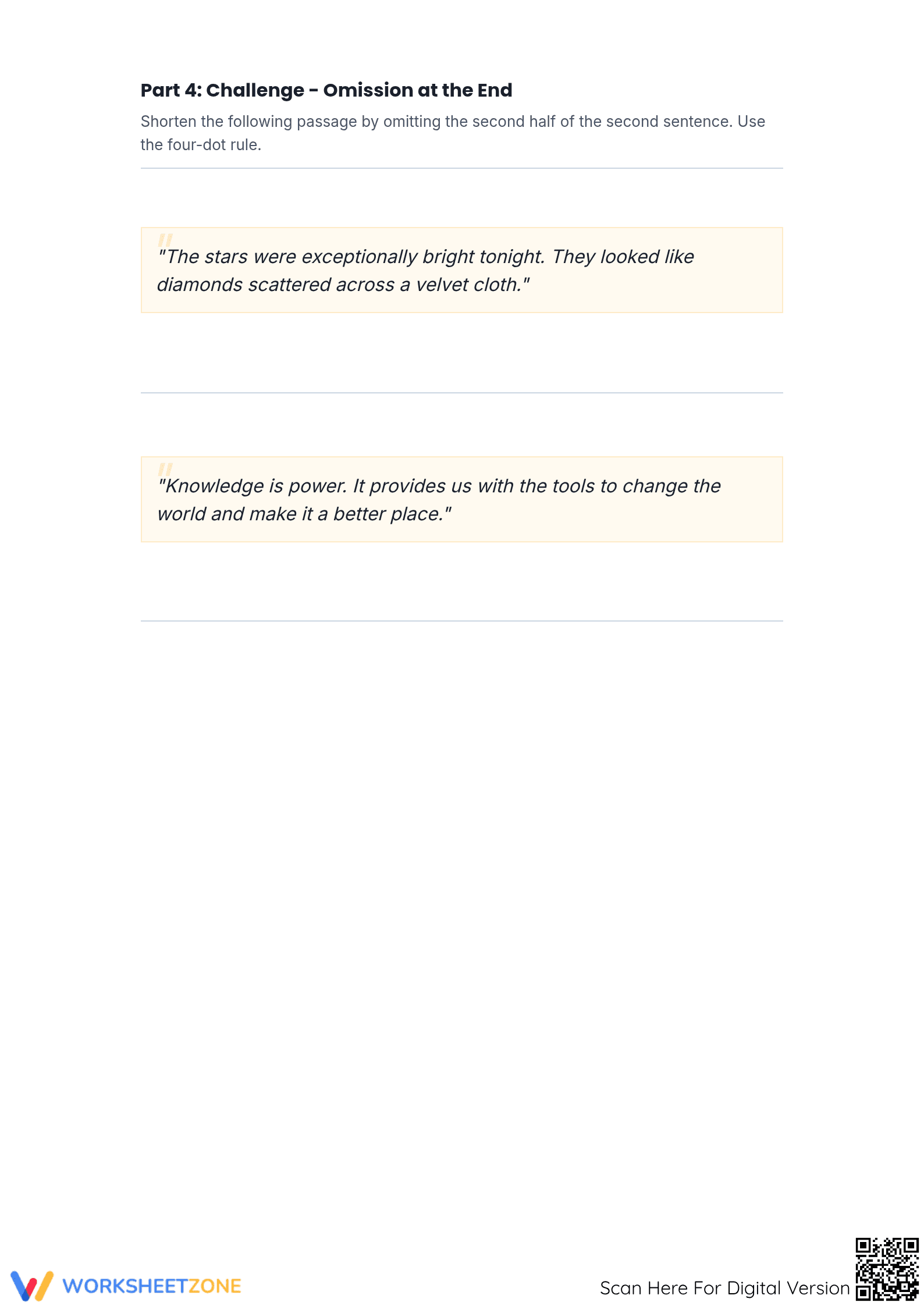
What's Inside: This comprehensive 4-page PDF includes a clear instructional header defining the ellipsis and its specific usage rules. The packet contains multiple-choice identification, quote-shortening exercises, a meaning-check section to prevent misrepresentation, and a final challenge focusing on the "four-dot rule" for end-of-sentence omissions. A full 4-page answer key is provided for immediate feedback.
Skill Progression
- Guided Practice: Students begin with multiple-choice questions that model correct spacing and dot counts for middle-sentence omissions.
- Supported Practice: Learners rewrite four specific quotes, applying the ellipsis to bolded text segments while maintaining grammatical flow.
- Independent Practice: The final sections require students to evaluate if shortened sentences preserve original intent and to apply the complex four-dot rule independently.
This sequence follows a gradual-release model to ensure students master technical punctuation before applying it to complex passages.
Standards Alignment
The primary focus is CCSS.ELA-LITERACY.L.8.2.B: "Use an ellipsis to indicate an omission." This resource also supports L.8.2, which requires students to demonstrate command of the conventions of standard English capitalization, punctuation, and spelling. Both standard codes can be copied directly into lesson plans, IEP goals, or district curriculum mapping tools.
How to Use It
Assign this worksheet during the "You Do" phase of a direct instruction lesson on punctuation. It works effectively as a formative assessment after teaching the difference between three-dot and four-dot ellipses. Teachers should observe Part 3 closely to ensure students understand that omitting text must never distort the author's original message. Completion typically takes 25 minutes.
Who It's For
This resource is designed for Grade 7 and 8 students mastering advanced punctuation. It is particularly helpful for students preparing for research-based writing where quoting and paraphrasing are essential. Pair this with a mentor text or a citation style guide to show how ellipses appear in professional academic journals.
Mastery of the ellipsis is a critical component of the CCSS.ELA-LITERACY.L.8.2.B standard, requiring students to use punctuation to indicate an omission accurately. This worksheet addresses the technical nuances of the "four-dot rule" and the ethical requirement of maintaining original meaning. According to Fisher & Frey (2014), the gradual release of responsibility—moving from identification to application—is essential for students to internalize complex grammatical conventions. By providing 10 distinct tasks across 4 pages, this resource ensures that learners move beyond rote memorization toward functional application in their own writing. The inclusion of a meaning-check section reinforces the importance of integrity in academic citations, a skill that scales into high school and collegiate-level research. This structured approach provides the necessary scaffolding for middle schoolers to navigate the complexities of standard English mechanics with confidence and precision.


