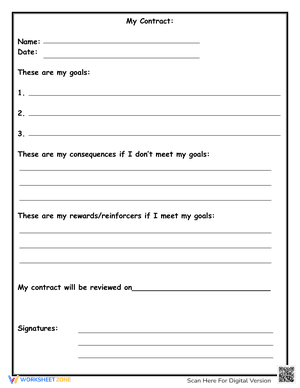
7th grade behavior contracts printable worksheets give teachers a repeatable structure for turning vague behavior concerns into documented, student-involved plans. Each worksheet moves the conversation away from "you need to do better" and toward specific, trackable actions — begins bell work within two minutes, uses a calm voice during discussion, submits work by the end of the period. The format works because middle schoolers at this developmental stage can engage in genuine goal-setting when the process is structured and the expectations are stated plainly.
What Each Worksheet Covers
Each worksheet provides dedicated space for target behaviors, adult supports, progress tracking, and signature lines. The structure keeps all parties — student, teacher, and family — aligned on what success looks like without requiring a lengthy individualized plan.
Core components across the set include:
- Observable behavior goals: Written in first-person, action-based language so students and teachers score them the same way.
- Student voice sections: Space for the student to name one challenge and one support that would help — moves buy-in from optional to built in.
- Adult support commitments: What the teacher or team will provide, not just what the student must do.
- Daily or weekly tracking grids: Simple ratings or checkboxes make progress visible without adding grading time.
- Review date and signature lines: A start date and a scheduled follow-up keep the contract active rather than letting it sit in a drawer.
Each worksheet stays focused enough to survive the pace of a middle school day. Teachers who have tried elaborate multi-document systems often return to simpler formats — not because they care less, but because a form that takes four minutes to complete actually gets completed.
Building Goals That Hold Up in Practice
The most important decision in any behavior contract is how the goal is written. Broad goals like shows respect or makes better choices create scoring disagreements before the first review cycle ends. Two adults should be able to observe the same classroom moment and agree independently on whether the goal was met. That level of clarity requires behavioral specificity: responds to redirection without arguing, remains in seat during independent work, uses a calm voice when expressing disagreement.
One to three goals works better than a long list. When a student is struggling in five areas, it feels logical to address all five at once. In practice, that approach overwhelms both the student and the adult monitoring the contract. Start with the behavior that most directly disrupts learning or peer safety, and add goals only after the first target shows consistent progress.
Match the goal to where the behavior actually occurs. If the problem surfaces during transitions, build the contract around transition behavior. If it happens during group work, track that specific window. A targeted goal gives cleaner data and makes feedback more fair.
Fitting These Into Your Week Without Losing the Thread
The best time to introduce one of these worksheets is not during the incident — it's during a calm, five-minute check-in, ideally at the start of a new week. Monday morning advisory, the minutes after homeroom, or a quiet moment before a class starts all work. Walk the student through the form, let them help word one goal in their own language, and name the first review date before closing the conversation.
For daily tracking, the most sustainable approach is a short, consistent moment at the same time each day — the last two minutes of a period or a quick midday check-in if the student moves between teachers. Feedback should stay neutral and brief. Lengthy post-mortems at the end of a rough day rarely help and sometimes entrench the problem. Note the score, give one specific comment, and move on.
When working with 7th grade behavior contracts printable worksheets across a departmentalized schedule, it helps to designate one teacher as the primary monitor. That person collects tracking data from other teachers, keeps the original worksheet, and runs the formal review. Otherwise the contract tends to drift — each teacher assumes someone else is following up, and consistent feedback disappears within two weeks.
Patterns Worth Watching Once the Contract Is Running
The pattern that derails contracts most often is not resistance — it's ambiguity baked into the goal itself. A student who agrees to "participate respectfully in groups" but interprets participation as staying quiet while others talk will technically meet the goal as written. This shows up in real student data as clean early scores followed by sudden peer or teacher concerns, and the disagreement almost always traces back to the original wording. Write the goal to close that gap before it opens.
A second common pattern: students who meet the goal early in the week and coast by Thursday. This usually signals the review cycle is too long or the reinforcement is front-loaded. Adding a midweek check-in often corrects this without requiring a goal revision.
Students who refuse to sign the contract usually aren't refusing the goal — they're resisting the formal document, often because it reads like a punishment form. Letting the student rewrite the success indicator in their own words, or framing the signature as "you're agreeing to have a plan," reduces that friction noticeably in most cases.
Adjusting Each Worksheet for a Range of Learners
For students who need more support, pair the worksheet with a visual check-in tool — a simple stoplight card or a numbered self-rating scale they can reference during transitions. The worksheet tracks the goal; the visual gives a real-time prompt without requiring constant adult intervention. Reducing the tracking interval from a full day to a single class period, then expanding it gradually as self-monitoring develops, also helps students who feel overwhelmed by end-of-day review.
For students who have already made progress with a basic contract, shift ownership. Ask them to score their own behavior before the adult reviews it. The goal stops being "did the teacher mark it green" and becomes "how accurately can I read my own behavior." Each worksheet in the set leaves open space for student-led annotation, which means the same resource grows with the student rather than requiring a separate advanced version. Using 7th grade behavior contracts printable worksheets this way — progressively increasing self-assessment while fading adult scoring — builds self-monitoring habits that outlast the contract itself.
In advisory or intervention groups, the same format supports small-group behavior planning. Each student's goals differ, but the consistent worksheet structure reduces confusion and speeds up group review sessions.
Frequently Asked Questions
How are these worksheets different from a formal behavior intervention plan?
A behavior intervention plan (BIP) is part of a student's IEP and requires formal evaluation, team input, and legal documentation. These worksheets sit below that threshold — a general education tool for students who need more than verbal reminders but less than a formally governed plan. They are not a replacement for a BIP, and a student with an existing BIP should follow that plan rather than a standalone contract worksheet.
Can these be used across multiple class periods in a middle school schedule?
Yes. Each worksheet includes room to track behavior across more than one class period, which makes the set workable in departmentalized middle schools where a student moves between four to seven teachers. Results are clearest when all involved teachers score against the same written criteria rather than each applying their own interpretation of what the goal means.
What happens when a student meets all the goals and the contract is finished?
Close the contract formally. Name what the student accomplished — specifically — before moving to a lighter self-monitoring check-in without adult scoring. Students who experience the full cycle of the 7th grade behavior contracts printable worksheets — goal, tracked effort, clear evidence of progress, and a definite endpoint — are more likely to internalize the self-monitoring process than students whose contracts quietly disappear when behavior improves.
How long should the contract stay active before a revision?
Start with a two-to-four-week window. If the student is consistently meeting the goal, begin fading support — move from daily tracking to every other day, then to weekly reflection. If progress stalls after two weeks, either the goal needs to be narrowed further or the adult supports documented in the contract are not happening with enough consistency to give the plan a fair test.
















 Interactive Worksheet Maker
 Quiz Maker
 Word Search Maker
 Crossword Puzzle Maker
 Word Scramble Generator
 Sentence Scramble Generator
 Handwriting Worksheet Generator
 Name Tracing Generator
 Fill In The Blank Generator