


























0
Views
0
Downloads

0.0
0
Save
0 Likes
Share
Plant Cell Worksheet: Label and Learn Parts
0 Views
0 Downloads
Paste this activity's link or code into your existing LMS (Google Classroom, Canvas, Teams, Schoology, Moodle, etc.).
Students can open and work on the activity right away, with no student login required.
You'll still be able to track student progress and results from your teacher account.
Information
Description
What It Is:
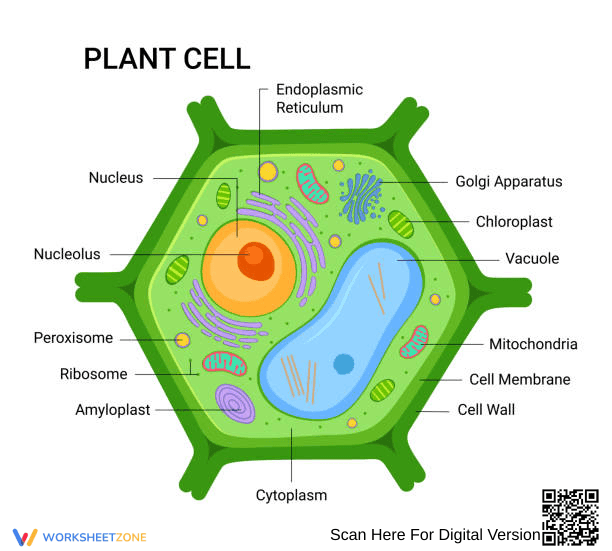
This is a diagram of a plant cell. It labels various organelles within the cell, including the nucleus, nucleolus, endoplasmic reticulum, Golgi apparatus, chloroplast, vacuole, mitochondria, cell membrane, cell wall, cytoplasm, peroxisome, ribosome, and amyloplast. The diagram is colorful and clearly shows the relative positions of each organelle.
Grade Level Suitability:
This worksheet is suitable for grades 6-9, specifically middle school life science or introductory biology. The diagram is detailed enough to provide a good overview of cell structure, but not so complex as to overwhelm younger students. It could also be useful for high school students as a review.
Why Use It:
This diagram helps students visualize the structure of a plant cell and learn the names and locations of the various organelles. It can be used to introduce cell biology or as a study aid for students preparing for a test on cell structure and function.
How to Use It:
Use this diagram as a visual aid during a lesson on plant cells. Students can label a blank version of the diagram, use it for flashcards, or compare and contrast the plant cell to an animal cell. The diagram can also be used as a reference while studying the functions of each organelle.
Target Users:
This diagram is beneficial for middle and high school students learning about plant cells in biology or life science classes. Teachers can use it as a teaching tool, and students can use it for studying and review. It's also suitable for homeschoolers studying cell biology.
This is a diagram of a plant cell. It labels various organelles within the cell, including the nucleus, nucleolus, endoplasmic reticulum, Golgi apparatus, chloroplast, vacuole, mitochondria, cell membrane, cell wall, cytoplasm, peroxisome, ribosome, and amyloplast. The diagram is colorful and clearly shows the relative positions of each organelle.
Grade Level Suitability:
This worksheet is suitable for grades 6-9, specifically middle school life science or introductory biology. The diagram is detailed enough to provide a good overview of cell structure, but not so complex as to overwhelm younger students. It could also be useful for high school students as a review.
Why Use It:
This diagram helps students visualize the structure of a plant cell and learn the names and locations of the various organelles. It can be used to introduce cell biology or as a study aid for students preparing for a test on cell structure and function.
How to Use It:
Use this diagram as a visual aid during a lesson on plant cells. Students can label a blank version of the diagram, use it for flashcards, or compare and contrast the plant cell to an animal cell. The diagram can also be used as a reference while studying the functions of each organelle.
Target Users:
This diagram is beneficial for middle and high school students learning about plant cells in biology or life science classes. Teachers can use it as a teaching tool, and students can use it for studying and review. It's also suitable for homeschoolers studying cell biology.


