


























Views
Downloads

Essential Magnetism Worksheet | Grade 3-6 Science
Paste this activity's link or code into your existing LMS (Google Classroom, Canvas, Teams, Schoology, Moodle, etc.).
Students can open and work on the activity right away, with no student login required.
You'll still be able to track student progress and results from your teacher account.
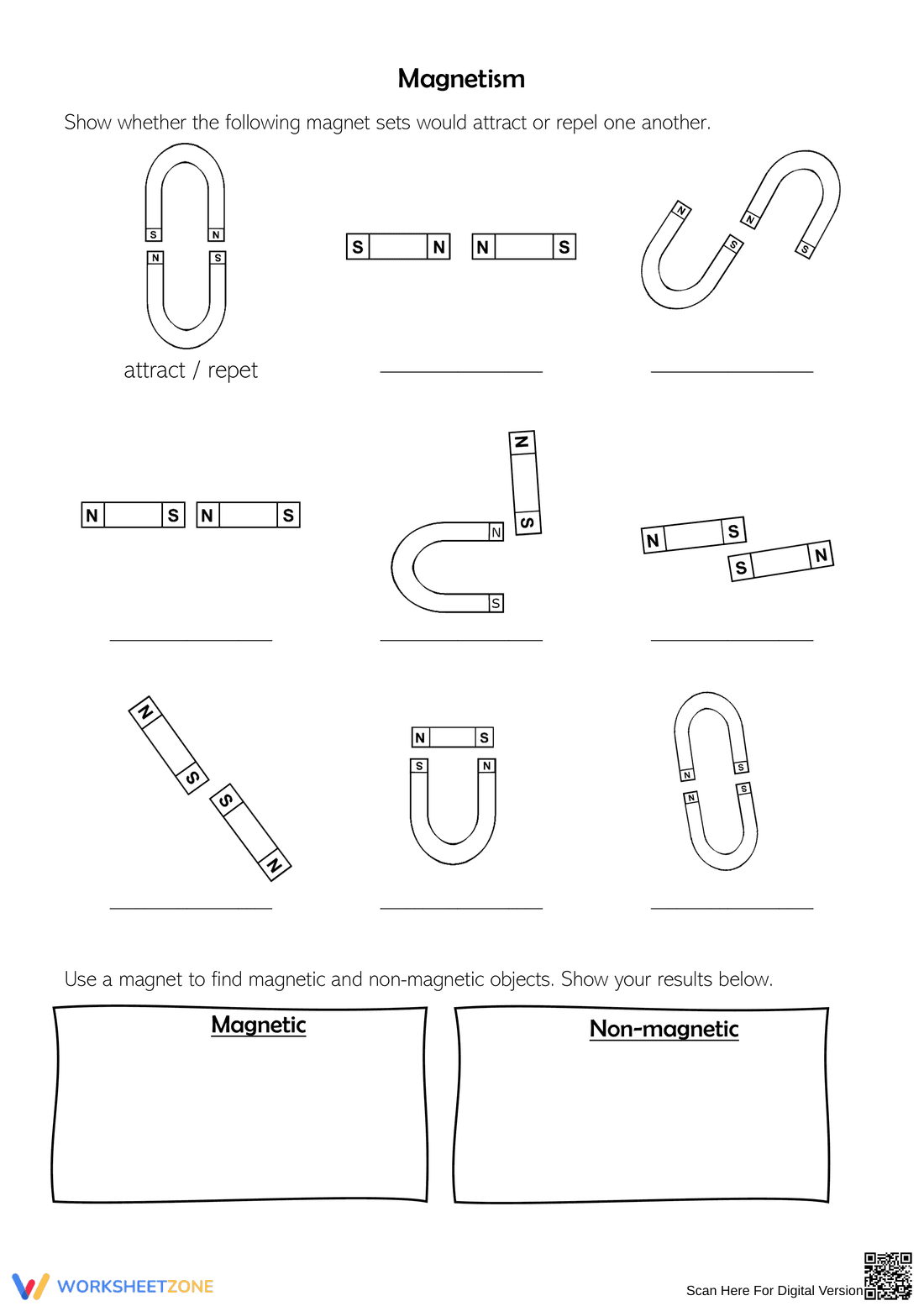
This Grade 3-6 magnetism worksheet helps students master the principles of magnetic force through visual prediction and material classification. Students analyze pole orientations to determine if magnets attract or repel, then categorize objects based on magnetic properties. It provides a clear, structured way to observe non-contact forces in action.
At a Glance
- Grade: 3-6 · Subject: Science
- Standard:
3-PS2-3— Determine cause and effect relationships of magnetic interactions between objects- Skill Focus: Magnetic Polarity & Classification
- Format: 1 page · 10 problems · Answer key included · PDF
- Best For: Independent science stations or formative assessment
- Time: 15–20 minutes
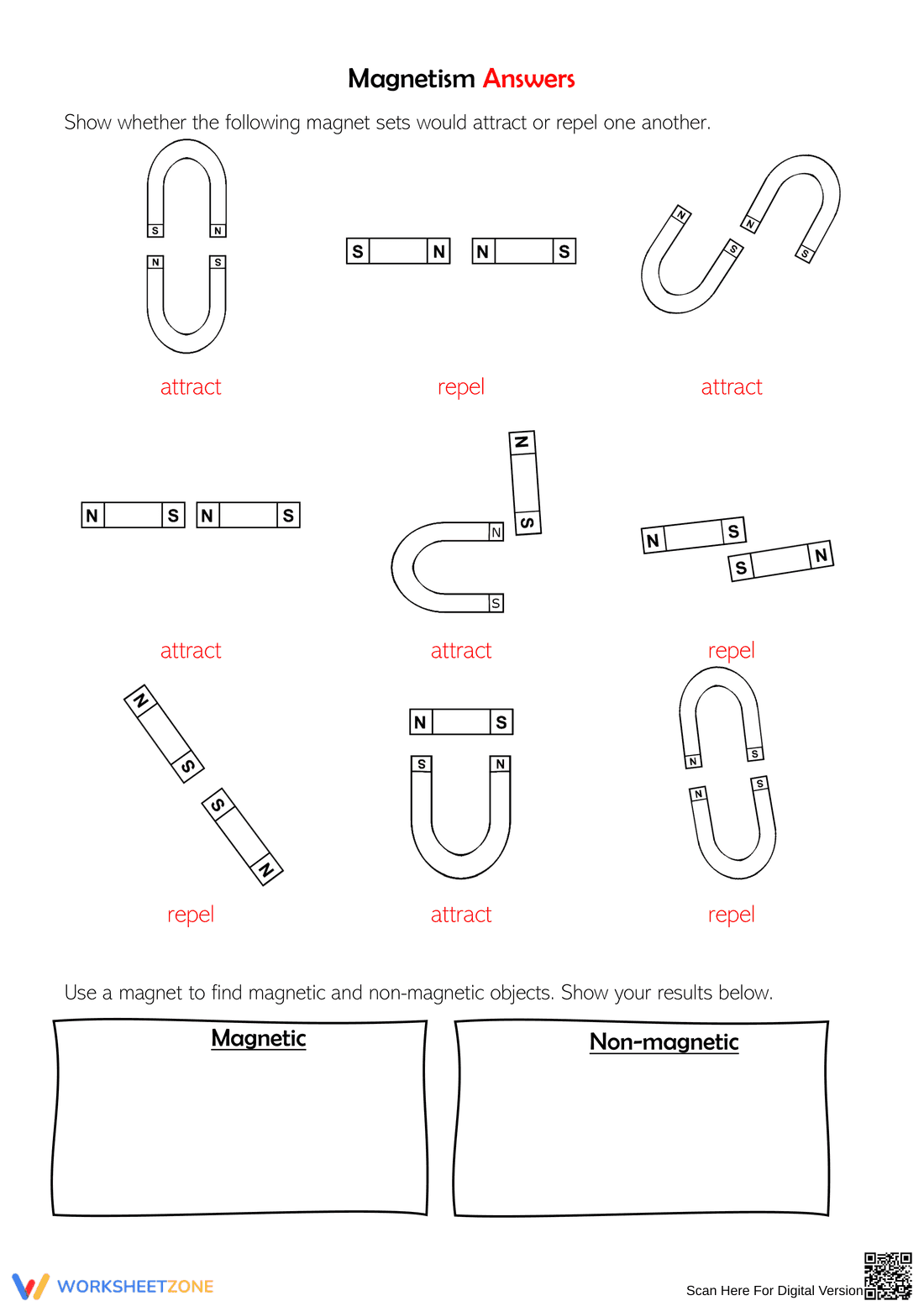
This single-page resource contains nine visual scenarios featuring bar and horseshoe magnets in various configurations. Students must identify the poles and predict the resulting force. The bottom half includes a dual-column sorting table for students to record magnetic and non-magnetic materials. A comprehensive answer key is provided for streamlined grading.
Zero-Prep Workflow
- Print (1 min): Generate a single-sided copy for each student. No complex assembly or multi-page stapling required.
- Distribute (1 min): Hand out the sheets as a bell-ringer or transition activity. The clear diagrams require minimal teacher explanation.
- Review (5 mins): Use the included answer key for a whole-class check or peer-grading session to provide immediate feedback.
Total teacher preparation time is under two minutes, making this an ideal emergency sub plan or quick formative check.
This resource is aligned with 3-PS2-3, which tasks students to "ask questions to determine cause and effect relationships of electric or magnetic interactions between two objects not in contact with each other." By identifying how like poles repel and opposite poles attract, students demonstrate a functional understanding of magnetic fields. This standard code can be copied directly into lesson plans, IEP goals, or district curriculum mapping tools.
Use this worksheet as a "Check for Understanding" immediately following a direct instruction lesson on polarity. Alternatively, place it at a science center with a bin of physical magnets and objects (paperclips, coins, erasers) to transform the sorting table into a hands-on lab. Completion typically takes 15 to 20 minutes.
This worksheet is designed for upper elementary and middle school students in general education or integrated science settings. It is particularly effective for visual learners who benefit from clear spatial diagrams. Pair this with a short reading passage on magnetic fields or a live demonstration using iron filings to deepen conceptual connections.
According to the RAND AIRS 2024 report on science instructional materials, high-quality visual scaffolds are essential for reducing cognitive load when students are learning abstract physical concepts like non-contact forces. This worksheet applies those findings by using clear, labeled diagrams of horseshoe and bar magnets, allowing students to focus entirely on the logic of attraction and repulsion. By requiring students to predict outcomes based on pole orientation, the resource reinforces the cause-and-effect relationships mandated by NGSS 3-PS2-3. Research indicates that structured classification tasks, such as the magnetic sorting table included here, help students move from intuitive misconceptions to evidence-based scientific reasoning. This dual-task approach ensures that learners not only understand the "how" of magnetic polarity but also the "what" regarding material properties. It serves as a reliable tool for building the foundational physics knowledge necessary for more complex electromagnetic studies in later grades.


