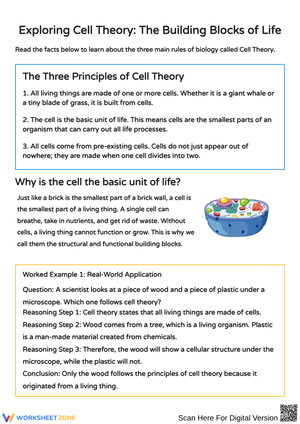
In Grade 6 science, students need repeated practice with the idea that all living things are made of cells, that cells are the basic unit of structure and function, and that cells come from pre-existing cells. For many teachers, this topic works best when students move between direct instruction, visuals, and brief written practice.
What Strong Cell Theory Practice Should Cover
When teachers look for cell theory worksheets, the goal is not just to fill time. The pages should help students remember the three main ideas and apply them in context. Student-friendly wording matters, especially in Grade 6, when some learners are still building confidence with science vocabulary.
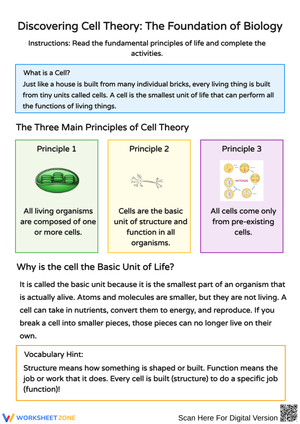
- Core statements of cell theory: students should identify and restate each part in simple language.
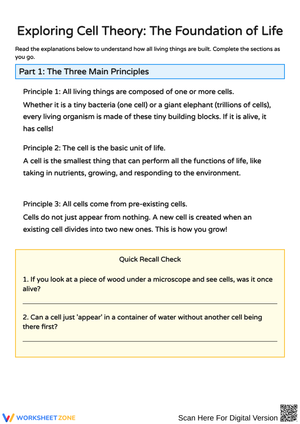
- Vocabulary review: terms like cell, organism, tissue, unicellular, and multicellular should appear in context.
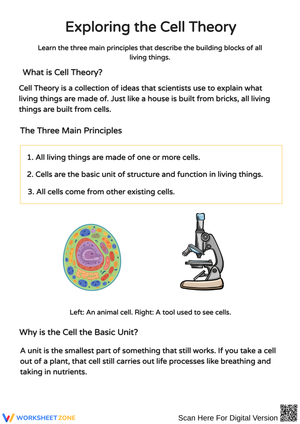
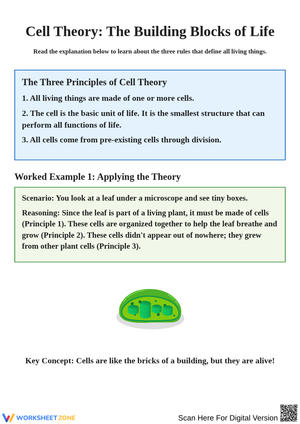
- Diagram work: students benefit from labeling plant and animal cells or sorting examples of living things by cell type.
- Short written responses: a few claim-and-evidence prompts help teachers check whether students truly understand the theory.
- Quick assessment items: multiple choice, matching, or exit-ticket style questions make grading faster.
This combination supports both instruction and assessment. A single worksheet can check recall, while a small packet can build from basic definitions to deeper reasoning about why cell theory matters in biology.
Classroom Implementation
Teachers can use cell theory worksheets in several practical ways across a science unit. At the beginning of instruction, a short pre-assessment page can reveal whether students already know that living things are made of cells. During the unit, matching and labeling pages work well for guided practice after notes or discussion. Near the end, mixed-review pages help students connect cell theory to cell types and levels of organization.
One practical approach is to print the same worksheet in two versions: one with a word bank and one without it. In the same Grade 6 class, that small change can support students who need language help while still giving other students a stronger recall challenge. It keeps the science target the same without creating an entirely different assignment.
- Bell work: use 3 to 5 quick items on the three statements of cell theory.
- Homework: assign a single page with vocabulary and one short explanation question.
- Stations: place a diagram page at one station and a claim-evidence prompt at another.
- Sub plans: choose a mixed-practice page that students can complete with minimal directions.
- Exit tickets: cut one worksheet into smaller response slips for a fast end-of-class check.
These routines keep the resource useful beyond one lesson. They also make it easier to gather evidence of understanding without building a brand-new activity every time.
Differentiation for Grade 6 Learners
Cell theory is foundational, but students do not all process it at the same pace. Good worksheet sets allow teachers to adjust support while keeping expectations clear. For some students, that means using sentence frames such as All living things are made of ___. For others, it means adding challenge questions that ask them to connect cell theory to observations from a microscope lesson.
Word banks are one of the simplest supports. They reduce writing load while still asking students to work with academic vocabulary. Teachers can also chunk a worksheet into smaller parts, asking students to complete vocabulary before moving to short answers. If a class has already learned plant and animal cell parts, a labeling page can help students tie structure back to the larger ideas of cell theory.
Challenge items can push stronger students beyond memorization. For example, a worksheet might ask students to explain how a scraped skin cell or a growing plant supports the idea that cells come from pre-existing cells. That type of prompt keeps the focus on evidence, not just reciting definitions.
Frequently Asked Questions
1. What should Grade 6 students know about cell theory?
Grade 6 students should know the three main statements of cell theory: all living things are made of cells, the cell is the basic unit of structure and function, and cells come from pre-existing cells. They should also be able to connect those ideas to simple vocabulary and cell examples.
2. Do cell theory worksheets work for quick assessment?
They do when the pages include short formats such as matching, diagram labeling, true or false, and brief written responses. Those item types make it easier to check understanding during a lesson or at the end of class.
3. Can teachers use cell theory worksheets with related biology topics?
Yes. Many teachers pair cell theory practice with plant and animal cells, microscope basics, and levels of organization. That helps students see cell theory as a central science idea rather than an isolated vocabulary list.
Sources referenced for topic accuracy include Britannica Kids, National Geographic Society, Khan Academy, and Biology Dictionary. These sources support the core ideas that cell theory explains living things as cellular, identifies the cell as the basic unit of structure and function, and states that cells come from pre-existing cells.












 Interactive Worksheet Maker
 Quiz Maker
 Word Search Maker
 Crossword Puzzle Maker
 Word Scramble Generator
 Sentence Scramble Generator
 Handwriting Worksheet Generator
 Name Tracing Generator
 Fill In The Blank Generator




 BACK TOSCHOOL