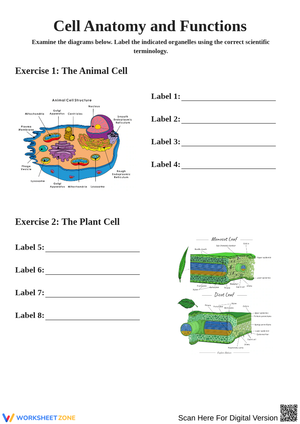
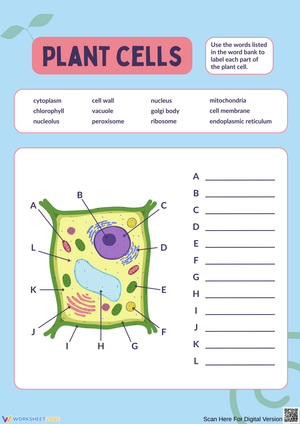
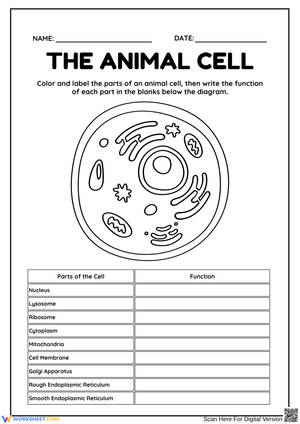
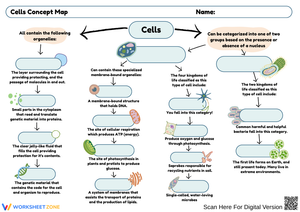
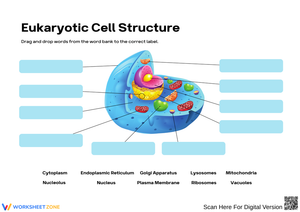
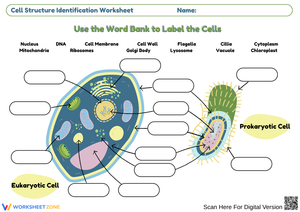
Cell labeling worksheets for 6th grade give teachers a clear, low-prep way to build biology vocabulary while keeping students focused on the parts of a cell they are expected to know. For this level, the most useful pages usually center on a small set of major parts: nucleus, cell membrane, cytoplasm, mitochondria, and vacuole, with chloroplasts and the cell wall highlighted when students study plant cells. A word bank, a short function match, or one sentence comparing plant and animal cells can turn a simple page into a stronger review tool. Instead of memorizing labels in isolation, students connect each organelle to its job and start using the vocabulary more accurately in class discussion and written responses.
What to include on a strong cell labeling worksheet
The most effective worksheet sets for Grade 6 science keep the visual load manageable and match the language students are learning in class. Teachers often get better results when they start with one clear animal cell diagram and one clear plant cell diagram rather than a crowded page with every possible organelle.
- Core labels: nucleus, cell membrane, cytoplasm, mitochondria, vacuole
- Plant cell features: chloroplasts and cell wall
- Support feature: a word bank for first practice
- Function check: a matching section or short prompt for each part
- Comparison task: one item asking what plant and animal cells share and what is different
National Geographic Kids - Plant Cell and Animal Cell is especially helpful for reinforcing the idea that both cell types share several structures, while plant cells include features that animal cells do not. That comparison shows up often in middle school biology instruction, so it makes sense for worksheets to include it directly.
Another helpful design choice is to use black-and-white diagrams that students can mark up. Teachers can ask students to color plant-only structures one color and shared structures another. This adds a quick visual sorting task without making the page feel like an art activity instead of a science activity.
Classroom Implementation
Teachers can open a lesson with a 5-minute bell ringer that asks students to label two familiar parts from memory. After direct instruction or a short video, students complete a full labeling page with a partner. At the end of class, an exit ticket can ask one function question, such as which structure helps control cell activities or which features are found in plant cells.
Worksheets also fit well into small-group instruction. One group can complete a supported word-bank version with teacher guidance while another group works on a challenge page. In classes using devices, the same worksheet can be assigned digitally by having students type labels into text boxes or annotate a diagram. This keeps the format familiar while allowing teachers to collect work quickly.
One practical move that often improves results is to teach the worksheet in two passes instead of one. On the first pass, students label only the parts they can identify with high confidence. On the second pass, they revisit the page with a function word bank and explain what each part does. This reduces random guessing and helps teachers separate “I recognize this picture” from “I actually understand the organelle’s job.”
For review days, teachers can project the diagram and have students hold up mini whiteboards with each answer before completing the paper copy. That brief whole-class check can fix common mix-ups, especially between the cell membrane and cell wall or between chloroplasts and mitochondria.
How these worksheets support biology understanding
When teachers pair labels with simple function prompts, students start making stronger statements in class, such as identifying the nucleus as the control center or explaining that chloroplasts are found in plant cells. Those details matter because they prepare students for later work on how cells support larger structures in living organisms.
Labeling pages can also help teachers catch misconceptions early. If students consistently place chloroplasts in an animal cell or skip the cytoplasm entirely, the worksheet reveals that right away. That makes reteaching more precise and keeps confusion from carrying into quizzes or lab discussions.
Frequently Asked Questions
1. What organelles should students label on a Grade 6 cell worksheet?
Most Grade 6 cell labeling pages should include nucleus, cell membrane, cytoplasm, mitochondria, and vacuole. For plant cells, teachers often add chloroplasts and the cell wall. Keeping the list focused helps students learn the major structures well.
2. What is the difference between a plant cell labeling worksheet and an animal cell labeling worksheet?
An animal cell worksheet usually focuses on shared cell parts, while a plant cell worksheet includes plant-only features such as the cell wall and chloroplasts. Many teachers use both together so students can compare what the two cell types share.
3. How can I make cell labeling easier for struggling students?
Start with a word bank, use a clear uncluttered diagram, and add simple function clues. Color-coding shared parts versus plant-only parts also helps. A two-step process of identify first, explain second can improve accuracy.
4. Can cell labeling worksheets be used for review, homework, or assessment?
Yes. They work well as in-class practice, homework, sub plans, quiz review, or a quick formative assessment. Teachers often keep one supported version for practice and one no-word-bank version for checking understanding.
For US teachers planning a cell unit, the best cell labeling worksheets for 6th grade are the ones that keep diagrams simple, connect labels to function, and include both plant and animal cell thinking. With a few differentiated versions on hand, one worksheet set can support direct instruction, review, and short assessment all within the same biology sequence.












 Interactive Worksheet Maker
 Quiz Maker
 Word Search Maker
 Crossword Puzzle Maker
 Word Scramble Generator
 Sentence Scramble Generator
 Handwriting Worksheet Generator
 Name Tracing Generator
 Fill In The Blank Generator




 BACK TOSCHOOL