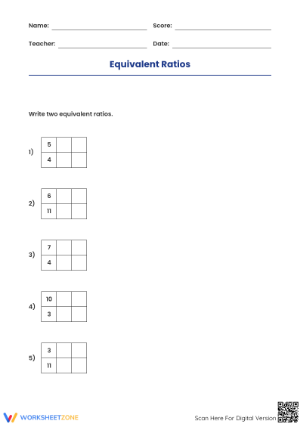
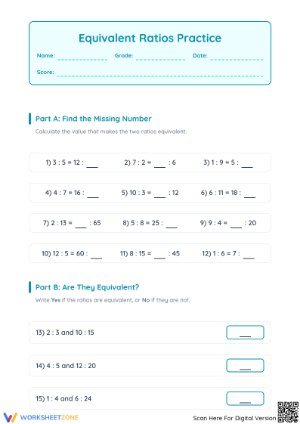
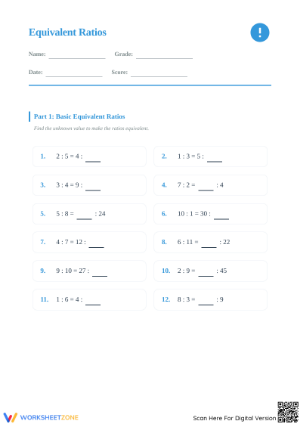
These equivalent ratios printable worksheets for 6th grade give teachers a ready set of structured practice materials covering the full arc of ratio reasoning — from whole-number scaling with small factors to multi-step word problems set in real contexts. Each worksheet targets a specific piece of that reasoning, so teachers can move from direct instruction to guided practice to independent work without hunting for new resources at every phase.
The Specific Skills Targeted
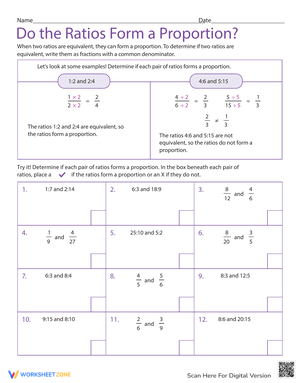
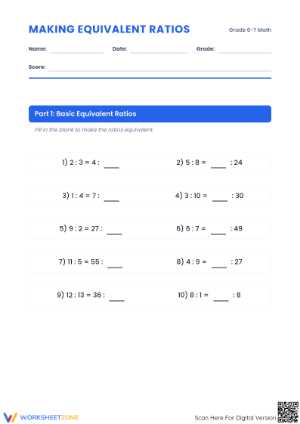
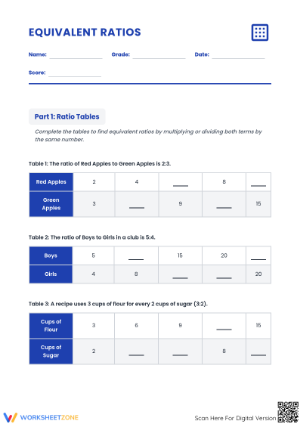
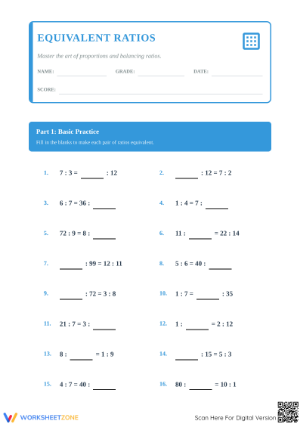
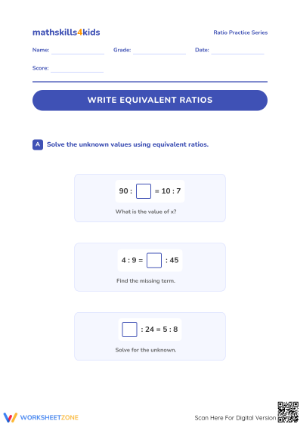
Most 6th graders arrive knowing multiplication facts reasonably well, but they haven't yet confronted the idea that a ratio can be scaled while preserving a relationship. That's the developmental gap this set addresses. Students work through problems that require them to multiply or divide both terms of a ratio by the same nonzero number, complete missing values in a ratio pair, extend a ratio table row by row, and match equivalent ratios from a set of options. The matching tasks matter because they force comparison rather than just production — a different cognitive move that's easy to skip in a typical assignment.
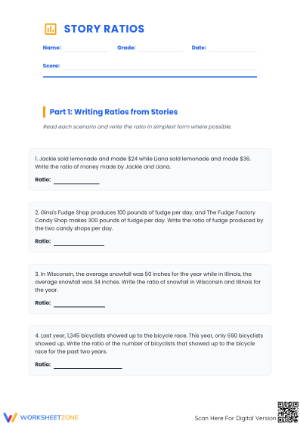
The word problems use contexts students recognize: adjusting ingredient amounts in a recipe, comparing ticket prices for different group sizes, reading a map scale. These aren't decorative. They're the situations where students need to decide whether two ratios actually describe the same relationship, which requires different thinking than filling in a blank.
Well-designed equivalent ratios printable worksheets for 6th grade also include explanation prompts alongside computational items. When a student writes "I multiplied both 3 and 5 by 4 to get 12 and 20," the teacher sees whether they understand the scaling operation or arrived at the answer some other way. Silent correct answers don't reveal that — and in ratio work, the reasoning matters as much as the result.
Student Errors Worth Catching Early
The most persistent error in ratio work is additive thinking. A student sees the ratio 2:3 and writes 4:5 as an equivalent pair, reasoning that adding 2 to each term works the same way as multiplying by the same factor. This error is logical from the student's perspective — they've been adding to both sides of equations since 3rd grade — and it doesn't always surface on problems where the additive and multiplicative approaches coincidentally produce the same result. The worksheets include item types that specifically separate these two operations so the mistake becomes visible rather than hidden behind a correct answer.
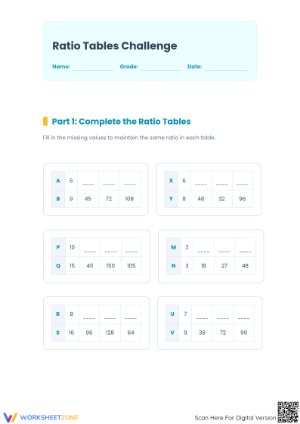
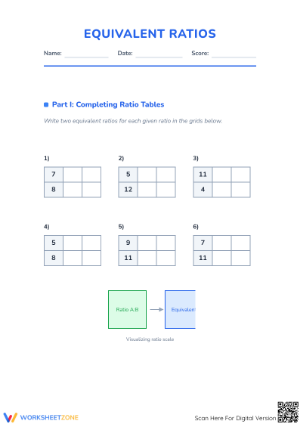
A second common error is scaling only one term. A student who knows the scale factor is 3 will correctly change 5 to 15 in the first position, then leave the second term unchanged. This happens most often when the problem presents the ratio horizontally and the student works one number at a time rather than treating the pair as a unit. Ratio table formats reduce this error because the column structure keeps both quantities visible simultaneously.
A third pattern appears in word problems: students strip out the context, solve numerically, and arrive at a correct number that answers the wrong question. Asking students to underline what each quantity represents before they compute catches this before it becomes a habit. A sorting move also helps — grouping worksheet items by the type of error they reveal (additive thinking in one set, single-term scaling in another, context confusion in a third) gives clearer diagnostic data than a randomly mixed set, because the pattern of mistakes points directly to the reteaching that's needed.
Building These Worksheets Into Your Unit Flow
A four-day instructional sequence works well here. Day one: use the ratio table worksheet during whole-group instruction — model one row together, students complete the next two with a partner, then finish the remaining rows independently. That gradual release — model, partner practice, independent — happens inside a single class period. Day two shifts to missing-value problems worked independently, which gives the teacher time to circulate and note who is still writing additive steps in the margin. Day three is a good moment for small-group work with the double number line worksheet, particularly for students who struggled on day two. Day four brings in word problems as an informal check: students complete the worksheet alone, compare answers with a partner, then the class discusses two or three problems together before the period ends.
The shorter worksheets — six to eight items each — work well in the last eight minutes before a transition or as a Monday warm-up after a weekend away from math. Explanation-prompt worksheets are better reserved for core instruction time, not the final minutes of a period, because they require students to slow down and write, which goes poorly when everyone knows the bell is close.
Used this way, the equivalent ratios printable worksheets for 6th grade serve different instructional purposes across a single unit rather than functioning as one repeated format — which keeps students from going through the motions and gives teachers more useful information about where understanding is actually solid.
Standard Alignment
These worksheets align to CCSS 6.RP.A.3, which asks students to use ratio and rate reasoning to solve real-world and mathematical problems — including working with tables of equivalent ratios, tape diagrams, double number lines, and equations. Within the RP cluster, equivalent ratio work appears before unit rates and percent, and the conceptual foundation here — that both quantities in a ratio must scale by the same factor — carries directly into those later standards. The early items in this set map to 6.RP.A.3a, which specifically names ratio tables and missing-value tasks, while the word problem worksheet supports the applied reasoning described across 6.RP.A.3b and 6.RP.A.3c. Teachers using this set at the start of a ratio unit will find it also lays groundwork for the proportional relationship work that extends into 7th grade.
Adjusting the Worksheets for a Range of Readiness Levels
For students who need additional support, start with ratio pairs that scale by 2 or 3 and provide the ratio table with the first row already completed. Having students write the multiplier in a small box beside each row — "× 3" written between the input and output columns — gives them a physical record of the operation and keeps it visible while they work. Double number line worksheets with smaller intervals reduce cognitive demand and let students focus on the relationship rather than the arithmetic.
For students ready to go further, the challenge move is asking them to find more than one equivalent ratio for a given pair, then explain what all the equivalent ratios have in common. Error-analysis tasks work well as extensions too: give students two worked examples, one using additive reasoning and one using multiplicative, and ask them to identify the incorrect one and write a sentence explaining what went wrong. That task is harder than it appears — it requires students to articulate the rule, not just apply it.
For mixed-readiness classes, one practical option is to print the base worksheet for everyone, then cut short extension strips that clip to the bottom for students who finish early. That keeps the class working on the same concept without requiring a separate copy job for every tier.
Frequently Asked Questions
Are these worksheets better suited for in-class practice or homework?
Both work, but with some planning. The ratio table and missing-value worksheets travel home well — the format is clear enough that students can work through them without a teacher present. Explanation-prompt worksheets are better kept in class where responses can be discussed afterward. Sending a worksheet home that asks students to justify their reasoning, with no chance to revisit those justifications, misses most of the point of asking them to write.
Can individual worksheets be used without running through the full set?
Each worksheet stands alone and can be pulled out based on where a class is in the unit. Teachers who need only ratio table practice can use that worksheet without the others. The set is organized so each worksheet focuses on one format — table, missing-value pair, double number line, or word problem — which makes it easy to assign based on what a class or small group actually needs at a given moment.
What's the difference between the visual model worksheets and the standard problem worksheets?
The visual model worksheets use double number lines and tape diagrams to represent the relationship between two quantities before any numbers appear in ratio notation. These work well early in a unit or for students who are still building the concept. The standard problem worksheets present ratios numerically and ask students to scale, complete, or compare — they assume some prior familiarity with what a ratio represents. Both types of equivalent ratios printable worksheets for 6th grade address 6.RP.A.3, but they put different demands on students and serve different moments in instruction.
Do the answer keys show work, or just final answers?
The answer keys show the scale factor used for each problem alongside the final answer. For ratio table items, the key shows each completed row. That makes it easier to pinpoint exactly where a student's thinking diverged from correct reasoning, rather than simply marking an answer right or wrong.













 Interactive Worksheet Maker
 Quiz Maker
 Word Search Maker
 Crossword Puzzle Maker
 Word Scramble Generator
 Sentence Scramble Generator
 Handwriting Worksheet Generator
 Name Tracing Generator
 Fill In The Blank Generator