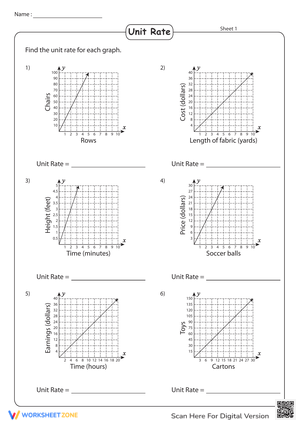
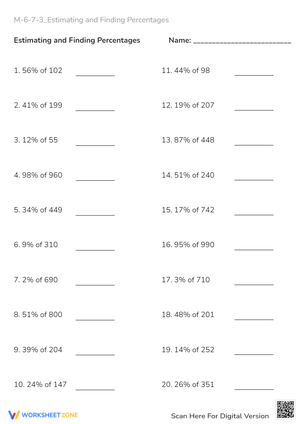
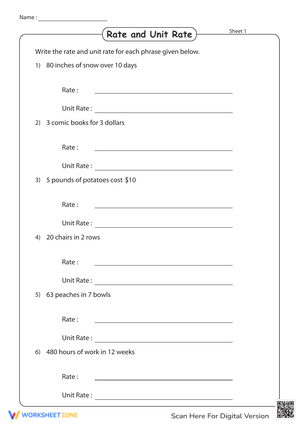
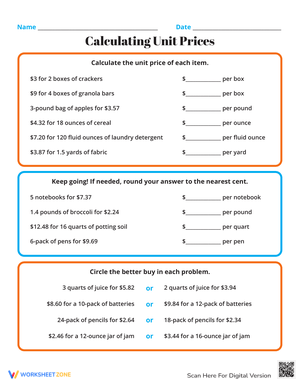
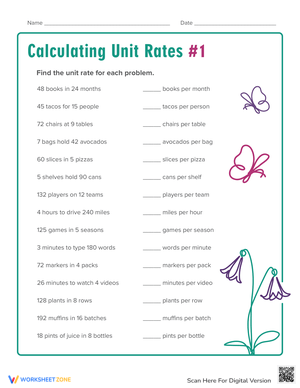
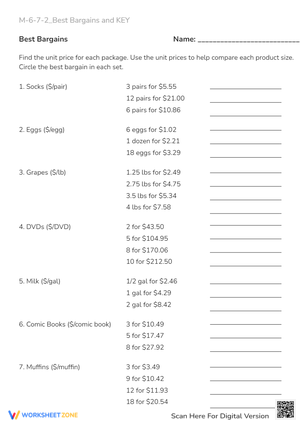
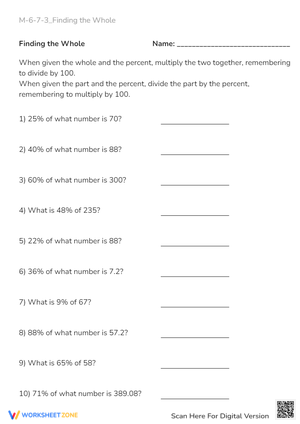
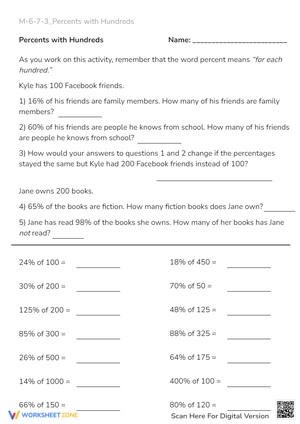
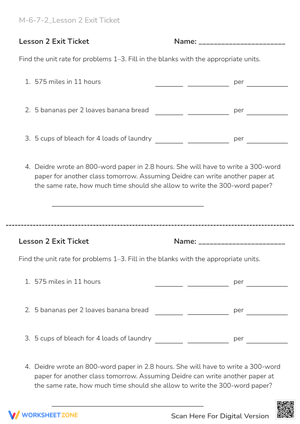
These 6th grade unit rates worksheets give teachers a targeted set of resources for pushing ratio reasoning beyond bare computation — each worksheet addresses finding, labeling, comparing, and interpreting unit rates across problem formats that appear on unit assessments and state tests. The set spans whole-number, decimal, and fraction rates in real-world contexts students can actually reason about.
The Specific Skills Targeted
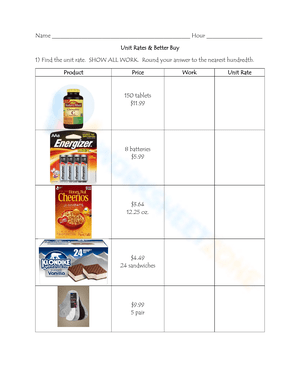
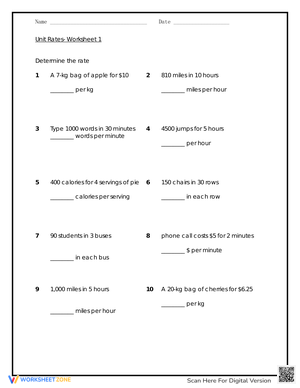
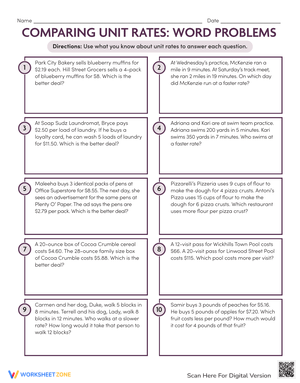
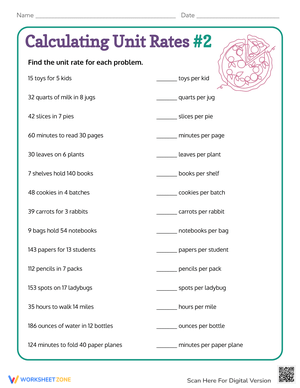
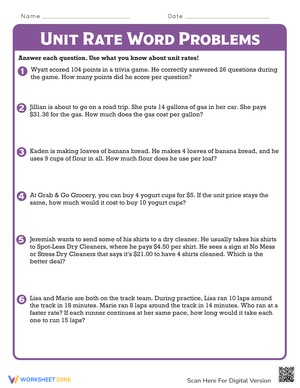
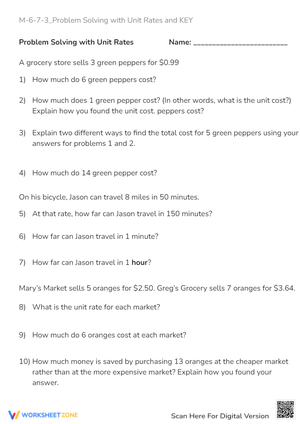
The worksheets move students through a sequence that starts at the definition and works outward. They begin by identifying whether a given rate is already a unit rate, then practice converting rates by dividing to a denominator of 1. From there, problems expand into comparison tasks — better-buy questions, speed comparisons, pay rate analysis — and finally into multi-step items where students use a unit rate they found in part one to answer a new question in part two.
- Converting a ratio table to a unit rate by finding the value when quantity equals 1
- Reading a word problem and deciding which quantity should become the denominator of 1
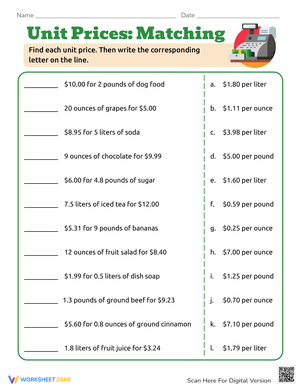
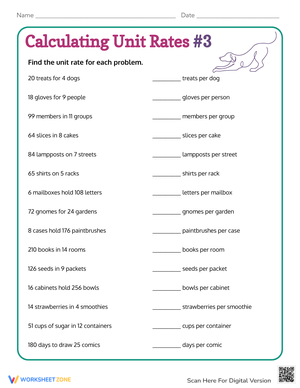
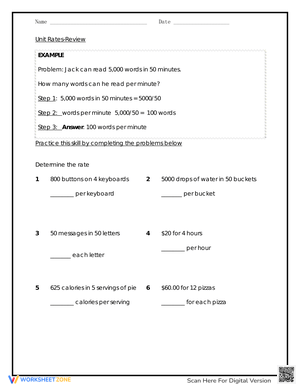
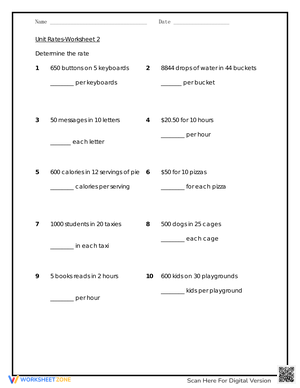
- Writing unit rates with correct labels — dollars per ounce, miles per hour, words per minute
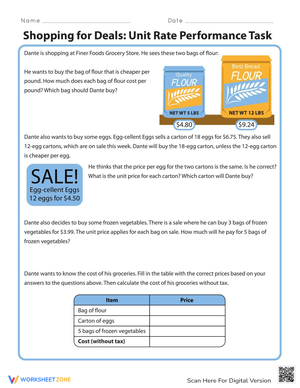
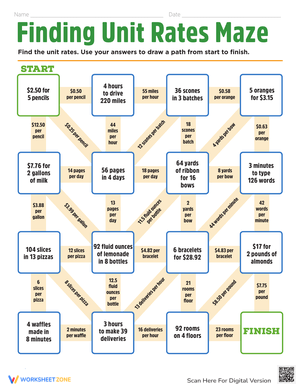
- Comparing two unit rates to choose the better buy or faster speed
- Explaining what a unit rate means within the context of the problem
- Applying a found unit rate to calculate a missing quantity in a follow-up scenario
That last item is where real understanding gets tested. A student who memorized "divide the two numbers" often stalls on the follow-up question. Each worksheet that includes multi-step tasks makes that gap visible before the unit test does.
Unit Rate Errors Worth Knowing Before You Hand These Out
Three errors dominate Grade 6 unit rate work, and they appear reliably enough that anticipating them before the lesson is worth the two minutes it takes. The first is division order. A student presented with "a grocery store charges $3.60 for 12 ounces" sometimes divides 12 by 3.60 and writes "3.33 ounces per dollar" — a technically valid unit rate, but not the one that answers a shopping question. The issue is not the arithmetic. It's that students haven't yet asked themselves which quantity they want one of. Teaching students to write "1 ___" as a placeholder before dividing redirects this almost immediately.
The second error is dropping units. Students write 4 or 4.50 and say "the price" when pressed, rather than "dollars per pound." The label carries the mathematical meaning, and a number without one is nearly useless for checking whether the answer is reasonable. Third is stopping at the rate. A student reads "60 miles in 2 hours," writes 60/2, and considers the problem done — because the expression already looks complete. Short written-response prompts built into each worksheet ("Write your answer as a sentence. What does it mean?") make this error visible without adding significant grading burden.
Getting the Most From These Worksheets Across Your Unit
The 6th grade unit rates worksheets work hardest when teachers place them at multiple points in a lesson sequence rather than holding them for end-of-unit review. A ratio-table worksheet makes an effective five-minute warm-up the morning after initial instruction — students rebuild the idea through retrieval before a new lesson starts, and that retrieval moment is worth more than another ten minutes of same-day practice. A word-problem worksheet fits better mid-unit, after students have the computational routine but before they've practiced choosing which context calls for which operation.
A practical sequencing move: sort worksheets by decision type rather than by surface context. Run all unit-cost problems together, then all speed problems, then all recipe-rate problems. Students begin to notice that the underlying reasoning — find 1, then apply or compare — holds constant across settings. That recognition is what transfers when the same idea appears on a quiz worded differently than the practice problems were.
How to Flex These Worksheets for Different Ability Levels
For students who need additional support, the most effective adjustment is reducing working memory demand without softening the concept. Partly completed ratio tables — where students fill in only the unit-rate row rather than the full table — keep the reasoning intact while removing the bookkeeping load. Sentence frames ("The unit rate is ___ per 1 ___.") prevent the blank-label error before it starts. Whole-number rates before decimal or fraction rates let students stabilize the procedure before number complexity enters. These students should work through one-step unit rate problems before any comparison task appears.
Students who are ready for more do best with open-ended comparison problems involving three or four options ("Which of these grocery packages costs least per ounce?"), error analysis tasks where a fictional student divided in the wrong order, and short written justifications using rate language. Real-data contexts work especially well here: laps logged in PE, books read per month, or words typed per minute all become rate problems that students remember precisely because they generated the numbers themselves.
Standard Alignment
These worksheets address CCSS 6.RP.A.2, which requires students to understand the concept of a unit rate associated with a ratio and use rate language in context, and CCSS 6.RP.A.3b, which asks students to solve unit rate problems including those involving unit pricing and constant speed. In classroom terms, 6.RP.A.2 is the understanding target — students should be able to explain what a unit rate represents — and 6.RP.A.3b is the application target. Teachers often find they need practice materials that address both at once, because students who compute unit rates reliably sometimes cannot explain why the answer matters. The 6th grade unit rates worksheets in this set include labeled-answer prompts and written interpretation items that connect computation directly to meaning.
Unit rates land in Grade 6 because this is the year students transition from whole-number multiplication to multiplicative reasoning with ratios and proportional relationships. The unit rate is the constant multiplier in any proportional situation — recognizing it as such builds the foundation for the proportional reasoning required throughout Grade 7.
Frequently Asked Questions
Are these worksheets better used for in-class practice or homework?
Worksheets built around comparison tasks and written interpretation work best in class, where students can talk through their reasoning before committing to an answer. Computation-focused worksheets — finding and labeling unit rates from tables or short word problems — transfer to homework without much loss, provided students have already seen the concept modeled. Sending home an interpretation prompt before students have discussed units aloud in class tends to produce blank spaces rather than real reasoning.
How much vocabulary instruction do students need before starting?
Students do not need to memorize the distinction between "rate" and "unit rate" before working through these problems. They need to understand that the goal is to find the value when one quantity equals 1, and they need to know that the label matters. The vocabulary consolidates through the problems themselves. Introducing the term after students have worked through a table problem — "What you just found is called a unit rate" — tends to stick better than front-loading definitions before any practice.
What helps when students consistently divide in the wrong order?
Have them write out the question they're answering before they divide. "Cost per ounce" means dollars on top, ounces on the bottom. "Ounces per dollar" reverses that. The moment students write out what "per 1 what?" means in words, the division order becomes less arbitrary. A brief class discussion of one wrong-order example — showing both answers and asking which one actually helps you decide which package to buy — usually resolves the confusion faster than re-explaining the procedure.
Do these worksheets come with answer keys?
Yes. Each worksheet includes a full answer key. For comparison and written-explanation problems, the key includes sample student responses so teachers have a reference for what strong reasoning looks like, not just the numerical answer. On the 6th grade unit rates worksheets that include multi-step tasks, the key shows intermediate steps so teachers can pinpoint exactly where a student's work diverged from the correct path.













 Interactive Worksheet Maker
 Quiz Maker
 Word Search Maker
 Crossword Puzzle Maker
 Word Scramble Generator
 Sentence Scramble Generator
 Handwriting Worksheet Generator
 Name Tracing Generator
 Fill In The Blank Generator