


























Views
Downloads

Equivalent Ratios Worksheet | Grade 6 Math Printable
Paste this activity's link or code into your existing LMS (Google Classroom, Canvas, Teams, Schoology, Moodle, etc.).
Students can open and work on the activity right away, with no student login required.
You'll still be able to track student progress and results from your teacher account.
This comprehensive math worksheet helps students master the fundamental concept of equivalent ratios. By working through a carefully sequenced set of problems, learners will build fluency in scaling ratios up and down, ultimately applying these skills to solve real-world proportional reasoning challenges.
At a Glance
- Grade: 6 · Subject: Math
- Standard:
CCSS.MATH.CONTENT.6.RP.A.3— Find missing values in equivalent ratios and solve real-world problems.- Skill Focus: Equivalent Ratios
- Format: 3 pages · 25 problems · Answer key included · PDF
- Best For: Independent practice and homework
- Time: 25–35 minutes
Inside this resource, educators will find a three-page activity featuring 25 distinct tasks. The layout is clean and organized, minimizing visual distractions so students can focus entirely on the math. The problem types range from simple fill-in-the-blank equations to multi-step word problems involving recipes and map scales. A complete, separate answer key is provided to make grading fast and accurate.
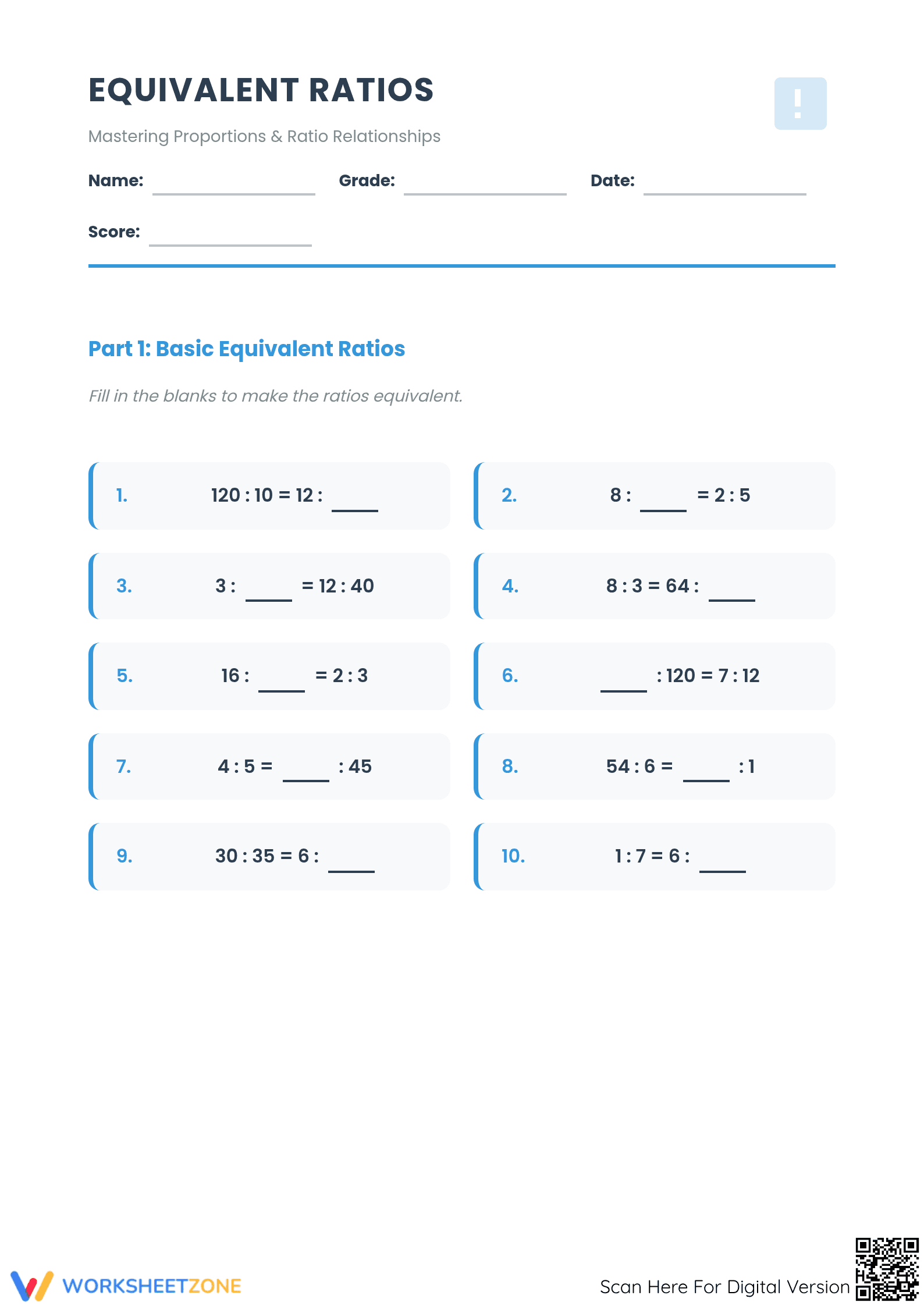
- Guided practice: The first 10 problems focus on basic equivalent ratios, allowing students to identify simple multiplicative relationships.
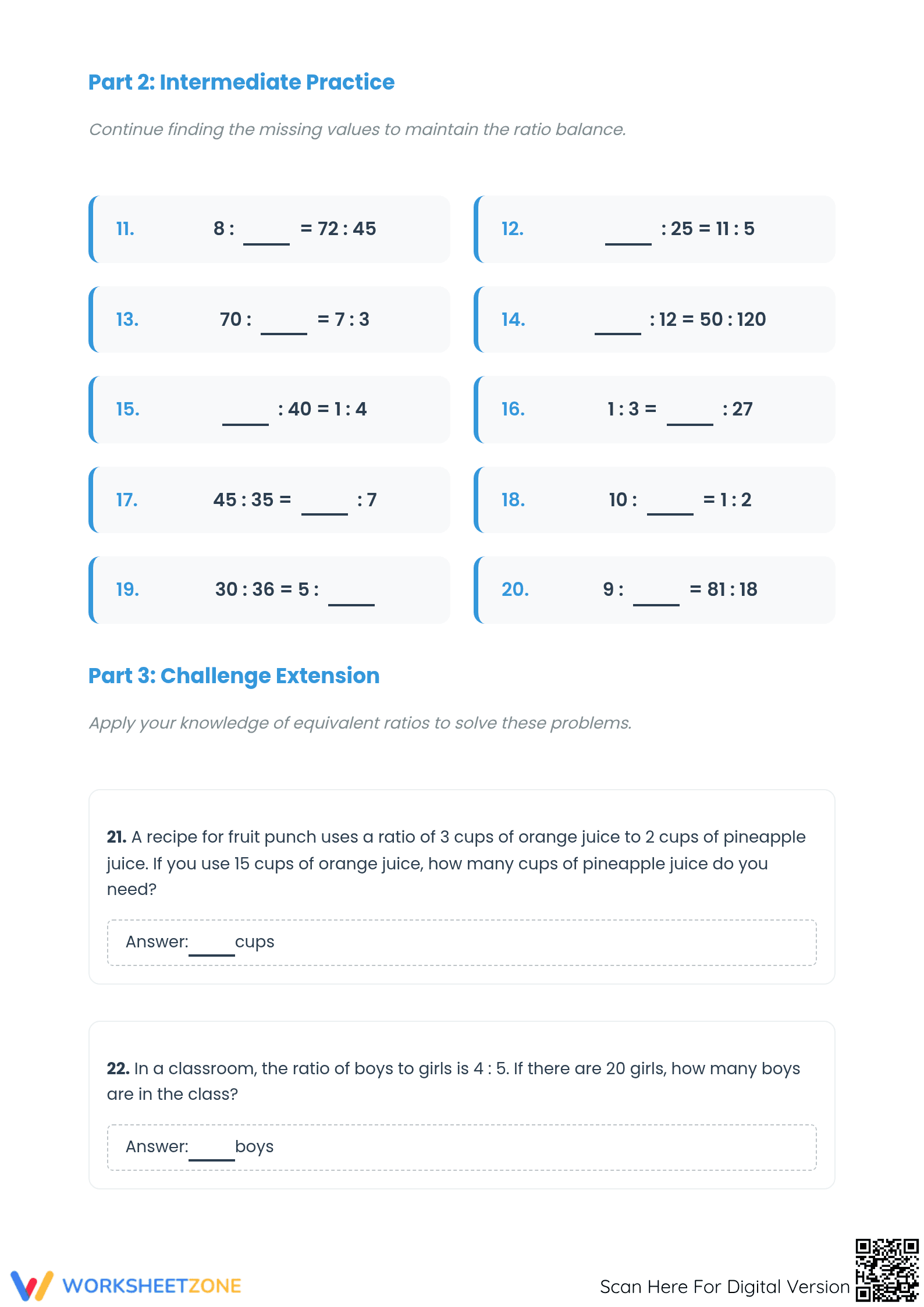
- Supported practice: The next 10 intermediate problems introduce larger numbers and reversed formats to build deeper numerical fluency.
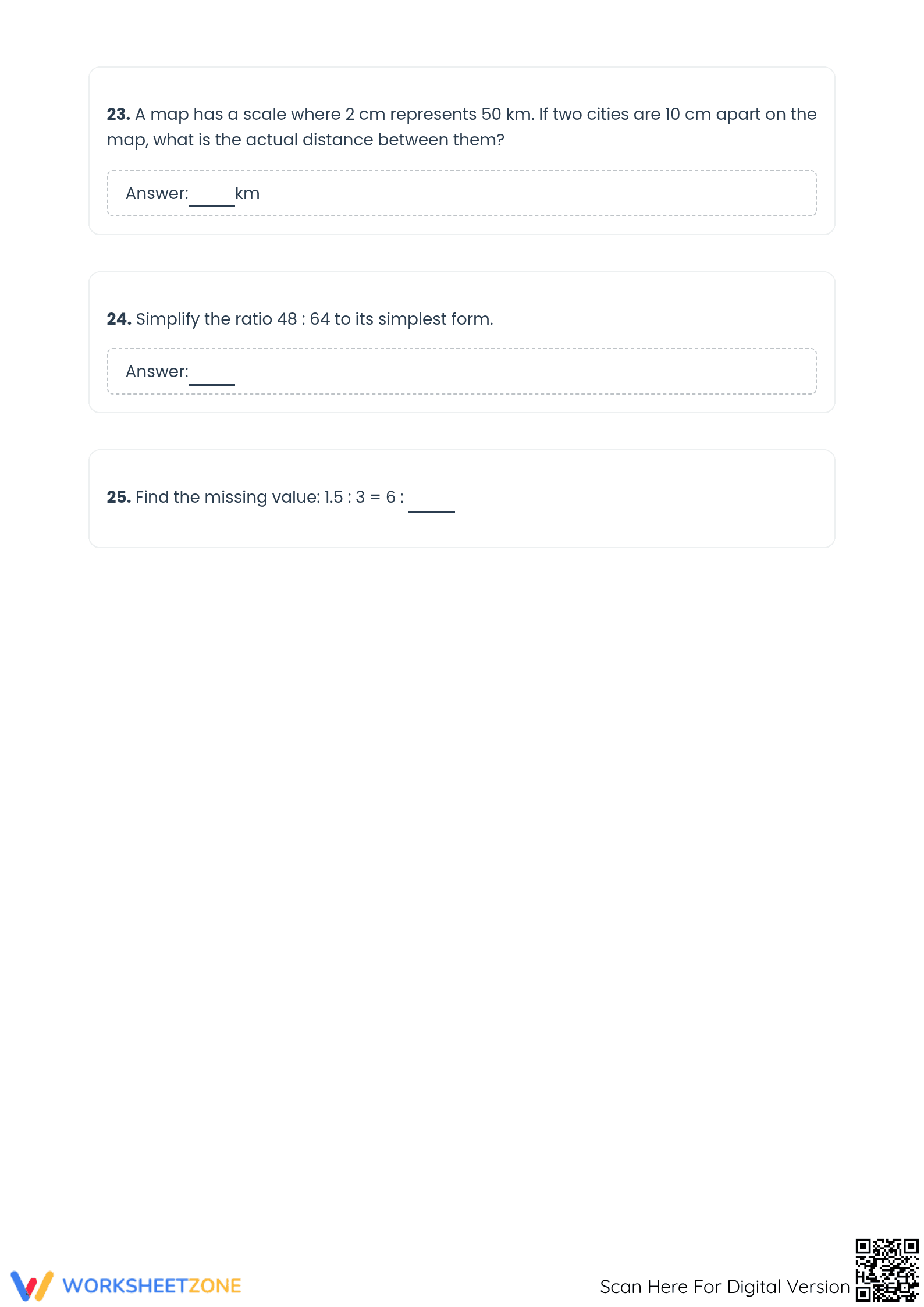
- Independent practice: The final 5 challenge extension tasks require students to apply their knowledge to word problems, map scales, and decimals.
This gradual-release structure ensures students build confidence before tackling complex applications, following a proven I Do, We Do, You Do methodology.
This resource is strictly aligned to CCSS.MATH.CONTENT.6.RP.A.3: Use ratio and rate reasoning to solve real-world and mathematical problems. It specifically targets the ability to find missing values in equivalent ratio pairs and apply proportional reasoning to everyday scenarios. Both standard codes can be copied directly into lesson plans, IEP goals, or district curriculum mapping tools.
Deploy this worksheet immediately following direct instruction on ratio relationships. It serves as an excellent independent practice assignment while the teacher pulls small groups for targeted intervention. As a formative assessment tip, monitor how students approach the challenge word problems on the final page; this will reveal whether they have truly grasped the multiplicative nature of ratios or are simply pattern-matching. Most students will complete the full sequence in 25 to 35 minutes.
This material is designed primarily for sixth-grade math students, though it serves as an excellent review for seventh graders preparing for advanced proportions. For students needing extra support, teachers can assign only the first page to isolate the foundational skill. Pair this worksheet with a visual anchor chart demonstrating how to use a giant fraction to multiply or divide both sides of a ratio.
Mastering proportional reasoning is a critical gateway to algebraic thinking. This resource aligns with CCSS.MATH.CONTENT.6.RP.A.3, focusing on the ability to find missing values in equivalent ratios and solve real-world problems. According to EdReports 2024, instructional materials that provide a coherent progression from concrete numerical relationships to abstract word problems significantly improve long-term retention of mathematical concepts. By structuring practice through a gradual release of responsibility, students are less likely to experience cognitive overload when encountering complex applications like map scales or recipe conversions. This structured approach ensures that foundational gaps are addressed early, allowing learners to build the robust mathematical fluency required for higher-level STEM coursework. Consistent, targeted practice with equivalent ratios remains one of the most effective strategies for developing strong proportional reasoning skills in middle school math classrooms.


