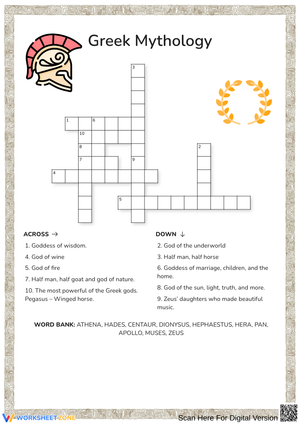
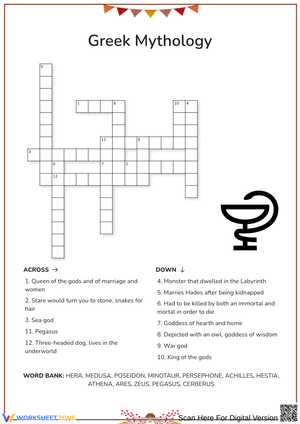
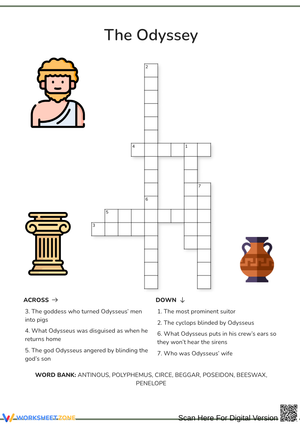
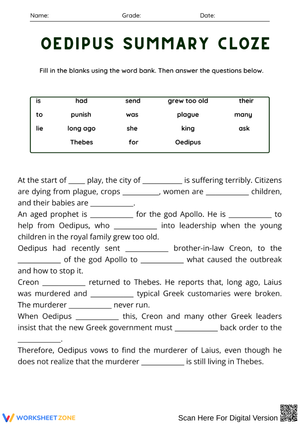
These myths worksheets for 6th grade give ELA teachers a set of standalone, printable resources built around the specific genre and reading skills middle schoolers are expected to handle during literary units on traditional narrative. The worksheets pair short myth passages — drawn from Greek, Roman, Norse, and world traditions — with text-dependent questions, vocabulary tasks, and written response prompts that move well past retelling and into genuine analysis.
The Skills Each Worksheet Targets
Each worksheet focuses on a cluster of reading and language skills that connect directly to 6th grade literary standards. The work is intentional rather than broad — students practice something specific on each worksheet rather than responding to generic questions that could attach to any story type.
- Genre identification: Students mark features that signal a text is a myth — divine characters, supernatural causation, an explanatory purpose tied to nature or culture, and the absence of realistic grounding that separates myths from legends.
- Text-dependent comprehension: Students answer questions about plot, conflict, setting function, and key details, returning to the passage to quote or paraphrase evidence rather than rely on memory alone.
- Theme analysis: Students articulate what a myth suggests about pride, hubris, justice, or human limits — and express that idea as a complete statement, not a single word.
- Character motivation and consequence: Students explain why a character makes a choice and trace the outcome, a skill that transfers directly to realistic fiction, historical fiction, and drama units later in the year.
- Vocabulary in context: Students encounter terms like deity, prophecy, mortal, and hubris inside authentic passage contexts and determine meaning without reaching for a definition list.
- Evidence-based written response: Students produce short written answers where claim, supporting evidence, and explanation are all present — the same structure 6th grade writing standards require.
Mistakes Students Make That These Worksheets Help Surface
The most common error in myth study is genre confusion. Students collapse myths, fables, legends, and folktales into a single category because all four feel old and involve unusual events. In student writing, this surfaces as sentences like "This is a myth because the animals talk and teach a lesson" — which is fable logic applied to the wrong genre. A compare-and-contrast worksheet with explicit genre categories forces students to sort those distinctions carefully instead of overgeneralizing. Without that concrete sorting task, the confusion tends to persist into essay writing, where students describe Icarus as "a fable about flying too close to the sun."
Theme is the second consistent trouble spot. Left to their own devices, most 6th graders write theme as a single noun: "the theme is greed" or "the theme is pride." That shortcut avoids the analytical work, which is explaining what a myth is actually saying about pride — typically something closer to "pride that ignores clear warnings leads to catastrophic and irreversible loss." Worksheets that require a complete thematic statement — not a topic word — push students to commit to a real interpretive claim rather than a placeholder.
A third pattern worth watching for: students cite text evidence but skip the explanation step entirely. They paste in a quotation and move on, as if the quote speaks for itself. Constructed response tasks on these worksheets require students to write what the evidence shows, not just where it appears. That one structural demand makes a measurable difference in written response quality across a unit.
How to Build These Worksheets Into Your Lesson Sequence
The most reliable classroom sequence is short myth passage, two annotation tasks, then independent worksheet questions. For the annotation step, students circle any word or detail that marks the text as a myth and underline the moment where the central conflict becomes clear. This takes about five minutes and activates genre awareness before students encounter the formal questions — so the worksheet doesn't feel disconnected from the reading. Students already have marks on the text when they begin responding, which tends to anchor their answers to the passage rather than to general impressions.
For center rotations, the myths worksheets for 6th grade format holds up well because the directions are fixed on each worksheet and require no teacher presence once the routine is established. One group handles vocabulary tasks, another works through comprehension questions, and a third writes a short response analyzing the myth's theme. Groups rotate, and the teacher conferences with one group at a time. The predictability of the printed format is what makes this work during a reading block where multiple needs are happening simultaneously.
These worksheets also function as reliable sub-plan material — worth stating directly. Because the passage and instructions are fully self-contained on each worksheet, a coverage teacher can run the lesson without any background in myth study or literary genre. That is a real operational advantage in a middle school building where substitute teachers are rarely content specialists.
Standard Alignment
RL.6.1 — citing textual evidence to support analysis — is present on every worksheet that asks students to back a claim with lines from the passage. RL.6.2 governs the theme work; 6th grade specifically requires students to determine theme and trace its development across the text, which is a step up from the more foundational theme identification expected in 5th grade. RL.6.3 covers character analysis, including how characters respond to challenges — the direct standard behind motivation and consequence tasks. Genre comparison worksheets address RL.6.9, which asks students to compare texts in different forms or from different authors. Vocabulary tasks connect to L.6.4, particularly determining word meaning from context. In most district planning documents, these standards cluster into a traditional literature or narrative unit placed in the first or second quarter of the school year.
Differentiating the Set Across Readiness Levels
For students reading below grade level, the most effective adjustment is pairing a shorter passage with a reduced question set — three or four items rather than six or seven — while keeping the same analytical focus. Sentence frames for evidence-based responses provide a useful entry point: a prompt like In the myth, the author shows this when... gives students the structural starting point without removing the thinking. The adjustment is in volume and entry-point support, not in intellectual expectation. These students are still analyzing genre features and working with text evidence.
Multilingual learners benefit from brief vocabulary work before the worksheet begins. Spending four minutes on three or four words — deity, mortal, prophecy, quest — with a visual or gesture often changes the entire experience on the worksheet. These are not words students encounter in everyday conversational English, so the reading load drops noticeably once they are familiar going in.
For students who finish early and are ready for a harder challenge, the written response section is the right place to extend the work. Ask them to compare two myths on a shared theme rather than analyze one in isolation, or to evaluate a character's decision with reference to a specific cultural value embedded in the myth. The myths worksheets for 6th grade set includes optional extension prompts on several worksheets for exactly this situation — students who are genuinely ready for deeper analysis will find the standard questions too thin without something additional to move into.
Frequently Asked Questions
How are myths different from legends and folktales, and how do the worksheets address the distinction?
Myths typically involve divine figures, supernatural events, and explanations for natural phenomena or cultural origins — they answer questions like why the seasons change or how fire came to humans. Legends connect more closely to historical or heroic figures and carry an implied claim of truth. Folktales center on community storytelling patterns without divine causation. The compare-genre worksheets in the set ask students to sort those distinctions across a structured chart, which is more effective than having students memorize definitions in isolation. The visual format of the chart makes the differences harder to blur.
Can these worksheets work for independent homework assignments?
Yes, and they hold up better for homework than many printables because the passage is included on each worksheet — students are not completing comprehension questions without the text in front of them. The main thing to know is that written response items work best for homework once students have practiced the annotation-then-respond sequence in class a few times. Students who have done that routine several times in school can usually replicate it at home without needing prompting.
How long are the myth passages?
Passages range from approximately 200 to 400 words — long enough to support meaningful comprehension and vocabulary questions, short enough to complete within a single class period alongside the accompanying tasks. The myths worksheets for 6th grade set does not include novel-length excerpts; the purpose is focused analytical practice on a contained text, not extended independent reading.
Do the worksheets include answer keys?
Each worksheet comes with a teacher answer key that covers factual and genre identification questions and provides model responses for short written answers. For open-ended theme and character analysis questions, the key offers sample acceptable responses with a note on what analytical elements a strong answer should include — which is more useful in practice than a single prescribed answer, since these questions genuinely allow for multiple well-supported interpretations.












 Interactive Worksheet Maker
 Quiz Maker
 Word Search Maker
 Crossword Puzzle Maker
 Word Scramble Generator
 Sentence Scramble Generator
 Handwriting Worksheet Generator
 Name Tracing Generator
 Fill In The Blank Generator