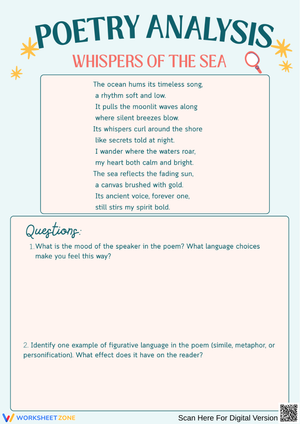
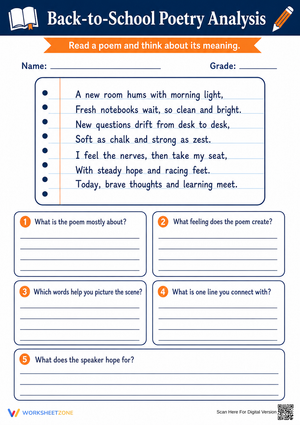
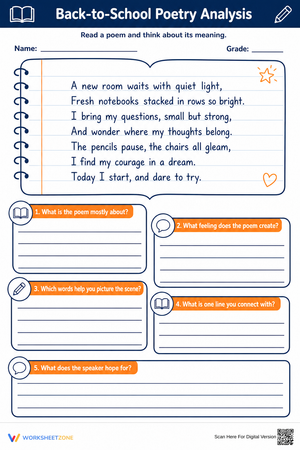
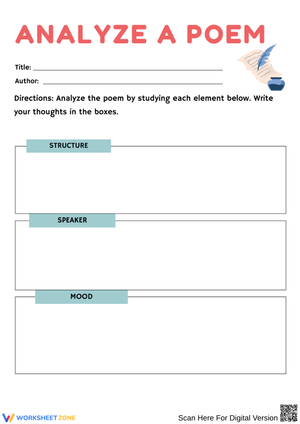
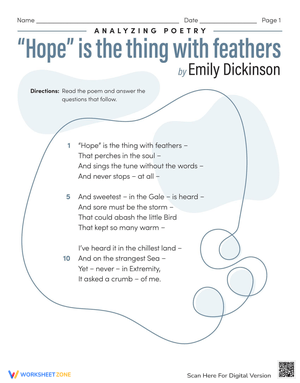
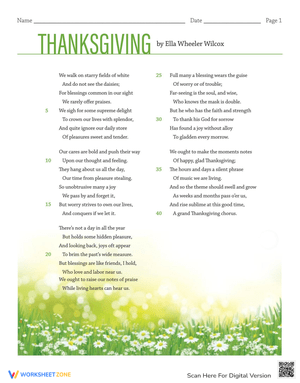
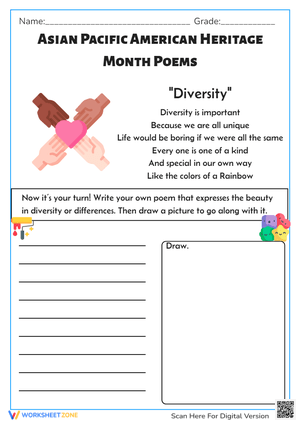
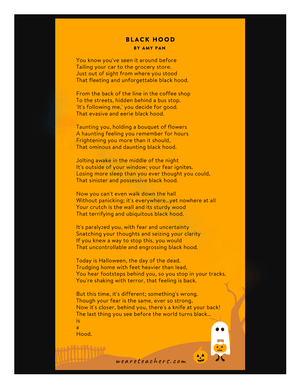
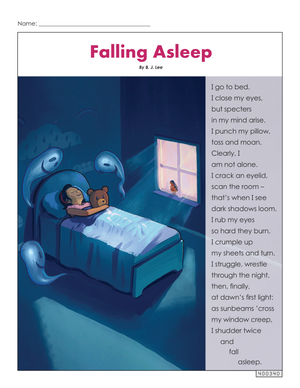
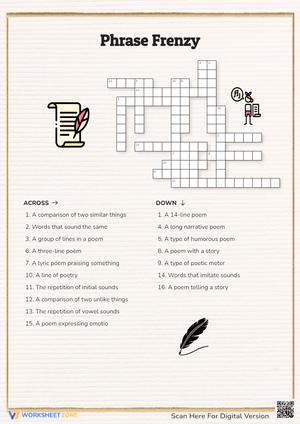
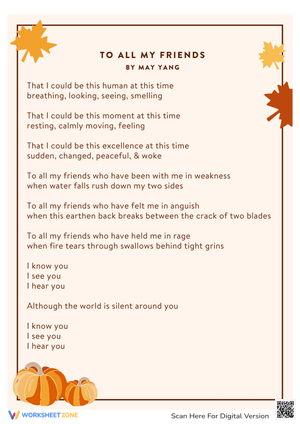
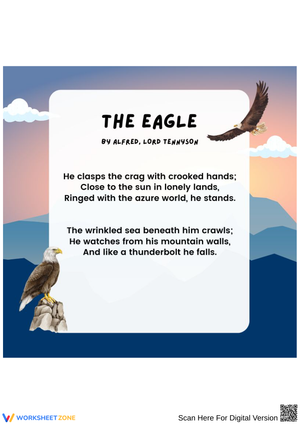
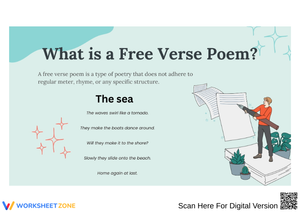
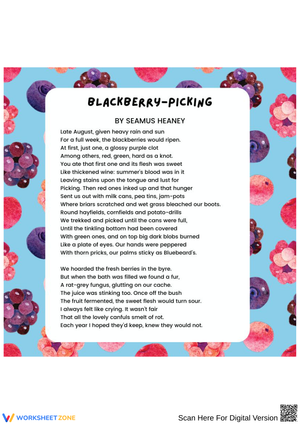
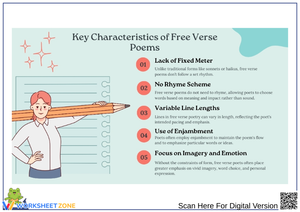
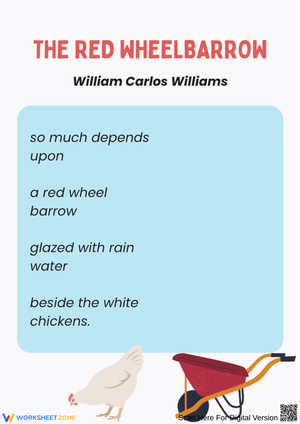
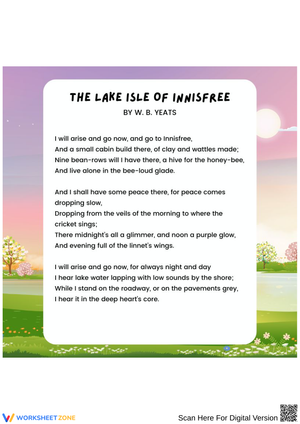
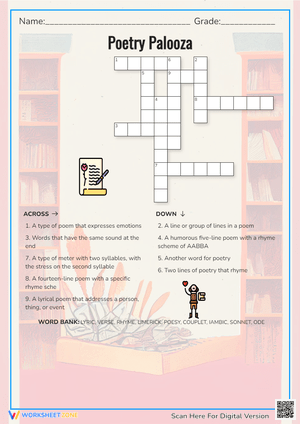
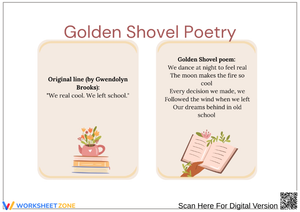
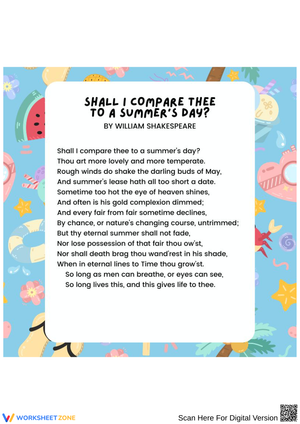
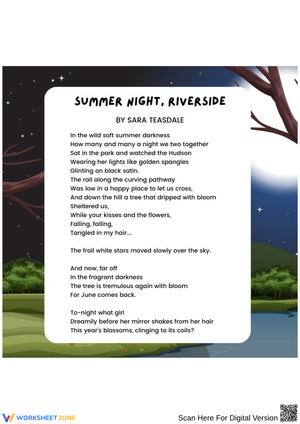
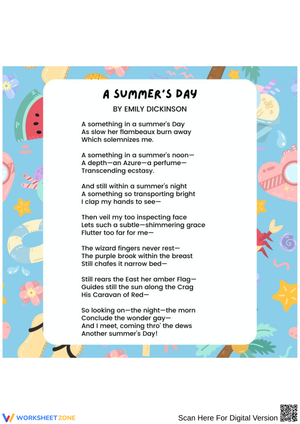
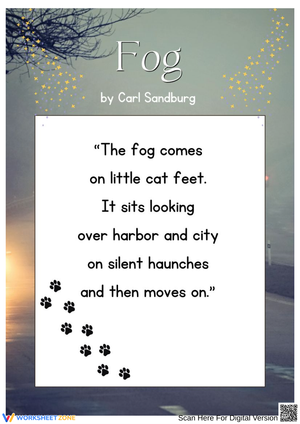
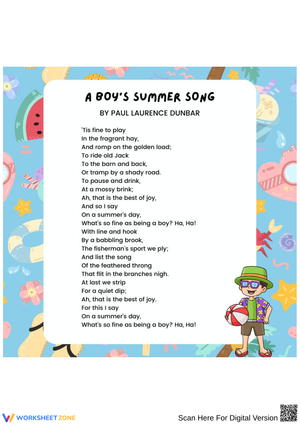
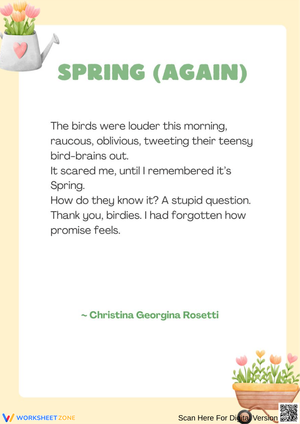
These poems printable worksheets for 6th grade give teachers a direct path from the surface-level poetry reading of elementary school to the literary analysis expected in middle school ELA. Each worksheet pairs a short poem with annotation space, targeted questions, and at least one written response prompt — everything needed for a structured close reading block without additional prep. The set works across whole-group instruction, independent practice, homework, and sub plans.
The Analytical Skills These Worksheets Target
Sixth grade is when poetry instruction shifts from recognition to interpretation. Students who spent years naming rhyme schemes and circling similes now need to explain what those devices actually do — how a metaphor shifts emotional weight, why a speaker's tone changes between stanzas, what a repeated phrase signals about theme. The question sequence in each worksheet reinforces this shift: literal comprehension first, craft-level observation second, interpretation last.
- Theme: stating the central message and backing it with two or three specific lines from the poem
- Tone vs. mood: distinguishing the speaker's attitude from the emotional atmosphere created for the reader — a reliable source of confusion at this grade
- Speaker: identifying who is speaking and considering how that perspective shapes what the poem emphasizes or withholds
- Figurative language: analyzing the effect of simile, metaphor, personification, and imagery — not just labeling them
- Structure: treating stanza breaks, line length variation, and repetition as deliberate choices rather than accidents of form
- Vocabulary in context: using surrounding lines to infer meaning before reaching for outside help
- Short written response: producing a 3- to 4-sentence explanation anchored in direct textual evidence
When these elements appear together in a single worksheet, teachers see quickly whether a student understands the poem at both a literal and analytical level. That is what makes poems printable worksheets for 6th grade useful for informal formative assessment as well as practice — the same worksheet generates information at two levels simultaneously.
The Analysis Errors That Show Up Most in 6th Grade Poetry Work
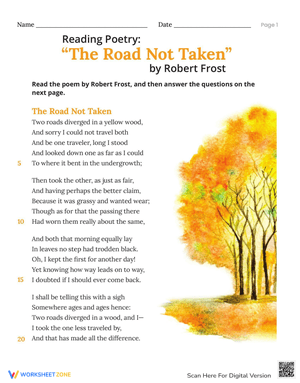
The most persistent error is what might be called the "label and leave" move: a student writes "the poet uses a metaphor" and considers the task finished. When a student annotates "the road not taken is a metaphor for a life choice" without explaining what that comparison does emotionally for the reader, they have hit the literal floor but not climbed to analysis. Questions built around "how does this comparison affect the reader's understanding?" push through that stall point. Every worksheet includes at least one question structured this way.
Students also routinely conflate the speaker with the poet. In a poem written from the perspective of a grieving child, most 6th graders write "the author is sad" rather than "the speaker expresses grief." That collapse matters analytically — if the speaker is always the author, students never have to consider how point of view shapes meaning. Placing "who is the speaker?" as an early prompt, before any figurative language or theme questions, retrains this default without requiring a separate mini-lesson. The third consistent error is tone-mood confusion. Students often read mood correctly ("it feels lonely") but cannot articulate tone ("the speaker is resigned, not angry"). Asking students to name a tone word and then find the specific line that most produces it keeps identification anchored in the text rather than in a general impression.
Where These Worksheets Fit Best in a Weekly Lesson Plan
A 10-to-15 minute weekly poem works far better than saving all poetry practice for a dedicated unit. Spaced practice across the year builds the habit of reading slowly and asking craft-level questions — habits that transfer directly to fiction and informational text analysis. By February, students who have annotated 15 to 20 short poems write stronger first-draft responses and move through the annotation process faster than students who encountered poetry only during a November unit. That's spaced retrieval producing a measurable classroom result.
For whole-group instruction, read the poem aloud twice before distributing each worksheet — once for gist, once for sound. Students who hear the rhythm before they annotate mark more purposefully. Then model the first two questions together, establishing consistent annotation marks: underline figurative language, star the line most connected to theme, box unfamiliar words. Repeating those same marks on every worksheet reduces the cognitive load of the tracking system itself, so students direct their attention toward the analysis. Each worksheet is also self-contained enough to function as a sub plan — leave an answer key and a note to collect completed work, and no additional materials are needed.
One honest tradeoff: students who freeze on open-ended interpretation sometimes spend their entire time with the poem and leave the written response blank. Attaching a sentence starter — "The speaker's tone is ___ because the line '___' shows ___" — solves this for most students without reducing what the task actually demands.
Standard Alignment
These worksheets address Reading Literature standards central to 6th grade ELA, particularly RL.6.1 (citing textual evidence to support analysis), RL.6.4 (determining the meaning of words and phrases including figurative and connotative meanings; analyzing word choice for meaning and tone), and RL.6.5 (analyzing how a particular stanza fits into the overall structure of a text and contributes to the development of theme). RL.6.4 and RL.6.5 appear in nearly every 6th grade literary analysis task, and poetry is among the most efficient text types for teaching both — a single stanza can carry a tone shift, a figurative comparison, and a vocabulary challenge simultaneously. That density is part of what makes poems printable worksheets for 6th grade one of the faster routes to meaningful, standards-aligned reading practice.
Making Each Worksheet Work for Every Reader in the Room
The same poem can carry different levels of demand depending on the task attached to it. For students who need more support, pre-teach two or three key vocabulary words before distributing each worksheet, reduce the number of written questions to one focused response, and offer a sentence starter. For multilingual learners, build in partner talk before writing — discussing what a metaphor pictures concretely often gets students to the interpretive step that a written prompt alone cannot reach.
On-level students work through the annotation, selected-response questions, and short-answer prompts independently, then compare with a partner before revising their written response. Advanced readers benefit from comparison tasks: offer a second short poem on a related theme and ask them to contrast how each speaker develops that theme differently, or ask them to analyze how a structural choice — an isolated final couplet, a sudden enjambment — shifts the poem's emotional register. These additions do not require a separate worksheet; a paragraph prompt written on the board is enough. Because the core resource stays constant across all three groups, differentiation stays manageable.
Frequently Asked Questions
What analytical skills do these poetry worksheets cover?
Each worksheet addresses theme, tone and mood, speaker, figurative language, structure, vocabulary in context, and evidence-based written response. Together these represent the transition from elementary-level device identification to the literary analysis that middle school ELA requires.
How much class time does one worksheet take?
Most students finish in 15 to 25 minutes depending on poem complexity and the number of written questions. A bell-ringer or morning warm-up format fits within 10 minutes; a full mini-lesson with annotation modeling and partner discussion runs closer to 30.
Are these worksheets appropriate for homework assignments?
They work well for homework after the annotation format and question types have been practiced in class. Sending poems printable worksheets for 6th grade home before that routine is established tends to produce surface-level answers and student frustration — two or three in-class sessions first makes independent work at home consistently more productive.
Can these worksheets function as sub plans?
Yes. Each worksheet includes the poem, full directions, and all questions, so a substitute needs nothing extra. Leave an answer key and a note to collect completed work, and the lesson runs reliably without teacher presence.












 Interactive Worksheet Maker
 Quiz Maker
 Word Search Maker
 Crossword Puzzle Maker
 Word Scramble Generator
 Sentence Scramble Generator
 Handwriting Worksheet Generator
 Name Tracing Generator
 Fill In The Blank Generator