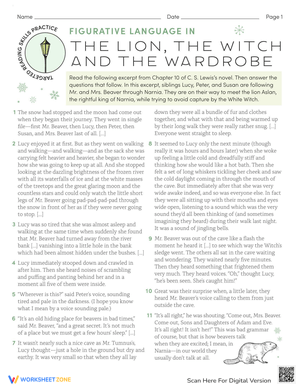
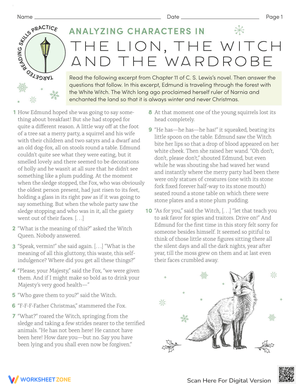
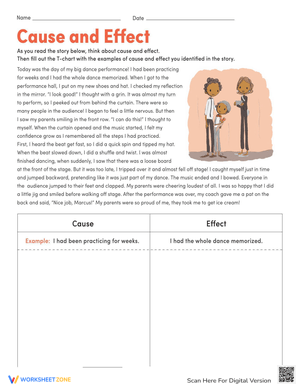
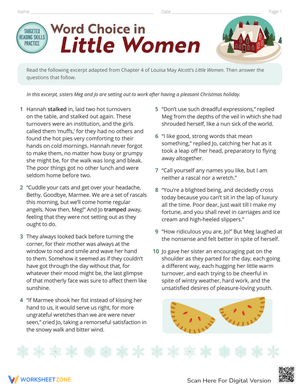
These fiction worksheets for 6th grade give teachers a print-ready set of literary analysis resources that go beyond basic comprehension — each worksheet asks students to return to the passage, locate specific evidence, and explain their reasoning in writing. The skills here are the ones middle school ELA instruction pivots on: theme with textual support, character development across a passage, point of view, and plot structure. Each worksheet stands alone, making the set easy to fit into warm-ups, direct instruction follow-up, or substitute plans.
The Literary Skills Each Worksheet Targets
At sixth grade, the shift in reading instruction is real and consequential. Students are no longer asked only what happened — they're asked how and why the author built the story that way. Each worksheet focuses on a specific skill so teachers can match the practice directly to what was just taught.
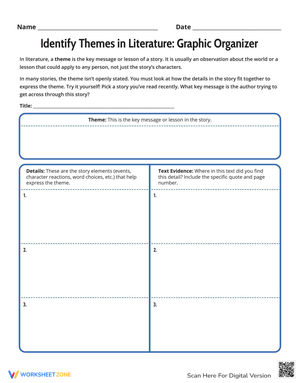
- Theme: Students state the message in a complete sentence, then cite two details from the passage that reveal it. The goal is a supported claim, not a one-word label.
- Character development: Identifying how a character shifts across the passage and naming the specific event or line that marks the change.
- Point of view: Naming the narrative position and explaining what that choice controls — what the narrator can report, and what remains withheld from the reader.
- Plot structure: Tracing conflict, rising action, climax, and resolution using textual references rather than general retelling.
- Textual evidence: Quoting or paraphrasing a specific line rather than gesturing toward a general section of the passage.
- Story elements: Used as grounding work — identifying setting, characters, and conflict before moving into deeper analysis.
The passages draw from realistic fiction, mystery, fantasy, and historical fiction. That range matters because a student who handles theme cleanly in a realistic story about a school friendship may lose the thread entirely when the same thematic structure appears inside a fantasy where the evidence is buried in world-building logic. Genre variety tests whether the skill is portable, not just familiar.
Where 6th Graders Consistently Go Wrong on These Skills
The most persistent theme error at this grade is the one-word answer. Students write "friendship" or "loyalty" instead of a statement of what the story actually argues about friendship or loyalty. It's not a reading failure — it's a definition gap. These worksheets require a full-sentence theme claim every time, and that gap shows up within the first two minutes of independent work.
Point of view produces a different pattern. Students consistently confuse who tells the story with whose story it is. A passage narrated in third person limited — following one character closely, reporting that character's internal thoughts — leads many 6th graders to call it first person because "the narrator knows what she's thinking." Worksheets that require students to name the narrative position precisely and then explain what that position allows the narrator to know surface this confusion faster than class discussion alone.
Textual evidence has its own reliable trap: students quote broadly. They'll cite an entire paragraph when one sentence carries the proof, or pull a quote that mentions the topic without connecting it to the claim. Worksheets that require underlining the exact supporting line and writing one sentence of explanation catch this pattern quickly. It's the kind of error that disappears in oral discussion but shows up immediately when students have to commit to a specific quote in writing.
Fitting These Worksheets Into Your ELA Week
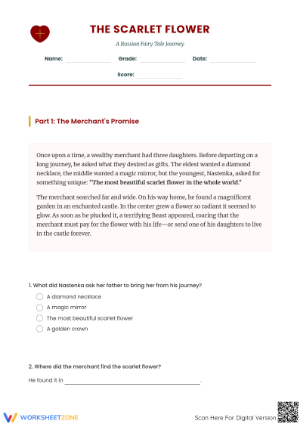
A story-elements worksheet — one with a brief excerpt and four to five focused questions — works well as bell-ringer material after a read-aloud the previous day. Students already hold the story; the worksheet asks them to extract specific lines, which keeps cognitive load on analysis rather than first comprehension. A theme or character development worksheet fits better after direct instruction: model the thinking with a whole-class passage first, then assign the worksheet version for independent practice. The fiction worksheets for 6th grade in this set move from identification to explanation to evidence-based argument within each worksheet, which mirrors the gradual-release progression most 6th grade ELA lessons already follow.
For sub plans and homework, the shorter realistic fiction and mystery worksheets work best. Those passages require the least background knowledge, and the directions stay consistent across worksheets, so students don't lose time decoding what they're being asked to do.
One habit worth building: after independent completion, spend five to eight minutes reviewing a single answer as a class. Students read their chosen evidence aloud, and the group evaluates whether it actually proves the claim. That brief debrief transfers more than completing the worksheet alone does — it makes the standard of evidence visible in a way that carries forward into the next reading task.
Standard Alignment
These worksheets align most directly to the Common Core State Standards for Grade 6 Reading Literature. RL.6.1 (citing textual evidence to support analysis) appears in nearly every worksheet because evidence citation is treated as a baseline expectation throughout the set, not a standalone task. RL.6.2 (determining theme and summarizing) drives the dedicated theme worksheets. RL.6.3 (describing how plot events and character decisions connect) anchors the character development and plot structure tasks. RL.6.6 (explaining how an author develops the point of view of the narrator) is the focus of the point-of-view worksheets.
Teachers in states with modified ELA frameworks will find the skill categories still align — theme analysis, character development, evidence citation, and narrative perspective appear across virtually every state's 6th grade literary reading standards, even when the code designations differ.
Making the Set Work Across Reading Levels
The most effective support move costs almost no prep time: identify two or three vocabulary words in the passage that will stall below-level readers before they even reach the literary task, and spend three minutes on those before students begin. Many students who appear to struggle with character analysis are actually stopped by an unfamiliar word in the third sentence of the passage. Removing that barrier first lets the analytical thinking happen. Sentence frames for written responses — "The character changes when ___ because the text states ___" — preserve the thinking requirement while reducing the blank-page paralysis that stops some writers cold.
On-level students work through the full worksheet independently. The question sequence moves from concrete identification to explanation to evidence-backed argument, so the structure supports pacing without the teacher needing to intervene at each step.
For extension, the most productive move is asking students to compare theme across two worksheets from different genres — arguing that a mystery excerpt and a realistic fiction passage share the same underlying message, with evidence cited from both. That task requires no additional materials. The fiction worksheets for 6th grade already supply the passages; the challenge comes entirely from the cross-text reasoning the student has to produce.
Frequently Asked Questions
What reading levels are the passages written at?
The passages are written for 6th grade text complexity — short narratives with clear conflict and defined characters, but with enough literary layering to require analysis rather than simple retelling. Strong 5th grade readers handle the story-elements and character worksheets well. Teachers using these at 7th grade typically treat them as early-year review or targeted support for students who need additional time with RL.6-level literary analysis before advancing.
How long does each worksheet take to complete?
Most students finish in 20 to 30 minutes. Worksheets with shorter passages and four or five focused questions fit a bell-ringer or homework slot. Worksheets with longer passages and multi-part written responses work better in an extended independent practice block, where students have time to re-read before committing to their evidence in writing.
Can these be used alongside a whole-class novel?
Yes, and that's one of the more effective ways to use them. If the week's instruction focuses on character motivation in a whole-class novel, assigning a character development worksheet with an unrelated short story gives students parallel practice — they apply the same analytical lens to a text without the shared class discussion as a crutch. It's a clean check for whether the skill is internalized or just borrowed from what classmates said about the novel. The fiction worksheets for 6th grade in this set are built for exactly that kind of standalone, skill-targeted use alongside longer anchor texts.












 Interactive Worksheet Maker
 Quiz Maker
 Word Search Maker
 Crossword Puzzle Maker
 Word Scramble Generator
 Sentence Scramble Generator
 Handwriting Worksheet Generator
 Name Tracing Generator
 Fill In The Blank Generator