




























Views
Downloads
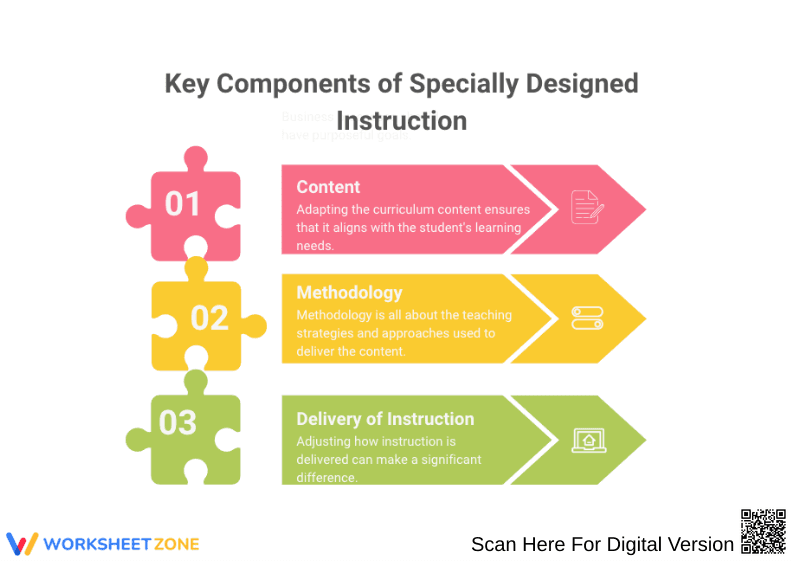

Specially Designed Instruction Printable Guide

Paste this activity's link or code into your existing LMS (Google Classroom, Canvas, Teams, Schoology, Moodle, etc.).
Students can open and work on the activity right away, with no student login required.
You'll still be able to track student progress and results from your teacher account.
This reference guide clarifies the core elements of Specially Designed Instruction (SDI) for special and general education teachers. By breaking down compliance requirements into three actionable areas, educators can effectively adapt teaching to meet the unique learning needs of students with disabilities across Grades 4-8.
At a Glance
- Grade: 4-8 · Subject: Special Education
- Standard:
IDEA.300.39— Adapt content, methodology, or delivery to meet unique student needs- Skill Focus: Specially Designed Instruction
- Format: 1 page · 1 reference guide · No answer key · PDF
- Best For: Teacher reference and IEP planning
- Time: 5–10 minutes
This visual reference sheet features a puzzle-piece infographic outlining the three foundational pillars of SDI: Content, Methodology, and Delivery of Instruction. The single-page layout provides concise definitions for each component, explaining how adapting curriculum, adjusting teaching strategies, and modifying instructional delivery impacts student success. It serves as an immediate visual anchor for IEP teams.
- Print (1 minute): Quickly generate copies of this reference guide for your special education department or co-teachers.
- Distribute (1 minute): Hand out during IEP meetings or co-planning sessions to ensure stakeholders share a common understanding of accommodations.
- Review (3 minutes): Discuss the three components to align on how specific student needs will be addressed.
With zero setup required, this resource takes under five minutes of prep time, making it an ideal addition to professional development binders.
This resource is aligned to IDEA.300.39, which defines special education as adapting, as appropriate to the needs of an eligible child, the content, methodology, or delivery of instruction. It ensures access to the general curriculum so that the child can meet the educational standards within the jurisdiction of the public agency. Both standard codes can be copied directly into lesson plans, IEP goals, or district curriculum mapping tools.
Use this infographic during collaborative planning sessions between special and general educators. Before direct instruction, co-teachers can reference the guide to determine which methodology or delivery adjustments are required for upcoming units. It also serves as an excellent visual aid during IEP meetings to explain supports to parents. As an observation tip, instructional coaches can use the three categories to track accommodations teachers implement. Expected review time is 5 to 10 minutes.
This guide is designed for special education teachers, inclusion teachers, and paraprofessionals working with Grades 4-8. It supports differentiation by providing a clear framework for modifying instruction for diverse learners, including those with specific learning disabilities. It pairs naturally with IEP goal-tracking sheets or direct instruction lesson plan templates to ensure compliance and effective support.
Understanding and implementing IDEA.300.39 is critical for ensuring students with disabilities receive appropriate educational supports in the least restrictive environment. This standard requires educators to adapt content, methodology, or delivery to meet unique student needs, ensuring equitable access to the general education curriculum. According to a recent EdReports 2024 analysis, teachers who utilize clear, structured frameworks for specially designed instruction demonstrate significantly higher fidelity in IEP implementation and foster greater academic growth among diverse learner populations. By categorizing accommodations into distinct, actionable areas, educators can systematically remove barriers to learning and promote independence. This visual reference guide synthesizes these complex legal and pedagogical requirements into an accessible format, empowering collaborative teaching teams to design more inclusive, responsive, and effective learning environments that directly address individual student profiles and promote long-term academic success across all subject areas.


