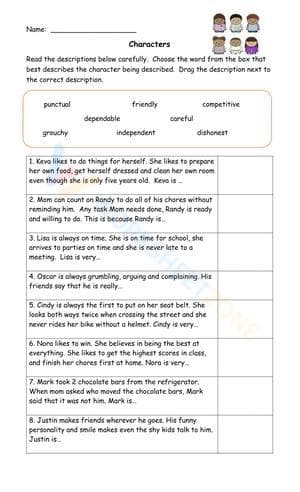
Grade 6 literary others worksheets support the reading skills that do not always fit neatly into one single category but are still essential for strong literary understanding. By sixth grade, students are expected to read more carefully, notice word meaning, analyze details, understand figurative language, and explain how authors build meaning. These worksheets can help learners practice important supporting skills such as context clues, literary vocabulary, inference, author’s word choice, and deeper text interpretation.
Middle school readers often need guidance as texts become longer and more layered. A short story, poem, or excerpt may include unfamiliar words, implied meanings, symbolic details, or lines that require discussion. Worksheets give students a structured way to slow down and think through these challenges. For example, a student might use sentence clues to figure out an unknown word, explain the meaning of a quote, or identify how a phrase affects the mood of a passage.
One especially useful skill for sixth graders is using context to understand meaning. Students cannot stop and look up every unfamiliar word when reading independently, so they need strategies for using surrounding sentences, examples, contrasts, and word parts. Teachers can use context clues worksheets to help students practice this skill in a focused way. When students become more confident with context clues, they read more fluently and rely less on guessing.
Literary learning can also become more engaging when students work with memorable lines from books, poems, or speeches. A meaningful quote can spark discussion about theme, character, tone, or personal response. Teachers who want to bring more thoughtful language into reading lessons can explore literary quotes for classroom reading and use them as short prompts for analysis, journal writing, or class conversation. This helps students see that literature is not only about answering questions, but also about thinking deeply about language and meaning.
Whether used during reading centers, small-group instruction, homework review, tutoring, or literature units, grade 6 literary others worksheets give students extra support with the smaller skills that shape stronger comprehension. They help learners build vocabulary, interpret language, support answers with evidence, and explain their thinking more clearly. With consistent practice, sixth graders can become more confident readers who understand not just what a text says, but how and why it creates meaning.
Frequently Asked Questions
Question 1: What skills are included in grade 6 literary others worksheets?
Grade 6 literary others worksheets may include context clues, literary vocabulary, figurative language, inference, quote analysis, author’s word choice, tone, mood, theme support, and short-response practice. These skills help students understand literature more deeply and prepare for more advanced reading tasks. They are especially useful when students need extra practice with the supporting skills behind strong comprehension and analysis.
Question 2: Why are context clues important for sixth grade reading?
Context clues are important because sixth graders often read texts with more challenging vocabulary. Instead of stopping every time they meet an unfamiliar word, students learn to use surrounding words and sentences to make a reasonable guess. This helps improve reading fluency, comprehension, and independence. Strong context clue skills also support performance in literature, nonfiction reading, vocabulary lessons, and test-style passages.
Question 3: How can teachers use literary others worksheets in class?
Teachers can use these worksheets during reading lessons, literature circles, small-group instruction, bell-ringers, independent practice, or review sessions. A worksheet might introduce a skill before reading, guide students during text analysis, or check understanding after discussion. Teachers can also pair a worksheet with a short story, poem, quote, or excerpt so students can apply the skill directly to meaningful reading material.
Question 4: How do these worksheets help students become stronger literary readers?
These worksheets help students become stronger literary readers by giving them repeated practice with the tools needed for deeper understanding. Students learn to notice important words, interpret clues, explain meanings, and support ideas with evidence. Over time, they become better at reading between the lines, understanding author choices, and discussing literature with more confidence and detail.















 Interactive Worksheet Maker
 Quiz Maker
 Word Search Maker
 Crossword Puzzle Maker
 Word Scramble Generator
 Sentence Scramble Generator
 Handwriting Worksheet Generator
 Name Tracing Generator
 Fill In The Blank Generator