


























Views
Downloads

Classroom Connections Web | Grade 3-6 Essential Worksheet
Paste this activity's link or code into your existing LMS (Google Classroom, Canvas, Teams, Schoology, Moodle, etc.).
Students can open and work on the activity right away, with no student login required.
You'll still be able to track student progress and results from your teacher account.
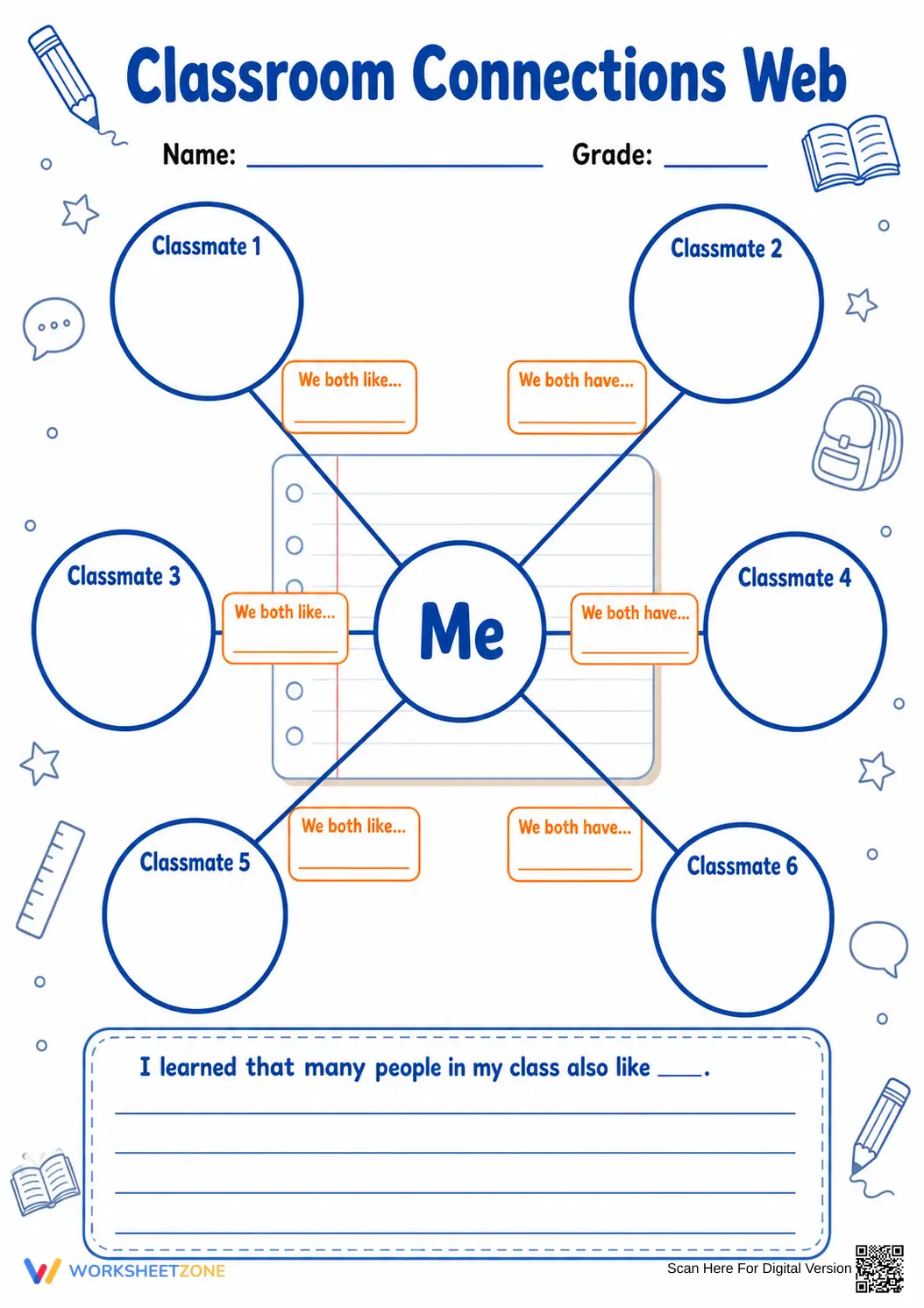
This Grade 3-6 icebreaker worksheet facilitates immediate peer-to-peer engagement by helping students identify shared interests and experiences. By mapping connections to six different classmates, students build social-emotional awareness and foundational communication skills. This activity transforms the first week of school into a structured opportunity for meaningful community building and inclusive classroom culture.
At a Glance
- Grade: 3-6 · Subject: ELA / SEL
- Standard:
CCSS.ELA-LITERACY.SL.3.1— Engage effectively in collaborative discussions with diverse partners to build on ideas- Skill Focus: Social-Emotional Learning & Peer Connection
- Format: 1 page · 7 tasks · No answer key needed · PDF
- Best For: First week icebreaker or community building
- Time: 15–20 minutes
The worksheet features a central "Me" node connected to six outer circles for classmate names. Each connection line includes a specific prompt tag—"We both like..." or "We both have..."—to guide student conversations. A dedicated reflection area at the bottom provides ruled lines for students to synthesize their findings, ensuring the activity moves beyond simple list-making into thoughtful observation and writing practice.
Zero-Prep Workflow
- Print: Generate copies of the single-page PDF for your entire roster in under 30 seconds.
- Distribute: Hand out the sheets and explain the "web" concept, encouraging students to move around the room to find six different peers (2 minutes).
- Review: Conclude the session by having students share one surprising commonality they discovered during their interactions (5 minutes).
Total teacher preparation time is under 2 minutes, making this an ideal resource for the busy first days of the semester.
Standards Alignment
This resource aligns with `CCSS.ELA-LITERACY.SL.3.1`, which requires students to engage effectively in a range of collaborative discussions with diverse partners. By requiring students to interact with six different peers, the worksheet ensures broad engagement rather than isolated social clusters. Both standard codes can be copied directly into lesson plans, IEP goals, or district curriculum mapping tools.
How to Use It
Use this as a "Mingle" activity during the first morning of school or after a long holiday break. Set a timer for 10 minutes and challenge students to fill all six circles with unique names. For a formative assessment, observe which students struggle to initiate conversation; this provides immediate data on social-emotional needs. It also serves as a perfect sub-plan filler for any point in the year when class cohesion needs a reset. Expected completion time ranges from 15 to 20 minutes depending on class size.
Who It's For
This activity is ideal for general education classrooms in grades 3, 4, 5, and 6. It is particularly effective for English Language Learners (ELLs) as the visual web and sentence starters provide necessary scaffolding for social interaction. Pair this with a "Classroom Bingo" or an "All About Me" poster to create a comprehensive introductory unit that supports every learner in the room.
Research from Fisher & Frey (2014) emphasizes that collaborative tasks are essential for developing the oral language foundations necessary for academic success. This worksheet applies those principles by structuring peer-to-peer dialogue around low-stakes personal commonalities. By meeting the requirements of `CCSS.ELA-LITERACY.SL.3.1`, the activity ensures that students are practicing the specific skill of building on others' talk in a social context. According to the NAEP, students who feel a sense of belonging and connection to their peers demonstrate higher levels of engagement and persistence in academic tasks. This one-page tool provides the necessary structure to foster that belonging through 7 distinct interaction points. It is a reliable, evidence-based method for establishing the collaborative norms required for a productive learning environment throughout the school year.


