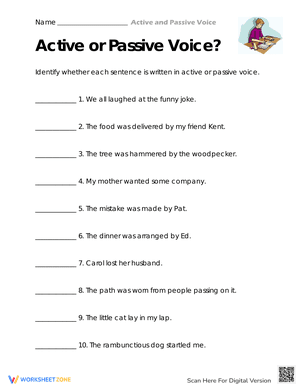
These active and passive voice printable worksheets for 6th grade give teachers a ready-to-use set for building sentence voice awareness inside editing and writing clarity work. Each worksheet moves students from identifying whether a sentence is active or passive to rewriting passive constructions — the progression that reveals whether students truly understand the concept or are pattern-matching on the surface.
The Specific Skills Each Worksheet Builds
The set builds from recognition toward revision. In early items, students read a sentence and mark it as active or passive. Then they underline the subject and the main verb so the sentence structure becomes visible before any rewriting begins. That small step — identifying what the subject is actually doing — consistently helps students who are unsure about where the action lives in a sentence.
Later items ask students to rewrite passive constructions in active voice. A sentence like The science fair project was assembled by three students becomes Three students assembled the science fair project. Students confirm the meaning has not changed while noticing that the revised sentence moves faster. A handful of items go further: they present passive sentences where revision would actually weaken the sentence, and students explain why they chose not to rewrite.
- Voice identification across a range of sentence lengths and structures
- Subject-verb underlining to make sentence patterns visible before revision
- Passive-to-active rewriting with meaning-preservation checks
- Intentional passive voice — items where students decide revision is not an improvement
- Content-area examples drawn from science lab write-ups and social studies passages
What Revision Tasks Reveal That Identification Alone Cannot
Identification tasks tell teachers that a student can categorize. Revision tasks tell teachers whether a student can construct. When a student rewrites The trophy was given to Maya by the principal, they have to select a new subject, choose the correct verb form, and confirm the sentence still makes sense — three decisions made in sequence, any one of which can break the sentence. Watching live revision gives sharper data than reviewing circled labels, and the rewrite tasks here provide the same quality of information even when students work independently at their seats.
One routine that holds up well: model three examples as a class using the anchor question Who is doing the action? Find the action, name the doer, move the doer into the subject position. Then release students to the worksheet. If time is tight — the last eight minutes of a block, for example — ask students to rewrite only the passive sentences and mark the active ones unchanged. That narrows the task without softening the cognitive demand.
Errors Students Make That These Worksheets Surface
The most common error is not misidentifying voice — it is getting the verb tense wrong during a rewrite. A student who correctly identifies The window was broken by Jake as passive will move Jake to the subject position but may write Jake breaked the window or even Jake was broken the window, especially students still internalizing irregular past tense forms. The rewrite task surfaces that gap directly, which is information a pure identification exercise would never produce.
A second pattern: students treating passive voice as a rule violation rather than a choice. Once they learn that active voice is often clearer, some students revise every passive sentence they encounter — including The results were recorded in the data table, where passive is standard in lab writing and revision would sound awkward. Addressing this during class discussion, rather than in red-pen corrections afterward, helps students develop judgment rather than a mechanical habit.
Building These Worksheets Into a Realistic Teaching Week
When planning a grammar block, active and passive voice printable worksheets for 6th grade fit several classroom formats without extra prep. Bell work runs cleanly: two identification items and one rewrite take under eight minutes and give teachers an immediate read on where the class stands before instruction moves forward. For grammar stations, one partner reads a sentence aloud while the other decides whether to revise — the verbal negotiation surfaces misconceptions faster than silent seatwork. For homework, each worksheet's self-contained format means students do not need a parent's explanation to complete it; the examples on each worksheet carry enough context.
Small-group intervention works especially well with five or six targeted items. Pull the group, spend two minutes reviewing the subject-does-action versus subject-receives-action distinction, then work through examples together before releasing students to independent items. For students ready to go further, ask them to pull two sentences from a piece of writing already in progress and revise the passive ones — that transfer step is harder than any worksheet item and shows whether the skill has moved beyond controlled practice.
Adjusting the Set for Different Learners
For students who are not yet secure with sentence subjects and verbs, pair the identification tasks with a simple entry strategy: circle the verb first, then ask who or what comes before it. That keeps the voice question anchored to sentence structure they already know, rather than treating voice as an entirely new category to memorize. Those students work through all identification items before attempting any rewriting.
Students working at or above grade level move quickly past identification and benefit most from the judgment items — the ones where they defend keeping a passive sentence unchanged. Ask those students to write a second sentence that uses intentional passive voice in a context where it fits: a science procedure, a news headline, a posted sign. That extension takes about five minutes and produces writing samples that demonstrate real understanding of voice as a purposeful tool rather than a grammar label.
Standard Alignment
Verb voice is formally introduced at the eighth-grade level under Common Core ELA standard L.8.1.b, which asks students to explain the function of verb voice in sentences. That placement confirms a sensible instructional strategy: teachers who use active and passive voice printable worksheets for 6th grade are building ahead, giving students two years of familiarity with a concept they will be formally assessed on in Grade 8. At the sixth-grade level, the skill fits inside the L.6.1 language cluster addressing sentence conventions and connects naturally to W.6.5, the editing and revision standard. Teaching it now as part of sentence clarity work — rather than as a standalone grammar topic — positions students to meet L.8.1.b with genuine confidence rather than encountering it as new material.
Frequently Asked Questions
Is passive voice a sixth-grade standard, or is it introduced later in middle school?
Passive voice is formally addressed at Grade 8 under Common Core standard L.8.1.b, but teaching it in Grade 6 is a sound instructional decision. Students at this level are already developing sentence control, and working with voice concepts strengthens revision habits in writing units. These worksheets function well as enrichment, preview, or intervention rather than as a primary compliance target for sixth graders.
How many items belong on a single practice worksheet for one class period?
Eight to twelve items strikes the right balance for most sixth-grade blocks. Fewer than eight items rarely provide enough range to show whether students have internalized the concept or are guessing. More than fifteen can push into diminishing returns, especially when rewriting is involved. For bell work or exit tickets, four to six items is enough.
Can these worksheets carry into content-area classes, not just ELA?
Yes, and they tend to be more useful when content-area examples are included. Science and social studies sentences like The solution was heated by the lab group or The treaty was signed by both nations help students see that voice decisions appear in real writing, not only in grammar drills. Science teachers find active and passive voice printable worksheets for 6th grade particularly relevant when addressing lab report conventions, since passive voice is standard in scientific writing and students benefit from understanding why the form is used there intentionally.
What is the clearest way to explain passive voice to a sixth grader who is confused?
Start with one question: who is doing the action? In an active sentence, the answer sits at the front. In a passive sentence, the doer is either missing or pushed toward the end, usually after the word by. Most students who struggle here are not confused about grammar — they are unsure where to look. Once they know to find the doer first, the classification follows quickly.















 Interactive Worksheet Maker
 Quiz Maker
 Word Search Maker
 Crossword Puzzle Maker
 Word Scramble Generator
 Sentence Scramble Generator
 Handwriting Worksheet Generator
 Name Tracing Generator
 Fill In The Blank Generator