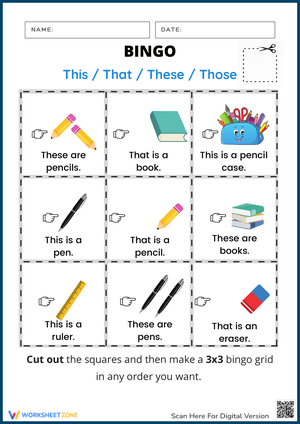
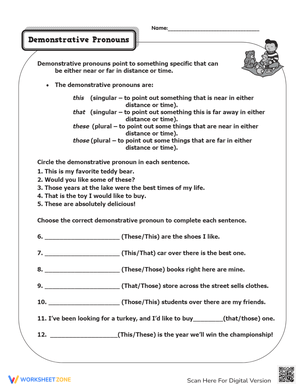
6th grade pronouns pdf worksheets address a skill set that sounds basic but lands in a complicated place in most middle school classrooms: students already know what pronouns are, but they still write "Me and Jordan went to the office" or "We finished the lab. This proved our hypothesis" — and they can't always see why those sentences are problems. This set gives teachers ready-to-print worksheets organized by specific pronoun skill, from subject and object case to vague pronoun revision.
The Skills Each Worksheet Targets
Pronoun instruction in Grade 6 covers more ground than most students expect. The skill progression moves from correct form selection into editing and revision, which is where real writing quality lives. Each worksheet in this set focuses on one of the following areas:
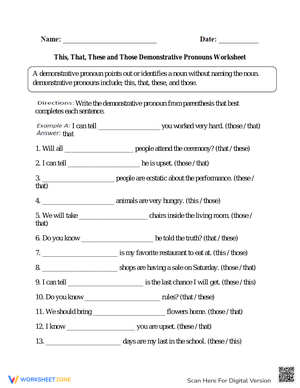
- Subject and object case: Students choose between forms like we and us, or they and them, in complete sentence contexts — not just fill-in-the-blank prompts.
- Possessive pronouns: Students distinguish possessive pronouns (his, hers, theirs, ours) from possessive adjectives and apply the correct form in sentence practice.
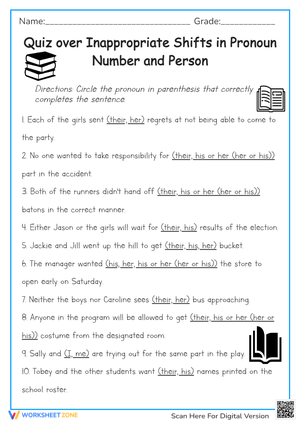
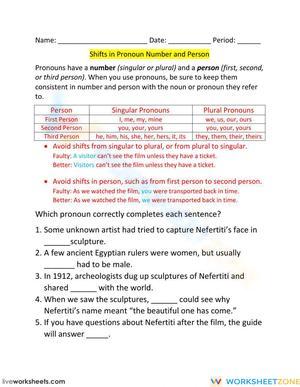
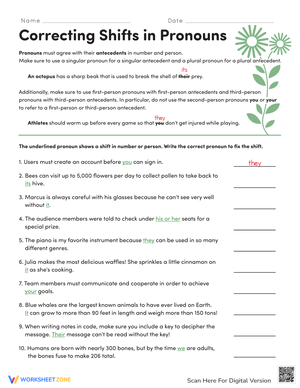
- Pronoun-antecedent agreement: Students check that number and person stay consistent from noun to pronoun, including in sentences where the antecedent appears several words before the pronoun.
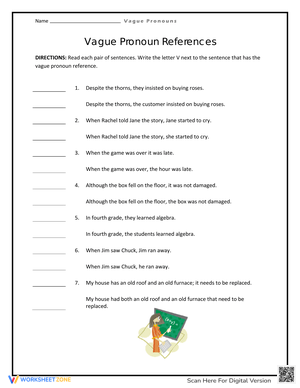
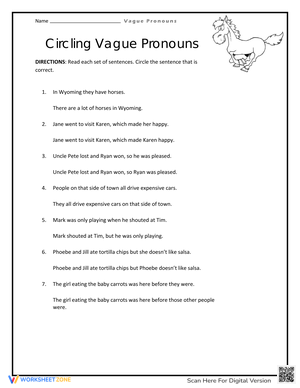
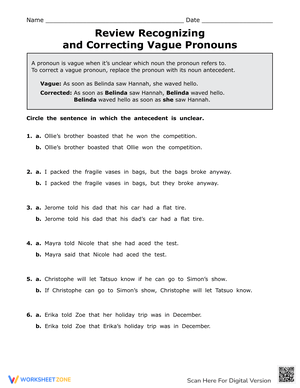
- Vague pronoun reference: Students revise sentences where it, this, or they point to nothing clear, then rewrite the sentence rather than just circling the problem word.
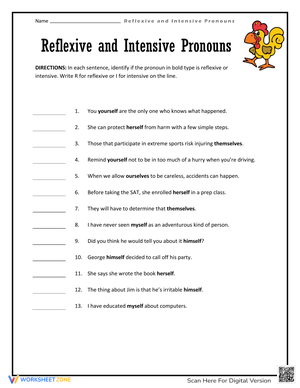
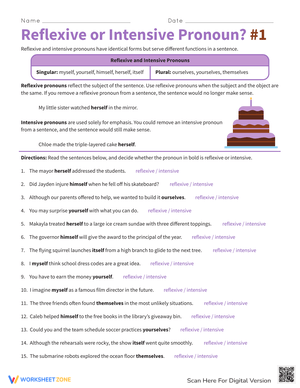
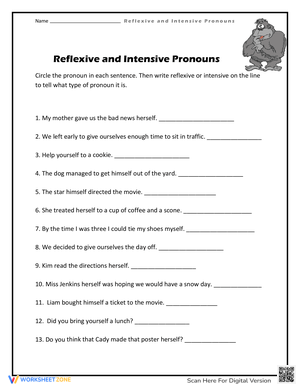
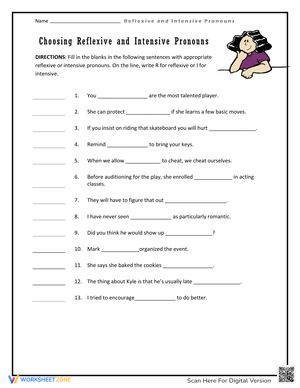
- Reflexive and intensive pronouns: Students identify correct uses of himself, themselves, and related forms in context, including the hypercorrection errors common at this grade.
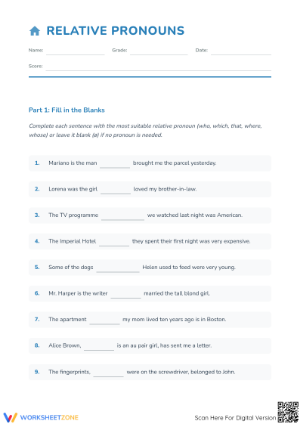
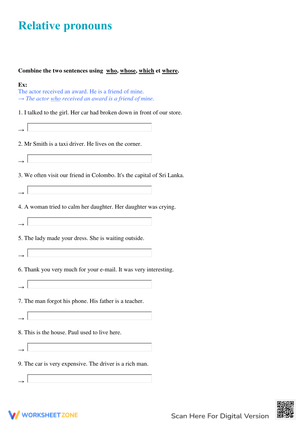
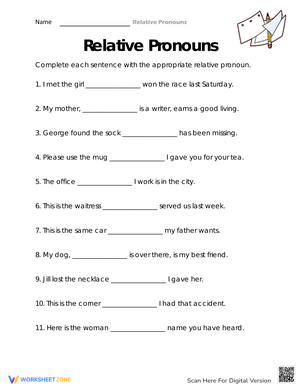
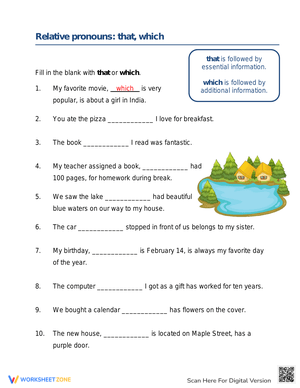
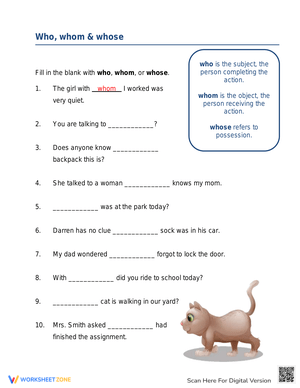
- Relative pronouns in context: Students choose between who, whom, which, and that inside subordinate clauses, a skill that connects directly to sentence variety in writing.
The strongest 6th grade pronouns pdf worksheets separate these skills by worksheet so teachers can target exactly what a lesson needs. When a teacher needs to reteach subject case to three students while the rest of the class works on vague pronouns, pulling the right worksheet instead of hunting through a mixed review takes about thirty seconds.
Student Errors Worth Catching Before the Writing Assignment
Two error patterns show up in Grade 6 student work more reliably than any others. The first is subject case with compound subjects. Students who have been corrected for saying "Me and Maya went to the store" sometimes overcorrect — and then write "The teacher spoke with Maya and I" or, more tellingly, "Maya told myself to fix it." That reflexive hypercorrection, where students reach for myself because they feel uncertain about whether me or I is right, signals that they need sentence-level case practice, not just the rule restated once more.
The second pattern is vague pronoun reference in informational and science writing. Students write "We completed the experiment. This showed us that temperature matters." Ask them what this refers to and they often say "the whole thing" — which is not a noun. Worksheets that require students to rewrite these sentences rather than just mark them force the thinking the writing assignment will eventually demand. Running a short vague-pronoun editing worksheet the Tuesday before a drafting day transfers more directly to actual student papers than completing the same task a week after drafts are returned.
Building These Worksheets Into Your Lesson Flow
In most sixth-grade classrooms, grammar instruction happens in short blocks — a ten-minute opener before reading, a quick reteach between writing workshop and lunch, the fifteen minutes after a mini-lesson before independent drafting begins. These worksheets fit those windows because each one has a narrow focus and clear directions. Printing five copies for a small group is a two-minute job.
For bell ringers, use three to five items from one of the editing worksheets. Students mark the error, correct it, and write the rule in their own words — that last step is the part most teachers skip, and it is worth keeping because it shows who is guessing versus who actually understands the pattern. For pre-writing days, a short antecedent-agreement worksheet handles the pronoun errors that would otherwise appear across a whole class set of drafts. For sub plans, the fill-in and edit worksheets work without teacher facilitation because directions are self-contained. The 6th grade pronouns pdf worksheets in this set include a separate answer key with each resource so substitute teachers can manage corrections without guessing.
Standard Alignment
The primary anchor for Grade 6 pronoun instruction is CCSS.ELA-LITERACY.L.6.1.A, which specifies that students demonstrate command of pronoun case, including the correct use of subjective, objective, and possessive forms in sentences. Instructionally, this standard points teachers toward three distinct worksheet moves: having students select the correct pronoun case, having them identify and correct usage errors in sentence context, and having them revise sentences where unclear pronoun reference breaks meaning. All three moves appear across the worksheets in this set.
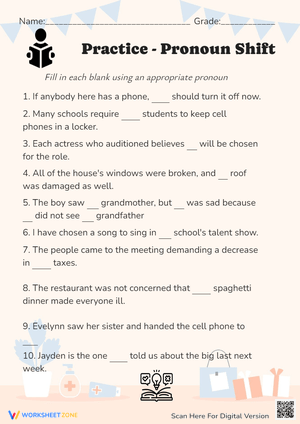
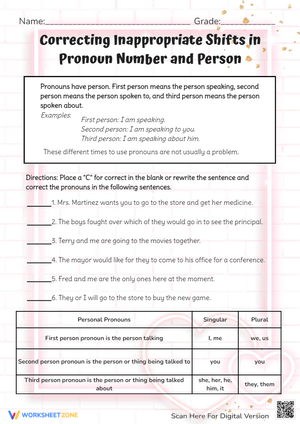
Grade 6 is also the level where the CCSS expects students to recognize and correct inappropriate pronoun shifts — both number shifts and person shifts. That expectation matters for worksheet selection: resources that only ask students to label pronoun types do not fully address L.6.1.A in practice. The editing-style worksheets in this set do.
Adjusting the Set for Different Student Levels
Students who are still working on basic pronoun identification need a different starting point than students who already choose subject and object forms correctly. For that lower-entry group, begin with the subject and object worksheets that use short, simple sentences — subject and antecedent in the same sentence, no compound nouns, no subordinate clauses. Once those students can reliably select the right case, move them to sentences where the antecedent appears farther from the pronoun. That distance is exactly where agreement breaks down in actual student writing, and it is the condition most worth practicing before a composition assignment.
For students working above grade level, the vague pronoun and relative pronoun worksheets offer natural extension. Ask those students not just to revise the sentence on the worksheet but to write a follow-up sentence that also uses the corrected pronoun — effectively producing two-sentence mini-paragraphs. That task raises the cognitive demand without requiring a separate resource, and it produces work teachers can use as a mentor text during the next whole-class lesson.
Frequently Asked Questions
What pronoun skills do these worksheets cover at the sixth-grade level?
The set addresses subject and object case, possessive pronouns, pronoun-antecedent agreement, vague pronoun reference, reflexive and intensive pronouns, and relative pronouns in sentence context. Each skill area has its own worksheets so teachers can match the resource to the lesson objective or the specific error pattern appearing in student writing.
Are these resources available as printable PDFs?
Yes. All worksheets download as print-ready PDFs. Teachers use them for in-class practice, homework, bell ringers, center rotations, and sub plans. The format stays clean across all those uses without requiring any reformatting before class.
How do these worksheets help students who keep making pronoun errors in their own writing?
The most direct approach is pairing a targeted editing worksheet with a short two-sentence revision task that asks students to apply the corrected rule in their own writing. Students who answer isolated questions correctly can still miss pronoun errors when the antecedent sits several sentences back — the working memory demand is simply higher in connected text than in single-sentence exercises. The 6th grade pronouns pdf worksheets that target vague pronouns and antecedent agreement put students in that longer-context situation, which is closer to what actual drafting demands.
Which worksheet type works best when students are just beginning the pronoun unit?
Start with identification and fill-in worksheets that use simple, complete sentences. Students need exposure to correct forms before they can reliably catch and fix errors. After two or three lessons using those entry-level worksheets, the editing and revision resources become much more productive — students know what they are looking for instead of guessing through the correction task.












 Interactive Worksheet Maker
 Quiz Maker
 Word Search Maker
 Crossword Puzzle Maker
 Word Scramble Generator
 Sentence Scramble Generator
 Handwriting Worksheet Generator
 Name Tracing Generator
 Fill In The Blank Generator