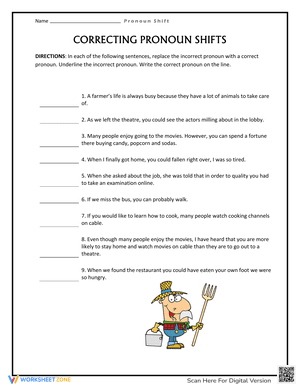
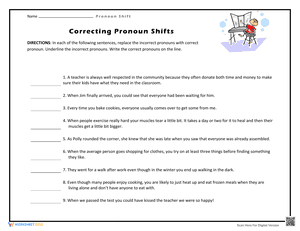
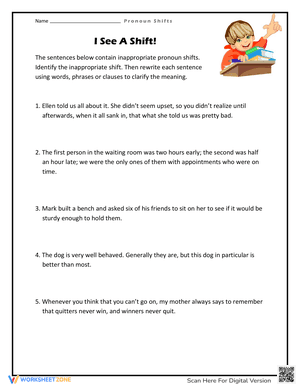
These pronoun shifts in number and person printable worksheets for 6th grade give teachers a targeted editing resource for one of the most persistent problems in middle school writing: students who open a sentence with a singular noun and reach for a plural pronoun two clauses later, or who drift from third person into second because that phrasing is closer to how they speak out loud. The set pairs isolated sentence correction with short passage revision, so individual worksheets can move from bell ringer to reteach station to exit ticket across a week's instruction.
Where Sixth Graders Consistently Go Wrong With Pronouns
Three error types show up reliably at this grade level, and they rarely appear in equal measure across a classroom. Some students will almost always match number correctly but lose track of person — especially when writing argumentative or explanatory responses, where the temptation to address the reader directly ("you should consider...") competes with the third-person register their teachers have been asking for. Others will handle person consistency but stumble on singular-plural agreement when the antecedent is separated from its pronoun by a prepositional phrase or a relative clause: Every student turned in their homework passes many a quick read-through, but the mismatch is there.
The third pattern is subtler. A student revises part of a sentence correctly and stops reading, missing a second inconsistency in the same line. This happens most often during self-editing, when students fix the error they noticed first and assume the work is done. Each worksheet that embeds two errors in a single sentence — not as a trick, but as a realistic sample of what drafts actually look like — trains students to keep reading after the first correction rather than moving on.
What the classroom record tends to show is that students who do well on isolated sentence drills still produce pronoun inconsistencies in their own writing. That gap exists because the cognitive demand shifts: in a drill, students hunt for one kind of error; in a paragraph, they manage syntax, meaning, and pronoun consistency at the same time. That's why the most useful editing tasks include at least one short passage where students have to hold onto meaning while checking pronouns — not just mark errors in sentences stripped of context.
Skills Covered Across the Set
Each worksheet targets one or more of the following error types, moving from simpler constructions to sentences where the antecedent and pronoun are separated by more material:
- Singular antecedent paired with a plural pronoun
- Plural antecedent paired with a singular pronoun
- Unplanned shifts from third person to second person mid-sentence
- First-to-third person drift in multi-clause constructions
- Passage-level revision items where students correct multiple pronouns in context
Directions across the set ask students to underline the inconsistent pronoun, identify whether the mismatch involves number or person, and rewrite the sentence or passage correctly. That three-step sequence makes the editing process visible — teachers can see exactly where a student's reasoning broke down rather than just seeing a wrong answer at the end. The sentence structures use realistic school-appropriate topics; students are not reading contrived grammar-book examples.
Standard Alignment
These worksheets align to Common Core State Standards for English Language Arts, Grade 6, standard L.6.1c, which requires students to recognize and correct inappropriate shifts in pronoun number and person. In classroom terms, this standard typically surfaces during the revision and editing phase of writing instruction — after students have drafted a paragraph or short response and need to inspect their language choices before submitting. Using pronoun shifts in number and person printable worksheets for 6th grade alongside a writing unit keeps grammar practice connected to purpose: students work on the skill at the moment the writing task makes it relevant, not as a separate grammar block that runs parallel to but never intersects with actual writing.
The Grades 6–8: Assessing Language Standards (Grammar and Conventions) for College and Career Readiness framework also supports short conventions tasks embedded in writing instruction rather than isolated as standalone grammar units. These worksheets fit that model because the sentence structures reflect the kind of writing sixth graders are actually producing — multi-clause sentences across informational, narrative, and argumentative contexts.
Fitting These Worksheets Into the Lesson Plan
The practical value of this set is how quickly individual worksheets drop into the schedule. Four to five sentences reviewed in the first seven minutes of class — before writing workshop opens — keeps the skill fresh without displacing the main lesson. That works especially well Monday through Wednesday; by Thursday, a short passage-based worksheet can serve as a low-stakes check before students revise their own drafts. The pattern is short, repeatable, and predictable enough that students come in knowing what to expect, which cuts the setup time to almost nothing.
For small-group reteach, sort students by error type rather than by general grammar ability. A student who consistently writes singular antecedents with plural pronouns needs different items than a student who defaults to second person in argumentative writing. Matching the worksheet to the specific mismatch means students spend their reteach time on the exact problem, not on items that miss the issue entirely.
The set also handles the practical realities: sub plans, early-finisher folders, intervention binders. Because each worksheet is focused and the directions are self-explanatory, students complete the task independently with minimal setup. Teachers using pronoun shifts in number and person printable worksheets for 6th grade as exit tickets — three to five items, last five minutes of class — get a clean read on who can apply the skill without direct support and who needs another round before the writing task moves toward a grade.
Adjusting the Work for Students at Different Points in the Skill
Students who are still uncertain about what an antecedent is benefit from starting with sentence-level items that isolate a single, clear error in a short construction. Once they can identify the mismatch reliably in simple sentences, they move to items where the antecedent and pronoun are separated by more words — a longer noun phrase, an embedded clause — which increases working-memory demand without changing the underlying rule. That progression can happen within a single worksheet or across two worksheets assigned in sequence, depending on where the student is when reteach begins.
For students who are already comfortable with sentence-level corrections, the passage-revision items carry more instructional weight. Ask them to annotate each pronoun before correcting it, noting whether the shift involves number or person. That annotation step slows the process down enough to make the reasoning visible — useful for the student and for the teacher reviewing the work during a writing conference. If a student's draft shows a pronoun inconsistency, pulling one of these worksheets, working through two examples together, and sending the student back to the draft with a clear editing lens is a more efficient conferencing move than explaining the rule again from scratch.
Students who write in a language other than English at home sometimes show a different error profile. In several languages, pronouns are not marked for number the way English ones are, and the agreement rule can feel arbitrary rather than logical. A brief anchor explanation that connects the rule to meaning — "readers need to know whether you're referring to one person or more than one" — reduces confusion before students begin the editing task and makes the correction feel purposeful rather than mechanical.
Frequently Asked Questions
What does it mean to shift pronoun number or person, and why does this standard appear at 6th grade?
A number shift means a student uses a singular noun as the antecedent but writes a plural pronoun to refer back to it, or the reverse. A person shift means the writing moves between first, second, and third person without a clear reason. Sixth grade is the natural placement for this standard because students at this level are writing longer responses — explanatory paragraphs, literary analysis, argument — where pronouns appear across multiple clauses and inconsistencies have room to develop. The short sentences that dominate earlier grade writing rarely exposed this pattern because the antecedent and its pronoun usually appeared within the same clause.
How do these worksheets differ from a general grammar review packet?
Each worksheet focuses on pronoun number and person consistency specifically — not parts of speech broadly, not all pronoun functions. The editing items use multi-clause sentences and short passages rather than single-clause drills, which means students practice under conditions closer to real revision work. That focus also makes the worksheets faster to assign: teachers know exactly which standard they are addressing and can pair any individual worksheet with a writing task the same day.
Are these worksheets useful for students who are already strong writers?
Strong writers often produce pronoun shifts in longer, more complex sentences — exactly the place where a simple fill-in drill would never surface the problem. The passage-level items in the set are demanding enough to be worth the time for students who can already handle sentence corrections comfortably, particularly when paired with the annotation step described above.
Can these worksheets support standards-based grading or test preparation?
The set supports formative assessment well. A five-item exit ticket drawn from one worksheet gives teachers a clear picture of whether a student can apply L.6.1c independently. For students preparing for state language and writing assessments, the passage-revision items most closely resemble the format those assessments use, so pronoun shifts in number and person printable worksheets for 6th grade can serve as low-stakes preparation for that kind of extended editing task without requiring teachers to build separate test-prep materials.















 Interactive Worksheet Maker
 Quiz Maker
 Word Search Maker
 Crossword Puzzle Maker
 Word Scramble Generator
 Sentence Scramble Generator
 Handwriting Worksheet Generator
 Name Tracing Generator
 Fill In The Blank Generator