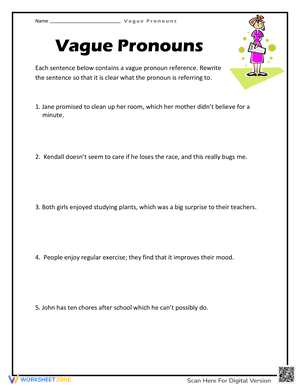
These 6th grade vague pronouns printable worksheets resources give teachers focused, classroom-ready exercises for one of the most persistent revision problems in middle school writing: a pronoun that could reasonably point to two or more nouns in the same sentence. The worksheets move students through three connected steps — identifying the unclear pronoun, naming the possible antecedents, and rewriting for a reader who has no access to the writer's intent. That progression is what separates pronoun clarity work from basic grammar labeling.
What Each Worksheet Asks Students to Do
The tasks across the set reflect the instructional sequence that actually builds revision skill. Students first underline the vague pronoun and circle every noun that could plausibly serve as its antecedent. Then they articulate the problem in writing — stating why the sentence is unclear, not just marking it. The final step is rewriting: substituting a precise noun, moving the antecedent closer, or restructuring the clause so only one reference is possible.
- Identification items with two-noun sentences where students underline the vague pronoun and mark both possible antecedents
- Explanation tasks that ask students to state in a sentence why the original version would confuse a reader
- Revision items where students rewrite using a specific noun or a restructured clause
- Short paragraph practice where students locate and correct one or two vague references in context
- Mixed review combining vague pronoun identification with pronoun-antecedent agreement and pronoun-person shifts
Several worksheets use content-area sentences rather than generic grammar examples. When a sentence mentions both a hypothesis and an experiment before using it, students must manage meaning and structure at the same time — the exact condition they face in real science or social studies writing tasks, not just during grammar practice.
Student Error Patterns Teachers Should Anticipate
The most common error is not failing to spot the ambiguity — it is fixing it badly. A sentence like Marcus told his brother he had won the award gets flagged correctly as vague, but many students revise it to Marcus told his brother that Marcus had won the award, which sounds stilted and reads awkwardly in context. The cleaner fix recasts the sentence entirely: Marcus told his brother, "I won the award." Worksheets that model two or three acceptable revisions — not just one correct answer — help students understand that pronoun clarity sometimes requires restructuring, not just a noun substitution.
A second pattern involves broad-reference pronouns: this, it, and that used to gesture at an entire previous sentence rather than a specific noun. Students write The committee rejected the proposal. This surprised everyone. and genuinely do not see the problem because the meaning feels obvious to them as the author. One classroom question cuts through that blind spot faster than general revision advice: "Can you replace that pronoun with a single noun from the previous sentence?" If the answer is no, the pronoun is doing too much work.
Grade 6 students also conflate vague pronouns with agreement errors, and that confusion is worth addressing head-on. A student who has been taught to check number agreement may confirm a pronoun matches its antecedent in number and move on — without noticing that two nouns of the same number are both in play. The distinction between grammatically matched and reader-clear needs explicit instruction, and each worksheet that mixes both error types in the same exercise gives teachers a natural opening to address it directly.
Building These Worksheets Into Your Weekly Routine
The most reliable approach is distributing practice across the week rather than front-loading it in a standalone grammar unit. Spaced retrieval keeps the skill active while students are simultaneously revising drafts — so the connection between worksheet practice and writing improvement stays visible to them throughout the unit.
A five-day bell ringer structure works well at this grade level: Monday, students identify vague pronouns in three short sentences. Tuesday, they name the possible antecedents and write one sentence explaining the ambiguity. Wednesday, they revise Monday's sentences. Thursday, they work through a short paragraph and locate the vague references in context. Friday, they complete an independent check without notes. Each day takes five to eight minutes, and the Friday item generates usable formative data. The 6th grade vague pronouns printable worksheets set includes items calibrated to each step of that sequence, so teachers are not adapting a single format across multiple task types.
Small-group conferences are another strong context. Pull two or three lines from current student drafts — anonymized — and use them as revision items. Students recognize the sentence patterns because they produced them, which makes correction feel purposeful rather than abstract. For intervention groups specifically, sentence-level items with only two competing nouns build confidence before students move to denser, paragraph-length examples where tracking multiple referents is harder.
One honest constraint worth naming: sentence-level exercises will frustrate students whose vague pronoun use stems from tracking meaning across a longer passage rather than within a single sentence. For those students, paragraph-level practice is the right entry point. Identifying that distinction early — which a brief diagnostic item can reveal — determines which worksheets to assign first.
Standard Alignment
L.6.1.d of the Common Core State Standards for ELA identifies recognition and correction of vague pronouns — specifically those with unclear or ambiguous antecedents — as a grade 6 expectation. The grade placement reflects a real developmental shift: sixth graders are writing multi-sentence responses and paragraph-length constructed answers, which is when vague pronoun use actually surfaces in their work. In grades 3 and 4, when most sentences are short and nouns stay close to their pronouns, the problem rarely appears. By grade 6, the increased syntactic complexity students are producing creates the conditions for ambiguous reference to take hold.
Instructionally, L.6.1.d belongs inside writing revision work, not only grammar warm-ups. The standard asks students to recognize and correct, which means the assessment target is revision fluency — a student's ability to spot and fix the problem in their own writing — not just the ability to label a pronoun in an isolated sentence. Teachers who embed vague pronoun practice inside writing conferences and revision workshops are more aligned with the standard's intent than those who treat it as a unit-closing grammar quiz.
Adjusting the Worksheets Across Learner Levels
For students who need additional support, the most effective adjustment is simplifying the sentence structure: two nouns, one pronoun, one unambiguous ambiguity. That format makes the problem visible enough to name before students attempt revision. Providing two model rewrites for each item — one that substitutes the correct noun, one that restructures the sentence — gives those students a concrete reference when their own rewrite stalls, rather than leaving them to generate solutions from scratch.
On-level practice shifts from individual sentences to short paragraphs where students locate and correct one or two vague references in running text. That task requires tracking meaning across multiple sentences, which is closer to the revision work students do on their own drafts. The surrounding context also makes broad-reference errors with this and it more visible — those pronouns rarely feel ambiguous in a single isolated sentence but become obvious problems when the rest of the paragraph is present.
Students ready for enrichment benefit from generating their own examples: write a sentence with an intentionally vague pronoun, identify the competing antecedents, and produce two different revisions that each solve the problem in a different way. Using 6th grade vague pronouns printable worksheets examples as a reference before students write their own items gives the task structure without removing the analytical thinking it requires. The strongest student-generated examples often surface sentence patterns the teacher hadn't anticipated — which makes them useful discussion material for the full class.
Frequently Asked Questions
What exactly is a vague pronoun, and how is it different from a pronoun error?
A vague pronoun is a pronoun that could refer to more than one noun in the sentence, leaving the reader unable to determine which one the writer intended. It is distinct from a pronoun-antecedent agreement error, which occurs when a pronoun does not match its antecedent in number or person. A vague pronoun may be grammatically matched to every noun in the sentence and still be unclear — which is why teaching both error types together, rather than treating them as the same problem, produces better revision outcomes.
Why do sixth graders struggle with this skill specifically?
Sixth graders are writing more syntactically complex sentences than they did in earlier grades — longer structures with multiple noun phrases, embedded clauses, and ideas that carry across several sentences. They understand what they mean when they write, so vague pronouns feel clear to them as the author. The skill demands reading with a stranger's perspective, which is genuinely difficult at this age. Students who internalize the question "Would a reader who has never seen my draft know exactly who or what this pronoun names?" catch the error far more reliably than students who simply reread their own work.
Do these worksheets support standardized test preparation?
Yes. State ELA assessments at grade 6 include editing and revision tasks that require students to identify and correct grammatical errors in written passages, and vague pronoun reference appears in that category. The revision-plus-explanation format used across these worksheets matches the kind of thinking assessments require — not just marking an error, but understanding why a revision improves clarity for the reader.
How do I introduce this concept to a class encountering it for the first time?
Start with a sentence that genuinely creates debate — one where two students will disagree about who the pronoun refers to. Something like When the coach spoke to the player, she was furious usually generates a productive argument without any teacher setup. Once students are disputing which person she names, the concept is understood in concrete terms before they need the vocabulary. From that entry point, 6th grade vague pronouns printable worksheets practice anchors the skill with labeled examples and structured revision tasks students can return to independently.















 Interactive Worksheet Maker
 Quiz Maker
 Word Search Maker
 Crossword Puzzle Maker
 Word Scramble Generator
 Sentence Scramble Generator
 Handwriting Worksheet Generator
 Name Tracing Generator
 Fill In The Blank Generator