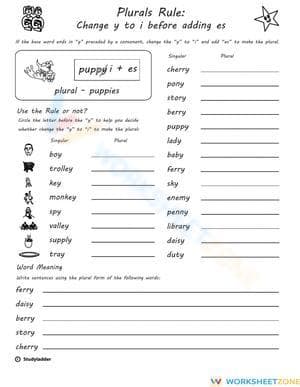
These 6th grade parts of speech printable worksheets close a gap that turns up in every middle school ELA classroom: students can name all eight parts of speech, yet they still write "She played good" without recognizing the problem. The set covers nouns, pronouns, verbs, adjectives, adverbs, prepositions, conjunctions, and interjections across targeted and mixed-review formats. Teachers get resources that fit a bell ringer, a center rotation, a homework assignment, and a sub plan without rebuilding any of them.
Skills Each Worksheet Builds
The worksheets move through identification, sorting, and revision at different points in the set. Early worksheets ask students to underline and label parts of speech inside complete, grade-appropriate sentences — not word lists pulled out of context. Later worksheets ask students to sort words that frequently swap categories (a noun used as an adjective, a verb used as a noun), fill in blanks that require choosing between grammatically similar options, and rewrite sentences using a stronger or more precise word from the same category. That sequence matters because grammar knowledge compounds: students who understand how adverbs function are better positioned to notice when one is doing double duty as an adjective, which is exactly where the confusion tends to start.
Each worksheet focuses on one or two related categories before the set shifts to mixed practice. The mixed-review worksheets treat grammar the way editing does — students encounter several parts of speech inside one short paragraph and have to track how each word functions, not just what it looks like standing alone.
Errors Worth Anticipating Before You Hand These Out
The most persistent problem at sixth grade is not definition confusion — it is function confusion. Students who can define "adverb" perfectly will still circle "very" as an adjective because it appears right next to the adjective it modifies. They label the phrase instead of each word. A related pattern shows up with words like "running," "painting," and "swimming" — students mark them as verbs regardless of sentence role, even when the sentence reads "Swimming is her strongest event." At sixth grade, that kind of grammatical flexibility is exactly what the standards push toward, and it is where these worksheets generate the most instructionally useful data.
Pronoun worksheets surface a different set of problems. Students can identify "he," "she," and "they" with no difficulty, but unclear antecedents barely register as errors in their own writing. A worksheet that asks students to identify the pronoun and then circle its antecedent — or flag when no clear antecedent exists in the sentence — makes the problem visible in a way that simply labeling pronouns does not.
Fitting These Resources Into a Real Week of Instruction
Short and focused is almost always the right call. One worksheet used at the start of class gives teachers five to eight minutes of quiet, purposeful work — enough to launch a mini-lesson with fresh evidence from what students marked. Assigning a worksheet for homework after teaching a category directly works well because families are reviewing practiced material rather than encountering new grammar terminology at the kitchen table. Used consistently, 6th grade parts of speech printable worksheets give teachers a running record of grammar development across the unit — which is far more useful evidence than a single end-of-unit quiz.
- Use identification worksheets at the start of a unit as a preassessment — what students mark tells you which categories still need direct instruction.
- Use sorting or matching worksheets when students confuse related categories, such as adjectives and adverbs, or prepositions and conjunctions.
- Use sentence revision worksheets after writing workshop so grammar work connects directly to what students are drafting.
- Use mixed-review worksheets on Fridays for a fast formative check before the unit moves forward.
- Keep one mixed-review worksheet in the sub binder — the task sequence is clear enough for students to work through independently without setup from the regular teacher.
One extension that costs no extra planning: after students finish any worksheet, ask two or three of them to read a sentence aloud, name the part of speech they marked, and explain why. That thirty-second exchange consistently reveals whether students are guessing from word endings or actually analyzing function — and it turns a routine worksheet into a brief accountable-talk moment without derailing the class.
Standard Alignment
CCSS.ELA-LITERACY.L.6.1 addresses command of standard English grammar and usage, including ensuring that pronouns are in the proper case and recognizing variations from standard English. The sentence-based identification and revision tasks in this set map directly to that standard — students are not memorizing definitions in isolation but working with grammar inside the kinds of sentences they read and write at sixth grade. That is the distinction L.6.1 draws: command means applying grammar, not reciting it. Teachers using these worksheets as formative tools can document whether individual students are meeting L.6.1 based on what they mark, what they revise, and which errors they repeat across multiple worksheets over the course of the unit.
Adjusting the Set for Mixed-Ability Classes
Differentiation here does not require writing separate lessons for every group. Students who need more support work through single-skill worksheets with shorter sentences and direct labeling tasks — the cognitive demand stays lower because students are not tracking multiple categories simultaneously. Students ready for more challenge move to mixed-review worksheets, correct deliberate errors embedded in short paragraphs, or explain in writing why one word shifts function across two different sentences. Both groups are working with the same eight parts of speech at grade-level content; what changes is the number of categories in play and how much explanation students must produce.
Timing and grouping offer another adjustment layer. A whole class might begin with the same warm-up worksheet, and what teachers notice during circulation — who finishes quickly, who marks everything as a noun, who blanks on prepositions — tells them exactly which small group to pull during independent work. Because 6th grade parts of speech printable worksheets are easy to organize by skill and difficulty, that kind of responsive regrouping takes minutes to set up rather than a full reteach period.
Frequently Asked Questions
What parts of speech do these worksheets cover at the 6th grade level?
The set addresses all eight standard categories: nouns, pronouns, verbs, adjectives, adverbs, prepositions, conjunctions, and interjections. Worksheets covering nouns, pronouns, verbs, adjectives, and adverbs appear most extensively because those categories intersect most directly with sentence structure, revision work, and the errors that surface most often in sixth-grade drafts.
Can I use these for intervention with students who are below grade level?
Yes. The single-skill identification worksheets work well for students who need focused review on one category at a time without the added load of tracking multiple grammar concepts at once. Pair a targeted worksheet with a brief direct-instruction moment — five minutes showing the pattern, then students practice — and you get a workable intervention cycle without rebuilding a full lesson from scratch.
How do these worksheets connect to writing instruction rather than acting as isolated grammar drills?
The revision-style worksheets ask students to replace a weak verb, sharpen a vague modifier, or correct a pronoun reference inside a real sentence — not a stripped-down drill sentence. That task type mirrors what students do during editing conferences and makes grammar knowledge immediately functional. When 6th grade parts of speech printable worksheets include that kind of revision work alongside identification tasks, grammar stops feeling like a separate subject and starts acting like a writing tool students can actually reach for.
Are these worksheets appropriate for a sub plan?
A mixed-review worksheet with clear directions is one of the most reliable sub-plan options in a grammar unit. Students understand the task without teacher setup, the work takes a predictable amount of time, and the completed worksheets give the regular teacher useful information about where the class landed. Including an answer key in the sub binder makes the transition even smoother.















 Interactive Worksheet Maker
 Quiz Maker
 Word Search Maker
 Crossword Puzzle Maker
 Word Scramble Generator
 Sentence Scramble Generator
 Handwriting Worksheet Generator
 Name Tracing Generator
 Fill In The Blank Generator