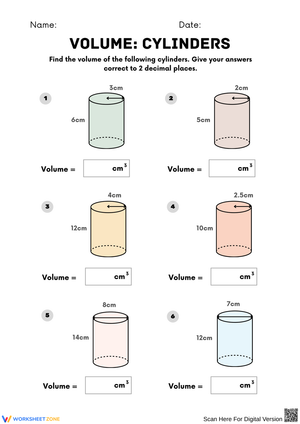
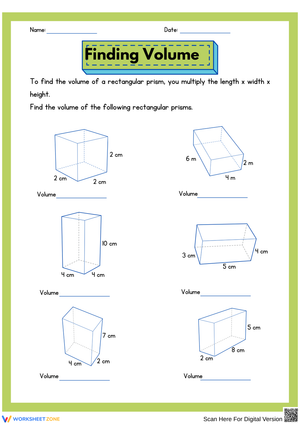
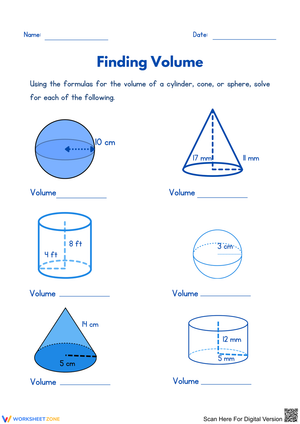
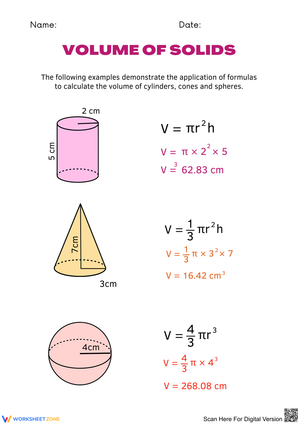
5th Grade Volume of 3D Shapes worksheets
These 5th grade volume of 3d shapes worksheets give teachers targeted practice across every major skill in the fifth-grade volume unit — from counting unit cubes in stacked arrays to decomposing composite L-shaped prisms into separate rectangular sections. Each worksheet addresses one specific skill, which means a teacher can pull exactly the right one to fill an instructional gap rather than assigning the full set in sequence.
What Each Worksheet Covers
This 5th grade volume of 3d shapes worksheets follows the progression most teachers use: visual cube counting first, formulas second, missing dimensions third, and composite figures last. That ordering matters. Students who jump straight to V = l × w × h before understanding what the formula represents tend to misapply it and fall apart when the problem format changes.
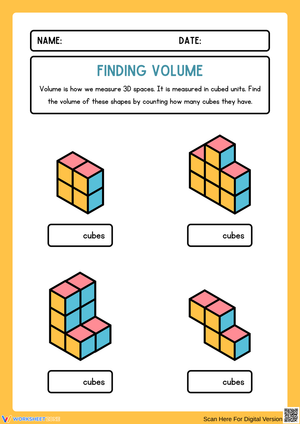
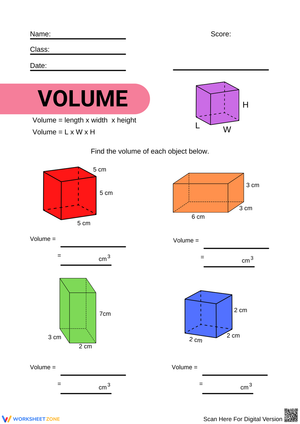
Unit cube worksheets ask students to count the cubes in a base layer, record that count, and multiply by the total number of layers — connecting counting logic to formula logic without making the connection abstract. Formula worksheets introduce both V = l × w × h and V = B × h, because both appear in fifth-grade standards and students need to see them as equivalent methods, not competing ones. Missing-dimension worksheets give students the volume and two measurements and ask for the third, pushing toward algebraic reasoning. Composite figure worksheets finish the progression with L-shapes and stair-step prisms that require decomposition before any formula work can start. Word problems using real contexts — shipping containers, aquarium capacity, storage unit dimensions — appear throughout rather than being saved for a separate tier.
- Unit cube counting with visual models, including partially hidden back rows
- V = l × w × h applied to whole-number labeled diagrams
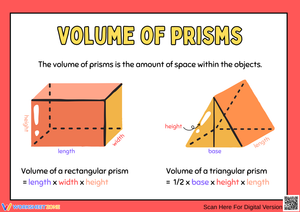
- V = B × h with base area calculated as an intermediate step
- Missing dimension problems treated as division from a known volume
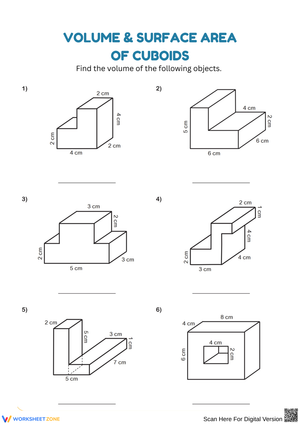
- Composite figure decomposition using additive volume
- Word problems in real-world measurement contexts
Error Patterns to Watch for When Assigning Volume Practice
The stickiest error is unit labeling. After weeks of area work, students write "square inches" on volume answers almost automatically, and the habit persists even when they get the number right. The unit cube counting worksheets surface this early: once a student has filled a prism with 24 cubes and has to decide whether the label reads "square centimeters" or "cubic centimeters," the distinction becomes real in a way that a formula introduction alone never makes it.
Missing dimension problems produce a specific and predictable mistake — students multiply every number they see. Given V = 60 in³, l = 5 in, and w = 3 in, a student will often write 5 × 3 × 60 = 900, treating the volume as one more factor rather than the result. The correct move is recognizing that 60 = 5 × 3 × h, simplifying to 60 = 15 × h, and solving for h = 4. That requires understanding volume as the product of a multiplication chain and this problem as working backward through it. Setting up the equation with a variable is the clearest way to make that logic visible, and the missing-dimension worksheets build toward exactly that approach.
On composite figure problems, the hidden dimension is where most work falls apart. When an L-shaped figure has an overall length of 10 and a labeled notch of 6, students need to subtract to find the remaining segment of the smaller sub-prism. About half will assign 10 to both prisms instead, effectively measuring one section twice. Providing a worked decomposition on the first composite worksheet and removing it on subsequent ones lets students internalize the subtraction step over two or three sessions without turning the worked example into a permanent reference.
Standard Alignment
These worksheets address 5.MD.C.3, 5.MD.C.4, and 5.MD.C.5 from the Common Core State Standards for Mathematics. Standard 5.MD.C.3 defines volume as a measurable attribute of solid figures and introduces the unit cube. Standard 5.MD.C.4 requires students to measure volume by counting unit cubes, making it the direct instructional link between the visual worksheets and the formula-based ones. Standard 5.MD.C.5 breaks into three parts: 5.MD.C.5a covers applying both formulas to right rectangular prisms with whole-number edge lengths; 5.MD.C.5b connects those formulas to real-world and mathematical problems; and 5.MD.C.5c specifically addresses additive volume for composite figures.
In most curriculum maps, this unit arrives in the third quarter of fifth grade, after students have solidified multiplication fluency, two-dimensional area, and basic geometric properties introduced in fourth grade. The conceptual distance between measuring area and measuring volume is larger than it appears on a pacing guide — students must extend their thinking from a flat surface to a filled solid, which is why the standards sequence hands-on unit cube work before formula instruction rather than alongside it.
Building These Worksheets Into Your Volume Unit
The unit cube counting worksheets work best as a two-day warm-up before any formula instruction begins. On the first day, have students build rectangular prisms with physical unit cubes and count to find the total. On the second day, hand out a 5th grade volume of 3d shapes worksheets with cube diagram exercises and ask students to verify their physical counts against the printed figures. Students who work only from diagrams frequently count visible cube faces instead of actual cubes — particularly when back rows are partially hidden. Moving from physical objects to printed diagrams in that order catches that error before the formula unit starts.
Once formulas are introduced, missing-dimension worksheets make efficient exit tickets. They take roughly eight minutes, and the results divide a class clearly: students who understand that volume is the product and the missing measurement is a factor work backward naturally; students who are still multiplying everything they see need a different approach before moving forward. That information lets you pull a small group the next morning during independent work rather than reteaching the full lesson.
For composite figures, a two-color highlighting strategy reduces mid-problem confusion: before writing any numbers, students shade each sub-prism in a different color. That commitment to a specific decomposition makes it immediately obvious when a dimension is being assigned to the wrong section of the figure.
Tailoring the Set to Different Student Levels
This 5th grade volume of 3d shapes worksheets varies in the amount of visual support each worksheet provides — early worksheets include labeled dimension arrows, and composite figure worksheets include dashed lines showing where to split the shape. Students who need additional grounding can work with physical unit cubes alongside the diagram-based worksheets simultaneously; running both at once surfaces spatial reasoning errors that either method alone would miss.
For students ready for more challenge, remove the dashed decomposition lines from composite figure worksheets and have them draw the split themselves before calculating. A further step: composite figures where the hidden dimension requires subtracting a labeled segment from an unlabeled total, adding a reasoning demand before the formula work even begins. Word problems with an irrelevant dimension included — a measurement that looks necessary but isn't — push students to select the right values rather than computing every number on the page.
Students who struggle specifically with the spatial side of composite figures often benefit from isometric dot paper alongside the worksheet. Drawing the three-dimensional shape themselves, even roughly, tends to make the decomposition lines feel more intuitive than trying to spot them on a flat printed diagram.
Frequently Asked Questions
What is the difference between area and volume, and why do students keep confusing them?
Area measures flat, two-dimensional space — the interior of a rectangle — using square units. Volume measures the three-dimensional space inside a solid object using cubic units. The confusion is partly a timing issue: students often begin volume right after finishing an area unit, so "square inches" is the automatic label. The unit cube counting worksheets address this at the point of confusion. Once a student has counted 24 cubes filling a prism and has to choose between "square centimeters" and "cubic centimeters," the distinction stops being abstract terminology and becomes a description of what was actually measured.
How does additive volume work for composite figures?
Additive volume means finding the total volume of a complex shape by splitting it into simpler, non-overlapping rectangular pieces. Students decompose the composite figure into two rectangular prisms, calculate each volume separately using V = l × w × h or V = B × h, and add the results. The step most students miss is determining the hidden dimensions — usually subtracting a labeled segment from the total outer measurement to find the unlabeled side of one of the sub-prisms before any formula can be applied.
What does the B stand for in V = B × h?
B stands for the area of the base — the flat rectangular face that would rest on a surface. For a rectangular prism, you find B by multiplying length times width, the same calculation as finding the area of any rectangle. Multiplying B by the height gives the total volume. Both V = l × w × h and V = B × h appear in fifth-grade instruction because V = B × h generalizes to prisms with non-rectangular bases in later grades. Students who understand it now — rather than just memorizing V = l × w × h — have a clear head start when triangular prisms and other solid shapes appear.
Why must students label volume answers with cubic units instead of square units?
A unit cube has three dimensions — length, width, and height — so counting how many unit cubes fill a solid figure produces a result measured in cubic units. Square units describe two-dimensional surfaces with only length and width; they have no depth dimension and cannot describe the capacity of a solid object. A concrete way to reinforce this before any formula work: have students describe what "one cubic inch" actually is — a cube that is 1 inch in each direction — and explain how stacking those cubes fills the prism they are measuring. That grounding makes the label feel like a description of what was counted rather than a rule to memorize.
Clear All