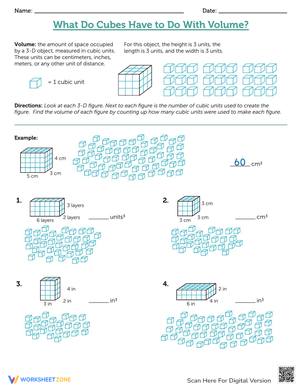
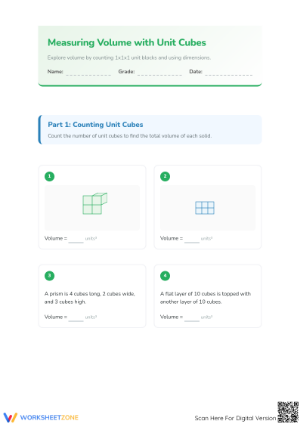
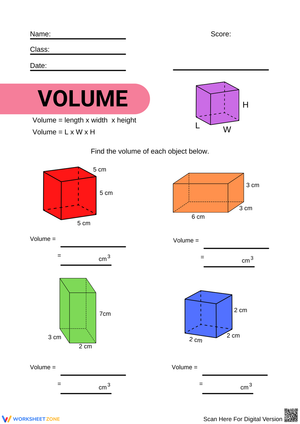
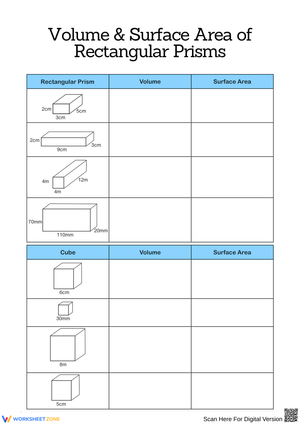
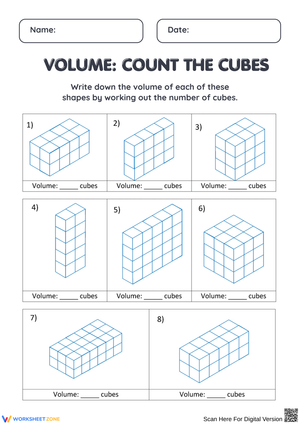
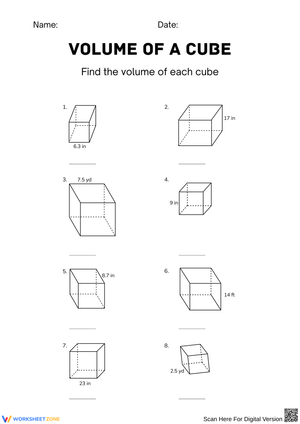
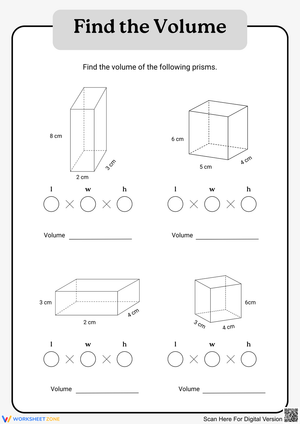
These volume of a cube worksheets for 5th grade give teachers a way to move students from counting unit cubes to confident formula use — and the set is organized so teachers can see exactly where each student's understanding stops. Visual models, direct computation, and short real-world problems appear across the worksheets, which maps onto the typical sequence of a 5th grade volume unit without requiring teachers to sort or sequence materials themselves.
What Students Work Through in This Set
Each worksheet targets a specific point in the progression from visual reasoning to formula fluency. Early worksheets have students count cubes arranged in clear layers — marking each layer before totaling — which builds the conceptual foundation before a formula appears. Later worksheets present a side length and ask for volume, with space to show the multiplication in full. The final worksheets in the set use word problems that describe cube-shaped objects without providing a diagram, so students identify the relevant measurement themselves.
- Counting unit cubes from layered diagrams, including some that ask students to label the number of cubes per layer before recording a total
- Identifying that all three dimensions of a cube are equal before applying s × s × s
- Computing volume with whole-number side lengths and recording answers in cubic units
- Solving word problems involving cube-shaped containers or blocks where the side length is embedded in a sentence rather than labeled on a diagram
- Comparing a cube to a rectangular prism with unequal dimensions to examine what changes and what stays the same
That last type — the comparison problem — is easy to skip but worth keeping. Students who see only cubes in isolation often have no path to a non-cube prism problem later, because they learned s³ as a standalone rule rather than a case of l × w × h.
Errors Worth Catching Before They Take Hold
The most reliable mistake in 5th grade volume work is a unit label error, not an arithmetic one. A student who correctly calculates 4 × 4 × 4 = 64 will write "64 square units" because the area work from 4th grade left a strong labeling habit. These worksheets build in explicit unit practice — students circle the unit type in the problem before solving and write it again in the answer — which gives teachers a fast way to check conceptual understanding separately from calculation accuracy.
A second consistent error: students multiply only two dimensions. They compute the area of one face (4 × 4 = 16) and stop, particularly when the problem leads with a diagram showing a single flat face. From their perspective, they multiplied two numbers and arrived at an answer. The third dimension didn't register as part of the calculation. Worksheets that label edges on all three axes reduce this error far more reliably than worksheets showing only a front-face view.
A third pattern worth watching is that students treat the cube formula and the rectangular prism formula as entirely separate procedures. When they see s × s × s on one worksheet and l × w × h on another, they don't connect them. A comparison worksheet that asks "How is a cube like a rectangular prism? What must always be true about its edges?" makes that a reasoning task rather than a memorization task — which is where the real understanding lives.
Fitting These Worksheets Into the Week
The counting-cube worksheets work well as whole-group practice during the first few days of volume instruction — project one, have students mark layers with tick marks, and discuss why four layers of 16 cubes gives 64 cubic units before the formula appears. Formula-based worksheets work as independent practice after a focused mini-lesson. The word-problem worksheets are the right length for an exit ticket: two or three problems, about five minutes, enough information for a teacher to see whether a student can locate the side length inside a sentence and apply s × s × s without a diagram to lean on.
For teachers using volume of a cube worksheets for 5th grade in intervention groups, the counting-cube worksheets offer a clean diagnostic. If a student adds edge lengths instead of multiplying them, the worksheet surfaces it immediately. Pull that student for a short session with physical snap cubes before returning to formula-based practice. That two-step approach — model then compute — closes the gap faster than re-explaining the formula alone.
Standard Alignment
These worksheets address CCSS.MATH.CONTENT.5.MD.C.3 (understanding volume as an attribute of solid figures measured in cubic units), 5.MD.C.5a (relating volume to multiplication through a packed prism model), and 5.MD.C.5b (applying the formulas V = l × w × h and V = B × h to rectangular prisms with whole-number edge lengths). The volume of a cube worksheets for 5th grade in this set treat cube volume as a specific, accessible case of the broader prism formula — which is also how the standard cluster is organized instructionally.
In most 5th grade math scopes, volume arrives in the third quarter, after students have worked through area and multiplication of fractions. The unit label error described above — writing square units instead of cubic units — comes directly from that prior area work, which is worth anticipating when planning the introduction.
Adjusting the Work for Different Entry Points in the Room
Students who need more support begin with worksheets that show pre-drawn unit cubes in distinct, clearly separated layers. The task is to count by layer — how many cubes in one layer, how many layers total — before any symbolic notation appears. That tells a teacher whether the student understands what volume represents, independent of multiplication fluency.
On-level students work with whole-number side lengths and standard computation, with explicit requirements to label answers in cubic units. The expectation is that they can move between a diagram and an equation without depending on the picture to get started.
Students ready for extension work backward from a given volume: if a cube holds 125 cubic units, what is the side length? That type of problem requires students to understand s³ as a relationship, not just a left-to-right calculation, and it quickly reveals whether they have that understanding or are pattern-matching to a procedure. Pairing a printable worksheet with snap cubes at a math center gives students a physical way to test their thinking before committing to a written answer.
Frequently Asked Questions
What formula do these worksheets use for cube volume?
The formula is s × s × s, where s is the side length. Each worksheet that introduces the formula also connects it to unit cube counting so students see where the shortcut comes from rather than treating it as an isolated rule.
Do students need to know exponent notation to use these worksheets?
No. The worksheets write the calculation as s × s × s rather than relying on the s³ notation, so students who haven't formally studied exponents encounter no notation barrier. Teachers who want to introduce the s³ form can layer it in alongside the written-out multiplication.
How long does each worksheet take to complete?
Most students finish a counting-cube worksheet in 6–8 minutes and a word-problem worksheet in 10–12 minutes. The time difference comes from the reading and interpretation load in word problems, not from the computation itself.
Can these worksheets be sent home for homework?
The diagram-based and computation worksheets send home reliably. Word-problem worksheets sometimes need classroom context — specifically, students need to know that the unit of measure stated in the problem determines which cubic unit belongs in the answer. The volume of a cube worksheets for 5th grade word problems work better as in-class practice where a teacher can clarify that kind of detail in the moment; the counting-cube and formula-computation worksheets are the cleaner homework choice.














 Interactive Worksheet Maker
 Quiz Maker
 Word Search Maker
 Crossword Puzzle Maker
 Word Scramble Generator
 Sentence Scramble Generator
 Handwriting Worksheet Generator
 Name Tracing Generator
 Fill In The Blank Generator




 BACK TOSCHOOL