




























Views
Downloads


Area of Parallelogram Worksheet | Essential Grade 5 Math

Paste this activity's link or code into your existing LMS (Google Classroom, Canvas, Teams, Schoology, Moodle, etc.).
Students can open and work on the activity right away, with no student login required.
You'll still be able to track student progress and results from your teacher account.
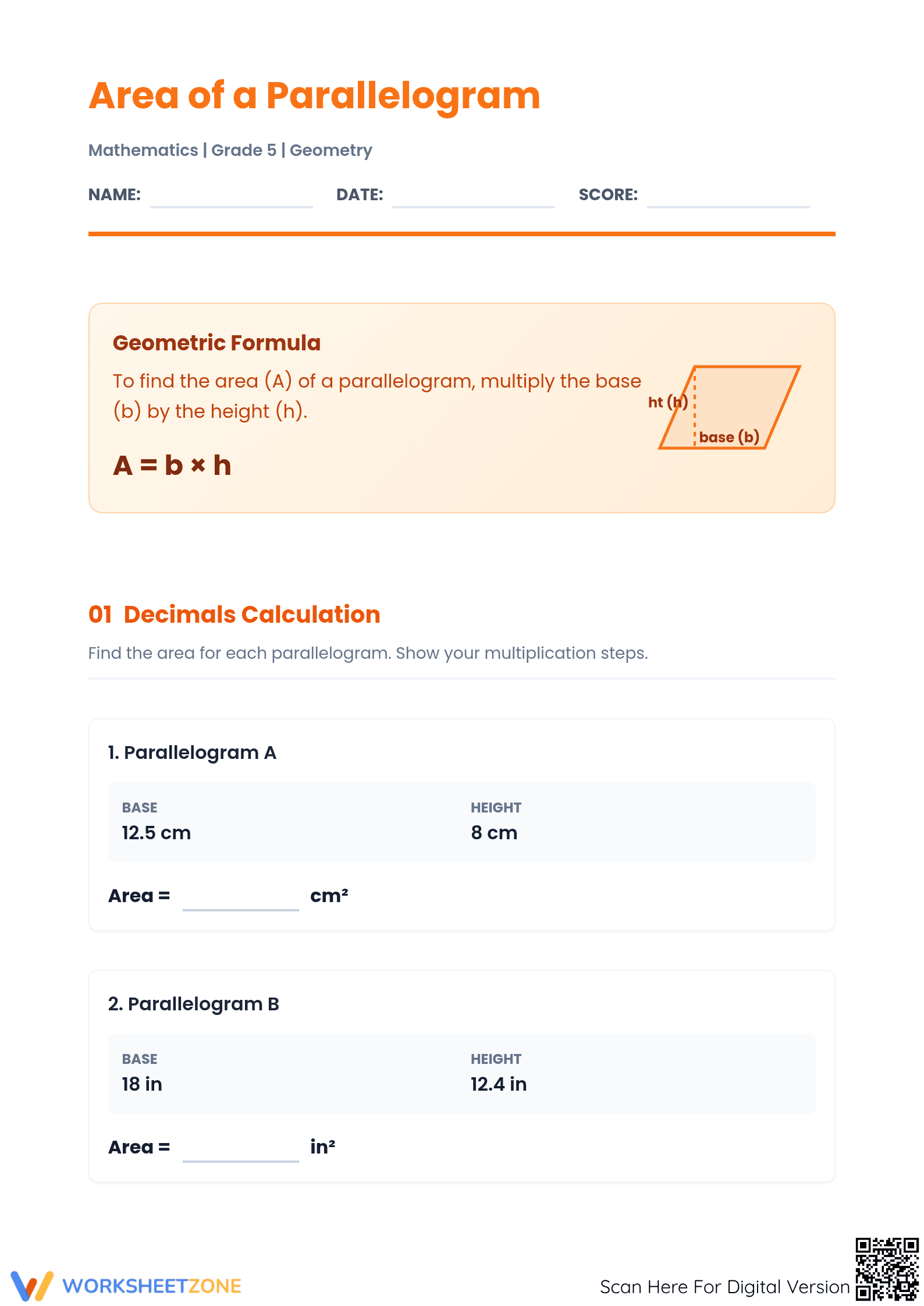
This Grade 5 math worksheet provides comprehensive practice for calculating the area of a parallelogram using the A = b × h formula. Students progress from simple decimal calculations to finding missing dimensions and solving complex real-world word problems. This resource ensures students develop a deep procedural and conceptual understanding of geometric measurements in varied contexts.
At a Glance
- Grade: 5 · Subject: Mathematics
- Standard:
CCSS.MATH.CONTENT.6.G.A.1— Find the area of special quadrilaterals by applying the base times height formula- Skill Focus: Area of Parallelograms · Decimals
- Format: 4 pages · 12 problems · Answer key included · PDF
- Best For: Independent practice, sub plans, and geometry review
- Time: 30–45 minutes
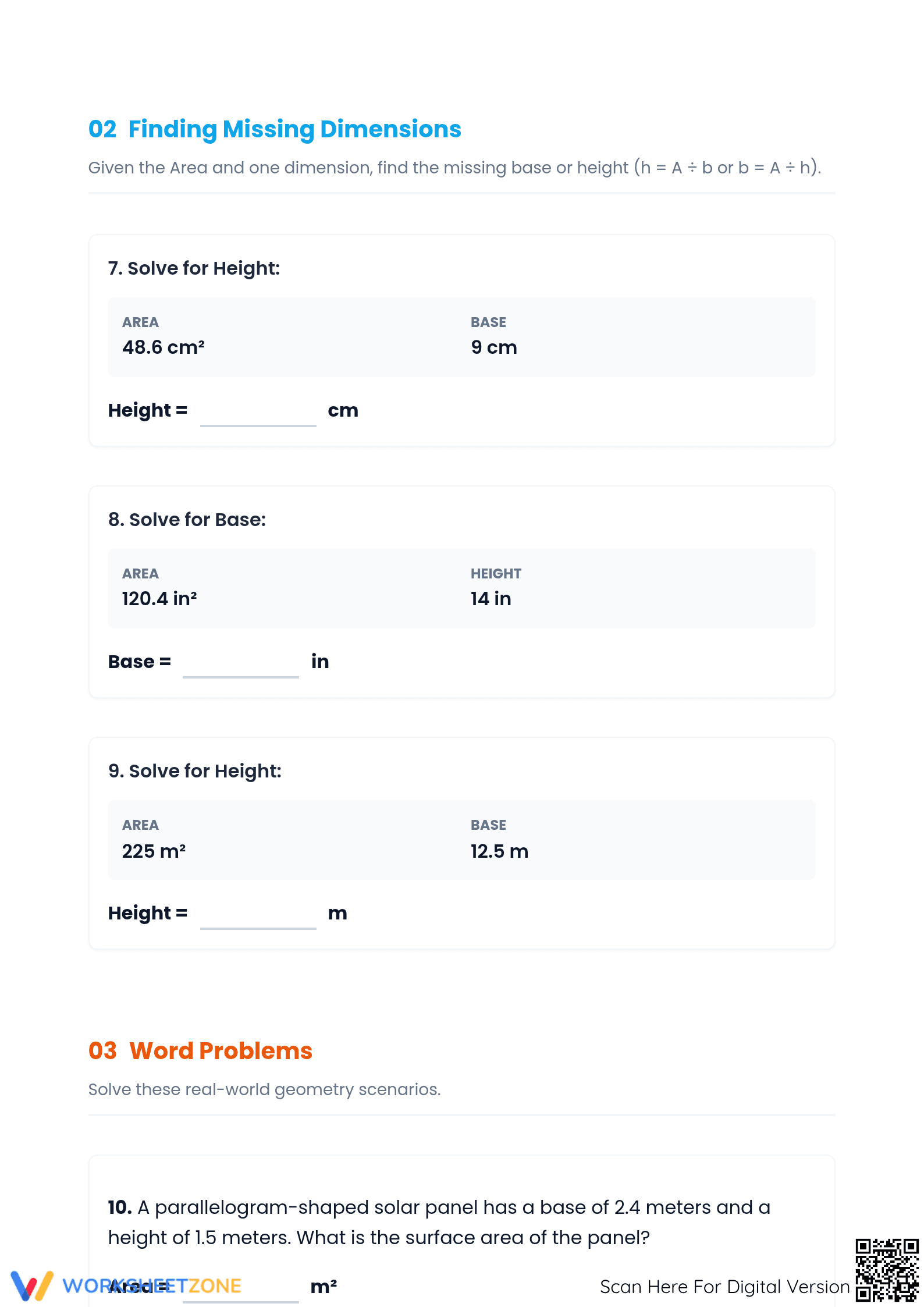
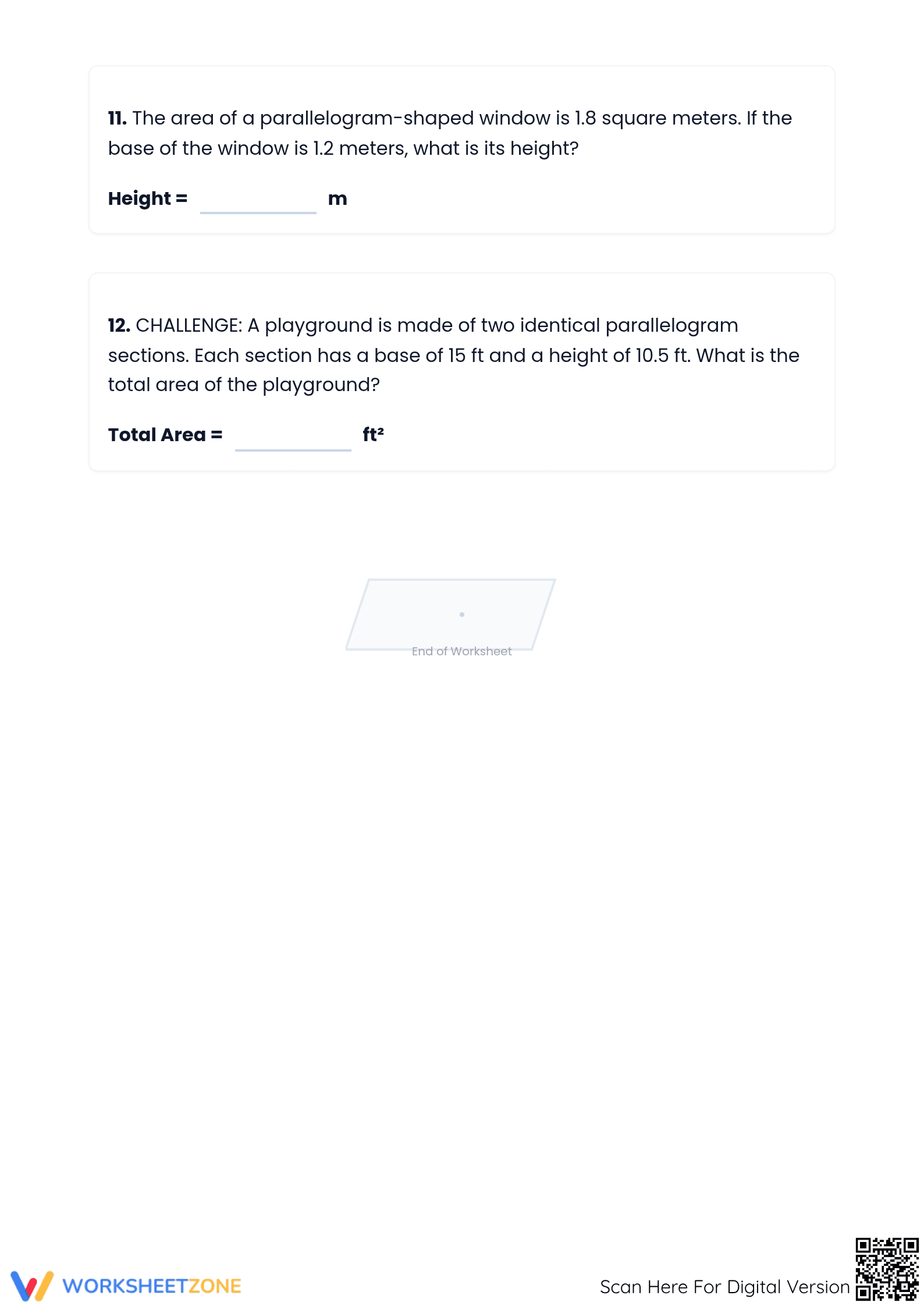
This four-page set includes a dedicated formula reference section to scaffold student learning. It features six direct calculation problems involving decimals, three "missing dimension" problems where students must solve for either the base or height, and three realistic word problems. The final task is a multi-step challenge problem. A full answer key is provided for immediate grading.
This resource is designed for immediate classroom implementation with a total teacher prep time of less than 60 seconds. Simply print the four-page PDF (1 minute), distribute the copies to your students (30 seconds), and use the included answer key for a rapid 2-minute review or self-checking session. It is an ideal solution for emergency substitute folders or planned geometry units.
The primary alignment is `CCSS.MATH.CONTENT.6.G.A.1`, which requires students to find the area of special quadrilaterals by composing into rectangles or decomposing into triangles. This worksheet specifically targets the application of techniques in the context of solving real-world and mathematical problems. This standard code can be copied directly into lesson plans, IEP goals, or district curriculum mapping tools.
Use this worksheet during the "You Do" phase of a gradual release lesson on geometry. It works exceptionally well as a formative assessment after teaching decimal multiplication within measurement contexts. Teachers should observe students during the missing dimension section to identify if they can correctly manipulate the formula algebraically, providing a clear window into their mathematical reasoning.
This resource is specifically designed for Grade 5 students working on advanced geometry or Grade 6 students meeting standard requirements. It provides necessary scaffolding for struggling learners via the formula box, while the challenge problem stretches high-achieving students. It pairs perfectly with an introductory geometry passage or a base-and-height anchor chart.
Effective instruction in geometry requires moving beyond rote memorization of formulas toward applying those formulas in diverse mathematical contexts. According to research from EdReports (2024), high-quality instructional materials must provide a balance of procedural fluency and application-based problem-solving. This worksheet achieves that balance by requiring students to navigate decimal multiplication alongside missing-dimension algebra and real-world scenarios. By integrating 12 distinct tasks across 4 pages, the resource aligns with the Fisher & Frey (2014) model of gradual release, moving students from guided formula use to independent challenge tasks. This structured approach to CCSS.MATH.CONTENT.6.G.A.1 ensures that students internalize the relationship between base and height measurements. Educational analysis from ScienceDirect TpT Analysis indicates that worksheets emphasizing "zero-prep" utility significantly reduce teacher burnout while maintaining rigorous academic standards. This resource serves as a validated tool for developing spatial reasoning and measurement accuracy in middle-grade learners.


