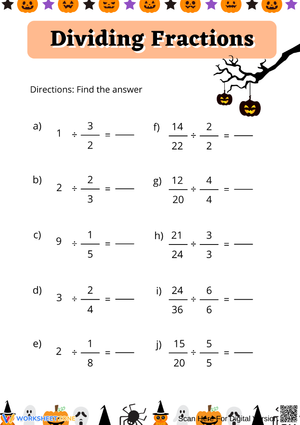
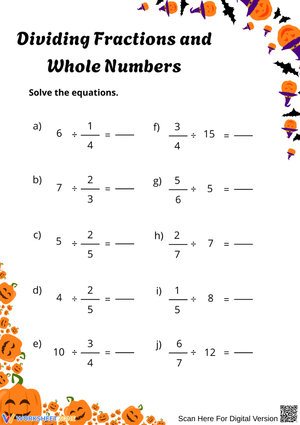
Dividing Fractions by Whole Numbers Printable Worksheets for 5th Grade
These dividing fractions by whole numbers printable worksheets for 5th grade give teachers a ready sequence of practice that moves from drawn models to bare equations to word problems — the arc most 5th graders need to genuinely internalize the skill rather than just memorize a procedure. Each worksheet stands alone, so a teacher can pull the visual model set on Monday and the algorithm practice mid-week without committing to any fixed order.
What the Set Covers
The resources address CCSS 5.NF.B.7 directly: dividing unit fractions by whole numbers. The progression across the worksheets is logical, though each can be used independently:
- Fraction bar and number line diagrams that ask students to shade, partition, and count before any equation is written
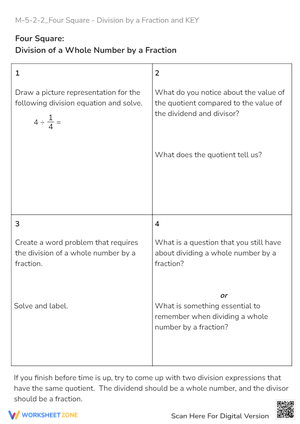
- Side-by-side comparisons of a visual model and its matching equation, so students connect the drawing to the procedure
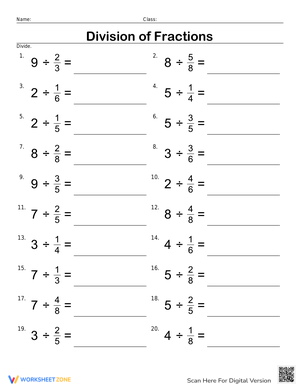
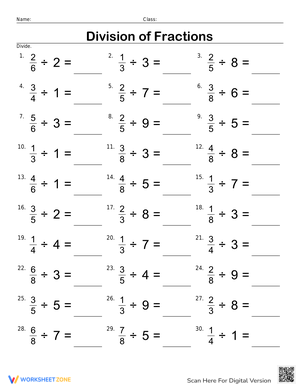
- Algorithm practice with unit fractions — 1/2 ÷ 3, 1/4 ÷ 5 — with a worked reference example at the top of each worksheet
- Extension problems with non-unit fractions for students ready to move beyond the standard
- Equal-sharing and measurement word problems written at a 5th-grade reading level
- Error-analysis tasks where students find a mistake in a solved problem, explain it in writing, and correct it
The error-analysis tasks deserve specific mention. Standard drill surfaces computation speed but hides the student who applies keep-change-flip correctly half the time and flips the wrong number the other half. Error analysis forces students to read each step deliberately and put into words what went wrong — work that shows up clearly in their written explanations and tells a teacher far more than a score does.
Mistakes Students Make That These Worksheets Help You Catch
The most persistent error at this level is direct division of the numerator. A student faced with 3/4 ÷ 3 writes 1/4, and when the numerator and divisor happen to share a factor, the answer is accidentally correct — which is exactly the problem. That shortcut holds for cases where the numerator is a multiple of the whole number, then collapses completely on a problem like 1/2 ÷ 3, where no such clean division exists. The error-analysis worksheets include this trap: a "solved" problem where someone divided the numerator directly, and students must name what the solver did and explain why it only sometimes works.
A second pattern appears once keep-change-flip is introduced: students flip the fraction instead of the whole number. They convert 1/3 ÷ 4 into 1/3 × 3 and land on 1 — a result that should trigger immediate doubt, since dividing a positive fraction by a whole number greater than one must produce something smaller than the original fraction. Students who have that conceptual anchor catch the error themselves. Students who went straight to the algorithm without time on the visual models often don't. The number-line worksheets build exactly this intuition: after drawing what happens when you split 1/3 into four equal pieces, students know the answer has to be less than 1/3 before they compute anything.
Getting the Most from These Worksheets in Your Weekly Planning
The visual model worksheets work best as the unit introduction — or as a Monday re-entry after the weekend — because they don't require any algorithm recall. Students can engage with the drawing and partitioning tasks even before keep-change-flip is formally taught. That matters here because the procedure has a surface-level simplicity that encourages students to skip the reasoning entirely. Slowing down with models first pays off when the algorithm instruction actually arrives.
Mid-week, once the procedure is in place, the bare equation worksheets work well as independent practice in a math center or as a closing task in the last ten minutes of a period. Dividing fractions by whole numbers printable worksheets for 5th grade that include a worked reference example at the top are particularly useful at this point — students who lose track of the steps mid-problem can reset without stopping the class.
The word problem and error-analysis worksheets land better at the end of the teaching sequence, after at least two sessions with the bare procedure. Fifth graders who are still reconstructing the algorithm from memory get overloaded when they also have to parse a word problem — the competing demands work against both skills. Once the procedure is relatively automatic, word problems become a useful check on whether students understand what they actually computed.
From Drawing to Equation: Building the Conceptual Foundation
The keep-change-flip mnemonic is efficient and easy to remember. It also travels without meaning unless students have done the conceptual work first. A student who has drawn 1/2 on a number line and marked it into three equal pieces understands immediately that each piece represents 1/6 of the whole. That student, when later shown the equation 1/2 × 1/3 = 1/6, can see why multiplying by the reciprocal matches what they drew. A student who learned "flip the number" without the model has no way to check whether an answer is even in the right neighborhood.
The visual model worksheets include prompts that explicitly bridge the two representations: students complete a drawing, write the unit fraction each piece represents, and then write the matching multiplication sentence underneath. That transition — from picture to procedure — is where conceptual understanding either consolidates or gets lost. Spending a full lesson on just that connection, before any bare-equation practice, is worth the time.
Adjusting the Set for a Range of Learners
Students who are still working out what a denominator actually represents — and there are always a few in a 5th-grade class — need more time on the fraction bar worksheets before they touch the algorithm at all. The drawing tasks don't require procedural fluency, so these students can build understanding through the visual work while the rest of the class moves into equation practice. The dividing fractions by whole numbers printable worksheets for 5th grade that use number line diagrams give this group a concrete entry point that bare equations simply don't provide.
For students who grasp the procedure quickly, the extension problems with non-unit fractions and the written error-analysis tasks are the right move. Explaining in writing why a flipped numerator produces a wrong answer — clearly enough that a classmate could follow the reasoning — is much harder than solving the problem correctly, and it surfaces gaps that a correct numerical answer hides entirely.
The word problems also tier naturally within the set. Some are one-step equal-sharing scenarios; others require students to set up the equation from a paragraph before calculating. Assigning the one-step problems to students still building procedural confidence while the multi-step problems go to students who are ready for interpretation challenges is a straightforward way to keep the whole class working on the same skill at appropriate difficulty.
Standard Alignment
CCSS 5.NF.B.7 — Number and Operations: Fractions — requires students to apply and extend previous understandings of division to divide unit fractions by whole numbers and whole numbers by unit fractions. This set specifically targets 5.NF.B.7b: interpreting division of a unit fraction by a non-zero whole number and computing the quotient. The standard sits at the end of the 5th-grade fractions progression, which means students are expected to arrive here with a working understanding of fraction multiplication (5.NF.B.4) and the concept of a fraction as division (5.NF.B.3).
In classroom terms, this skill typically appears in the second half of the year. Teachers who assign the visual model worksheets before any algorithm instruction position the skill as a logical extension of what students already know about fractions — rather than a new rule that arrived out of nowhere. The error-analysis and word problem worksheets align with the standard's emphasis on interpretation, not just computation.
Frequently Asked Questions
Do students need to understand fraction multiplication before starting these worksheets?
Yes — specifically the conceptual sense of what multiplying a fraction by a fraction means, not just the procedure. Keep-change-flip converts a division problem into multiplication by the reciprocal, so students who haven't done 5.NF.B.4 work tend to execute the flip correctly but can't explain why multiplying by 1/4 is the same as dividing by 4. The visual model worksheets can be used before fraction multiplication is fully solid, since they don't rely on the algorithm — but the equation-based worksheets assume that foundation is in place.
What's the difference between the unit fraction problems and the non-unit fraction problems in the set?
Unit fraction problems — 1/2 ÷ 3, 1/5 ÷ 4 — are what 5.NF.B.7 explicitly targets. Non-unit fraction problems — 2/3 ÷ 5, 3/4 ÷ 2 — go beyond the standard but appear in many 5th-grade curricula and on most standardized assessments. The dividing fractions by whole numbers printable worksheets for 5th grade in this set cover both, with unit fraction work appearing first and clearly distinguished so teachers can stop there if the standard is all they need to address.
Can the error-analysis worksheets work for re-teaching after a quiz?
They work well for exactly that purpose. Students who performed poorly on a quiz often disengage when handed another set of blank computation problems — it can feel like repetition of failure. Starting re-teaching with an error-analysis worksheet shifts the task: the student is the expert locating someone else's mistake, not the person who got it wrong again. That reframe tends to help with re-engagement, and writing out an explanation of the error forces the correct procedure more deliberately than re-solving problems from scratch ever does.
Clear All