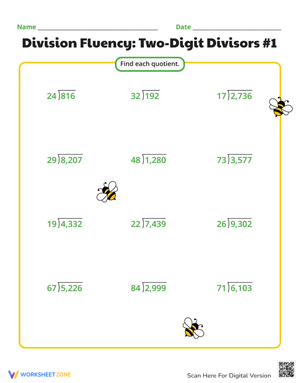
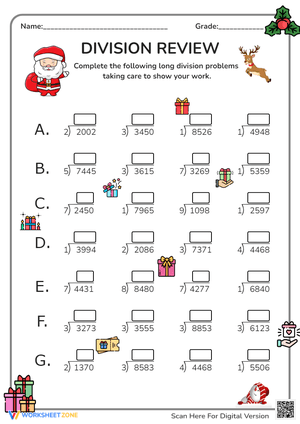
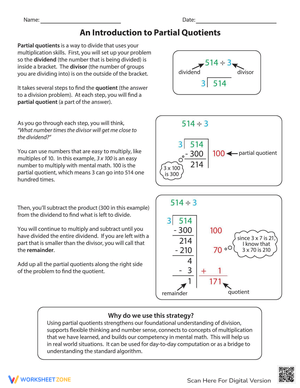
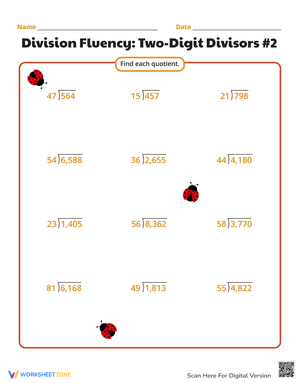
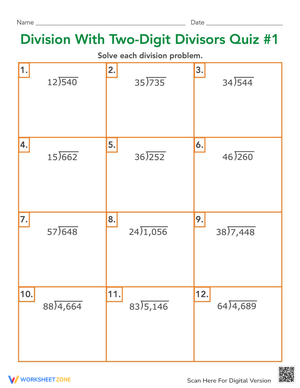
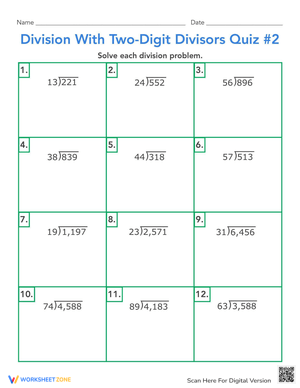
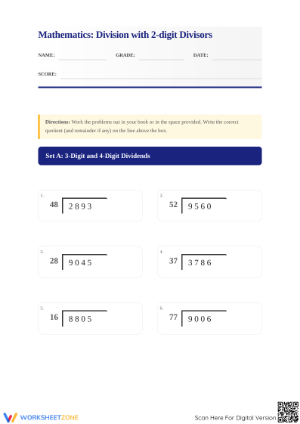
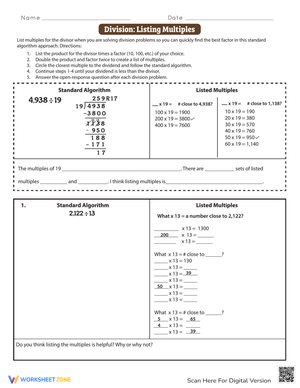
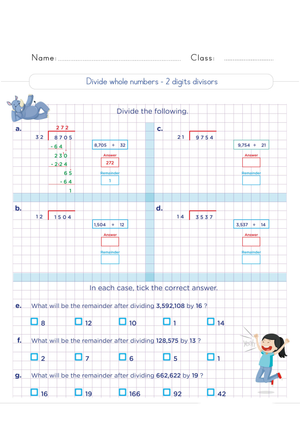
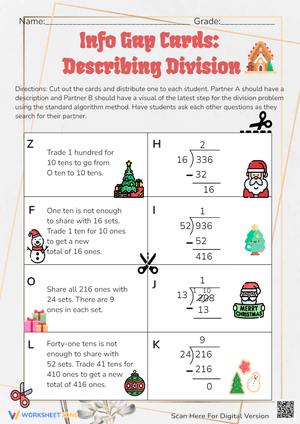
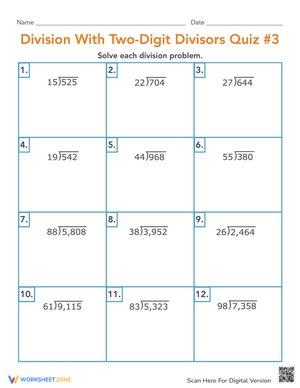
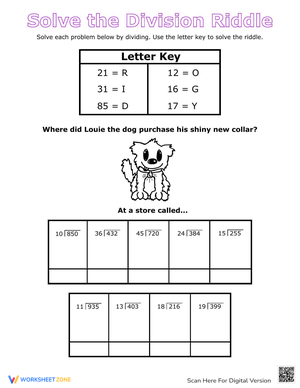
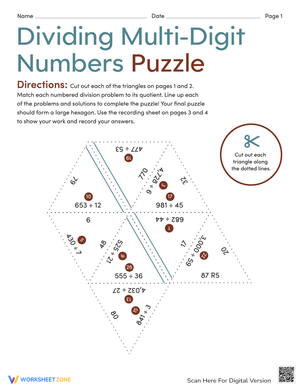
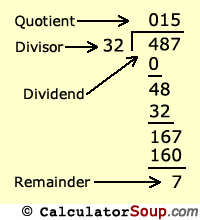
These division with two digit divisors worksheets for 5th grade give teachers print-ready practice that slots directly into the instructional window after one-digit divisors and before decimal division. Each worksheet moves students through a specific part of the skill arc — from estimating a reasonable quotient digit to full long division with remainders to word problems that require interpreting what's left over — so the set functions as a planning tool as much as a practice resource.
What Each Worksheet Targets
The worksheets cover the full progression of dividing by two-digit numbers. Early worksheets focus on estimation: students identify the closest multiple of the divisor before computing, which builds the habit of reasoning first instead of guessing and erasing. Middle worksheets move into full long division with four-digit dividends, keeping the written work visible so every multiply-subtract-bring-down cycle is traceable on the page. Later worksheets introduce remainders, then connect computation to short word problems where students must decide whether the remainder rounds the quotient up or gets discarded entirely.
- Quotient estimation with multiples of ten as anchor points
- Full long division with exact quotients and four-digit dividends
- Remainder problems with complete written work required
- Word problems that test whether students can interpret the remainder in context
- Answer keys included with each worksheet for fast review
Building These Worksheets Into Your Math Block
Bell work is the fastest entry point. Four or five estimation-focused problems from an early worksheet take about eight minutes and prime students to think before they compute — a habit that matters once the dividend hits four digits. After a whole-class modeled example, a full worksheet makes a clean independent practice block. A useful mid-session move for students who need more processing time: pause after six problems and ask them to explain one step aloud to a partner. That brief pause reduces the crossed-out, restarted work that makes notebooks hard to read during a conference.
For targeted intervention, sort students by error pattern rather than by overall performance. Three students who keep placing the quotient digit in the wrong column share a place-value issue; three students who choose an unreasonable first digit share an estimation issue. Those are different reteach targets, and the written work visible on a completed worksheet makes the distinction quick to identify. For centers, mixed worksheets — some exact quotients, some remainders — keep the routine stable without making the task feel repetitive once students know the procedure.
Mistakes Students Make That These Worksheets Help You Catch
The most predictable error in this unit is an estimation problem that looks like a computation problem. A student dividing 2,184 by 36 will sometimes choose 8 as the first quotient digit, multiply to get 288, notice it is greater than the partial dividend, erase, try 7, and repeat the whole sequence. The root cause is not a weak multiplication fact — it is that the student never reasoned that 36 times 6 is approximately 216 and is a sensible starting point. The written work on these worksheets shows exactly where the trial-and-error began, which makes the reteach conversation much more direct than a general prompt to "show your work."
Remainder interpretation trips students up in a different way. A student who correctly records "13 R1" after dividing 157 by 12 will often treat the problem as finished. When the word problem asks how many buses are needed to transport 157 students in groups of 12, the answer is 14 — the one remaining student still needs a bus. Students encounter this distinction for the first time and it rarely sticks on the first pass. Including a straight computation problem and its word-problem counterpart in the same session gives teachers a direct comparison between the two responses, which is exactly where that gap becomes visible and teachable.
Standard Alignment
5.NBT.B.6 — Common Core State Standards for Mathematics — expects fifth graders to find whole-number quotients with up to four-digit dividends and two-digit divisors using strategies based on place value, properties of operations, and the relationship between multiplication and division. Division with two digit divisors worksheets for 5th grade built around four-digit-by-two-digit problems address that standard at its core — this is not an enrichment topic or a stretch skill but the grade-level expectation for the unit.
In most unit sequences, 5.NBT.B.6 follows multi-digit multiplication work under 5.NBT.B.5 and precedes decimal operations. Accuracy with whole-number quotients needs to be established before decimal division makes sense, so these worksheets sit at a genuine instructional hinge point in the Grade 5 math year. Teachers can also use the verification step — checking quotients by multiplying back — to reinforce 5.NBT.B.5 in a meaningful context rather than as isolated review.
Adjusting Each Worksheet for a Range of Student Readiness
For students who need more support, choose problems where the dividend is close to a friendly multiple of the divisor. Dividing 2,400 by 30 is a cleaner entry point than 2,413 by 31 because the estimation step requires less rounding judgment. One concrete pre-work move: ask these students to write the nearest multiple of ten for the divisor and circle it before beginning. That structured first step builds the estimation habit without requiring a separate resource or a different set of problems.
On-level students handle mixed worksheets well after two or three modeled examples. The combination of exact-quotient problems and remainder problems keeps the cognitive demand from flattening. For students ready for more challenge, add a brief writing requirement after each word problem: "I rounded up / ignored the remainder because..." That prompt does not change the computation task but forces the mathematical reasoning to be stated rather than assumed, which surfaces gaps that correct final answers can hide.
Division with two digit divisors worksheets for 5th grade work across ability levels when teachers vary the number of problems assigned, the amount of talk-aloud support offered, and the follow-up expectation — not the worksheet itself. One answer-key-supported set can serve the whole class without producing three separate packets for three groups.
Frequently Asked Questions
What should students know before starting these worksheets?
Students need multiplication fact fluency through at least the tens, experience with long division using one-digit divisors, and enough place-value understanding to estimate whether a quotient digit belongs in the tens or ones position. Without those foundations, students guess rather than reason, and every worksheet in the set becomes a frustration exercise instead of a productive practice task.
Do the worksheets include word problems, or only straight computation?
The set includes both. Straight computation builds the procedural fluency students need. Word problems test whether that fluency transfers to real reasoning. A student who correctly solves 195 divided by 13 as a bare equation but writes the wrong answer when one student is left over on a bus problem has a remainder-interpretation gap that only a context-based problem can expose. Having both types in the same session makes that gap visible without extra materials.
How are the answer keys structured for classroom use?
Each worksheet includes its own answer key, which supports independent use in centers, take-home folders, and substitute lesson plans. During small-group instruction, the answer key speeds up the conferencing cycle — teachers can move from confirming a final answer to analyzing the written work quickly, spending more time on error diagnosis than on arithmetic checking.
Are these useful for test preparation?
Division with two digit divisors worksheets for 5th grade align directly to 5.NBT.B.6, which appears on most major Grade 5 standardized assessments. The written-work format — where students record every step of the divide-multiply-subtract-bring-down cycle — also reflects how assessments expect students to demonstrate reasoning, not simply report a final answer.














 Interactive Worksheet Maker
 Quiz Maker
 Word Search Maker
 Crossword Puzzle Maker
 Word Scramble Generator
 Sentence Scramble Generator
 Handwriting Worksheet Generator
 Name Tracing Generator
 Fill In The Blank Generator




 BACK TOSCHOOL