Printable Prewriting Pages That Help 5th Graders Plan Better Writing
These 5th grade prewriting printable worksheets resources address one of the most persistent problems in upper elementary writing instruction: students who have something to say but stall the moment the prompt appears. The set covers all three major text types — opinion, informative, and narrative — giving teachers planning tools that work across genre units, small-group instruction, and independent writing blocks.
The Planning Skills Each Worksheet Targets
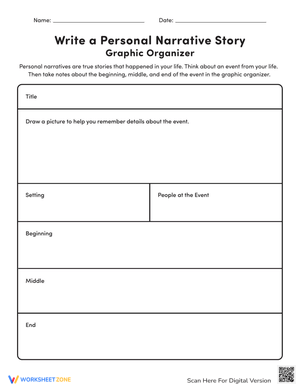
The worksheets are organized by text type because the thinking required to plan an opinion piece is not the same as what narrative or informative writing demands. Opinion worksheets ask students to state a claim, list specific reasons — not restatements of the claim — and identify where their supporting evidence comes from. Informative worksheets focus on sorting facts into categories before drafting so the final piece has clear structure rather than becoming a loose list. Narrative worksheets give students space to record character, setting, problem, key events in sequence, and resolution before writing a single sentence of prose.
Beyond the text-type organizers, the set also includes brainstorming webs, quick-write worksheets, and paragraph-level planners for different stages of the planning process:
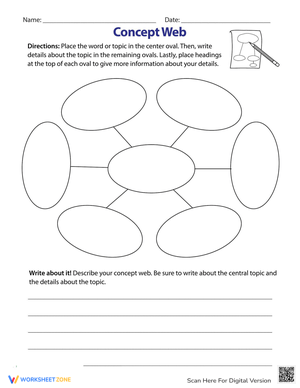
- Brainstorming webs — for topic generation when the prompt is open-ended or student choice is involved
- Quick-write worksheets — for low-pressure idea generation, especially before students commit to a topic or argument
- Paragraph planners — for organizing a focused response when the student already has a direction but needs to sort the parts
- Story maps — for narrative writing, tracking setting, characters, and event order before drafting begins
- Evidence planners — for opinion writing that requires reasons paired with specific supporting details
That range matters: no single format fits every writer or every assignment, and 5th grade prewriting printable worksheets resources that cover all three genres let teachers match the tool to the task rather than forcing every planning session through the same format.
Frequent Planning Errors That Surface Before Students Draft a Word
In opinion writing, the most predictable prewriting mistake is confusing a reason with a restatement of the claim. A student planning an argument about reducing homework will write "reason 1: too much homework is bad" — which is just the claim again, wearing a different hat. The opinion planning worksheets ask students to answer "how do you know?" next to each reason, which pushes them toward actual evidence before drafting starts. Without that prompt, students typically discover mid-draft that they have nothing new to say after the opening sentence.
In informative writing, the common failure is the detail dump — students list every fact they know without sorting it into categories. A category planner makes that problem visible immediately: if a student cannot assign a fact to one of three sections, it either needs a more specific home or it doesn't belong in the piece at all. That sorting decision is far easier to make during planning than during revision of a completed draft. Informative writers at this grade also frequently conflate the main idea with its supporting detail — "dogs need exercise" written as both the section heading and the only supporting point beneath it.
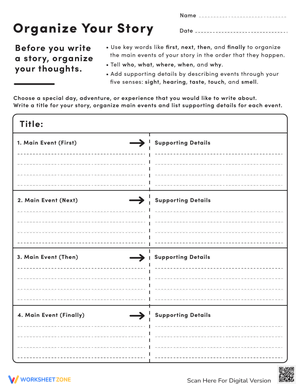
Narrative planning tends to produce a different kind of error: detailed setting notes paired with a single-sentence summary of all the action. "They went into the cave and found the treasure" is not a sequence — it's an endpoint. The story-map worksheets ask students to note what each character does and what changes at each step, which reveals that thinness before it becomes a structural gap in the full draft.
How to Work These Worksheets Into Your Writing Block
The most practical placement is a 6-to-8-minute planning routine right after the mentor text read-aloud or the prompt introduction, before students open their notebooks to draft. That window is long enough for real planning decisions but short enough that momentum doesn't stall. If students are still filling in the organizer after 10 minutes, the worksheet is carrying too much weight — move to a simpler layout for whole-class use and save the detailed planner for small groups.
In whole-group instruction, projecting the organizer and thinking aloud through one section at a time makes the planning process visible. Many grade 5 students believe that real writers go directly from prompt to paragraph — seeing a teacher pause, cross something out, and rearrange reasons on the planner does more to normalize planning-before-drafting than any amount of explanation. In small groups, the completed planner functions as a quick diagnostic: thin evidence on the planning worksheet predicts thin paragraphs in the draft, and you can address that gap before drafting begins rather than after.
For homework or take-home practice, these worksheets give students a clear entry point — no blank page to stare at, just a familiar planning format they have already used in class. The printable format also makes these reliable sub-day materials since the task is self-explanatory and doesn't require the classroom teacher to set it up in advance.
Standard Alignment
These worksheets support CCSS.ELA-LITERACY.W.5.1, W.5.2, and W.5.3 — the grade 5 standards for opinion, informative or explanatory, and narrative writing. Each standard includes organizational requirements: logical order and supporting evidence for opinion pieces, grouped information for informative essays, clear event sequences for narratives. Prewriting is where those structural decisions are most efficiently taught. Waiting until a draft is complete to address weak organization means students are revising at the sentence level when the real problem is structural.
W.5.4, which addresses producing clear and coherent writing, is also supported here because coherence is built during planning, not applied afterward. Grade 5 is frequently the first year students are asked to write multi-paragraph responses independently, which means the structural thinking these worksheets develop is not a supplement to grade-level expectations — it is how those expectations become reachable for most students.
Adapting the Set for a Range of Writers
For students who need more support, the structured organizers — those with labeled sections, sentence starters, and explicit prompts like "my strongest reason is..." — reduce the load of figuring out what goes where. These students can direct their attention to the content of their plan rather than its form. For students who are already fluent planners, a simpler layout with minimal prompts keeps prewriting from feeling like busywork. The goal for those writers is speed and focus, not a filled-out form.
Students writing below grade level often do better moving through two worksheets in one session — a brainstorming web first, then a paragraph planner — rather than jumping directly into a detailed organizer. That two-step approach keeps planning manageable without abandoning structure entirely. Students writing well above grade level can use the evidence planner to raise the specificity of their support: instead of noting "evidence: statistics," they record the actual data they plan to cite, which lifts the quality of the draft without changing the genre task.
One honest limitation: the multi-section planners frustrate students who process writing holistically and resist sorting their ideas into boxes before drafting. For those writers, the quick-write worksheet — a timed free-write with a focus question — produces a more useful plan than a structured organizer. Having both formats available in the set means those students are not forced into the same entry point as everyone else.
Frequently Asked Questions
Do these worksheets work for both timed writing practice and extended unit writing?
Yes. For timed practice, the shorter brainstorm and quick-write formats give students a workable plan in under five minutes. For unit writing, the paragraph planner and evidence organizer suit longer preparation windows where students have time to develop their thinking before drafting. The 5th grade prewriting printable worksheets set is organized by format type so teachers can identify the right worksheet for the task quickly rather than sorting through unrelated materials.
Do the worksheets cover all three text types, or only one genre?
The set includes planning worksheets for opinion, informative, and narrative writing, plus brainstorming webs and quick-write formats that work across genres. Each worksheet is a standalone planning tool, so teachers can assign individual worksheets based on the current unit rather than working through the set in sequence.
Can these be used for state writing assessment preparation?
Grade 5 state writing assessments typically include at least one extended prompt, and students who have practiced planning on a structured organizer are better prepared to use the scratch-work section on the test itself. What these worksheets build is the habit of planning before drafting — the transferable behavior the assessment requires — rather than test-format familiarity specifically. Teachers preparing students for assessments that include opinion or informative prompts will find those two organizer types the most directly applicable.
What should a teacher do when a student rushes through the planner and wants to draft immediately?
Let them draft — as long as the planner is substantively complete. A student who has listed one reason on an opinion worksheet is not done planning. But a student who has filled in all sections with specific evidence is ready to write, and holding them back to fill more boxes is counterproductive. The 5th grade prewriting printable worksheets resources work best when teachers treat a genuinely complete planner as a go-ahead signal rather than requiring a fixed amount of time on the task.
Clear All