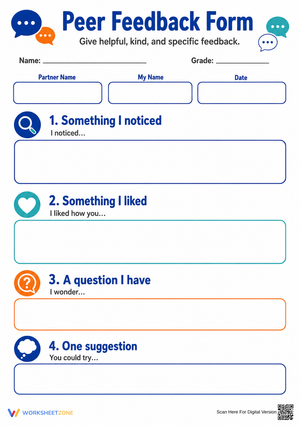
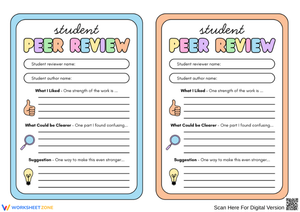
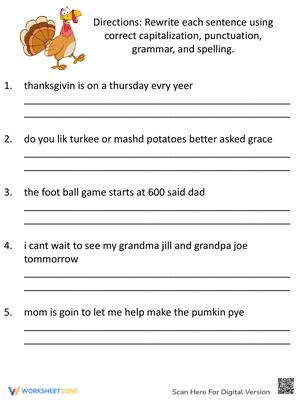
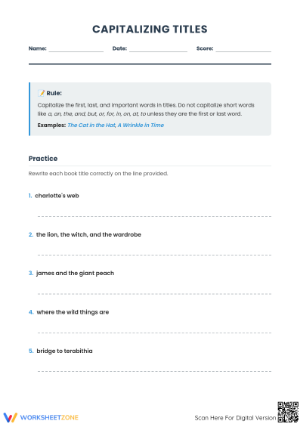
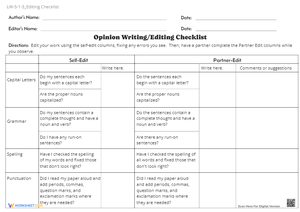
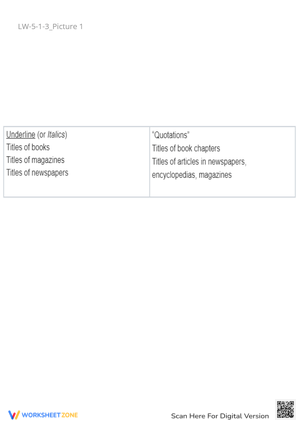
These editing pdf worksheets for 5th grade give teachers a direct route into proofreading practice — targeted enough to address the exact errors appearing in student drafts that week, short enough to run as a bell-ringer or center task without eating into longer writing time. Fifth graders are producing opinion, informative, and narrative pieces across the year, and they need repeated contact with conventions before those habits show up reliably in their own finished work.
The Specific Skills Covered in Each Worksheet
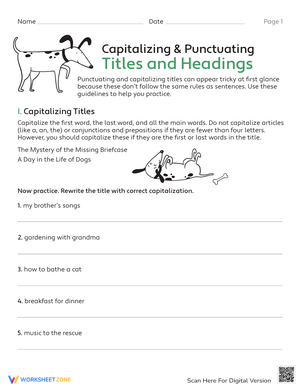
Fifth graders at this stage are past circling random mistakes. Stronger proofreading practice asks them to read with intention and name what signals the error. Across this set, the skills that surface most — and that also appear most frequently in actual student drafts — include punctuation at sentence boundaries, comma placement in compound sentences and after introductory elements, capitalization of proper nouns and titles, spelling of high-frequency academic vocabulary, and sentence clarity when a long, ambitious sentence starts to lose control of its own structure.
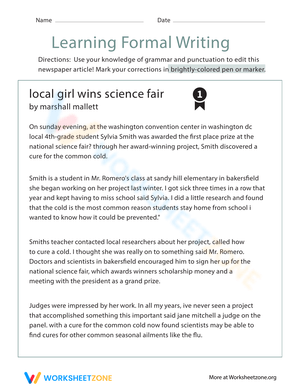
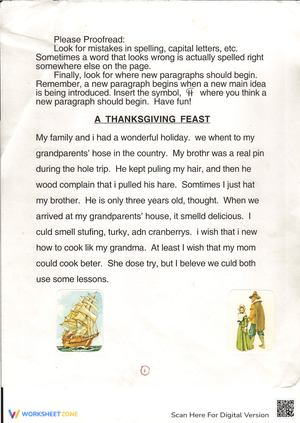
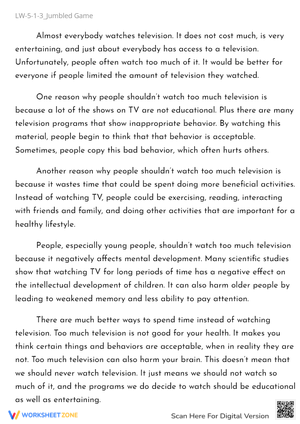
Each worksheet moves between sentence-level items and short passage proofreading. The sentence-level tasks isolate one pattern so teachers can reteach it cleanly — or use it as a formative check right after a mini-lesson. The passage tasks ask students to sustain attention across several lines, which is closer to what they actually do when editing a paragraph before turning in a final draft. Rotating between those two formats builds a stronger bridge from isolated practice to real writing work.
One pattern worth naming explicitly: in isolated sentences, most fifth graders correctly flag "there," "their," and "they're." In a six-sentence passage, the same students skim past the same error because they're reading for meaning rather than scanning each word individually. Passage-level proofreading is where the real training happens, and it's where teacher observation tells you the most.
Editing Versus Revising — Why the Distinction Matters
Students treat both revision and editing as "fixing," and teachers often have to reteach the split deliberately. Revising asks whether the writing actually says what the author means — it touches ideas, organization, elaboration, and coherence across a whole piece. Editing is narrower: it corrects conventions so the writing is ready for readers. Both matter in fifth grade, but the sequence is critical. Editing before revision is done wastes the effort; students spend time perfecting punctuation in sentences that may still need to move, expand, or disappear entirely.
A simple routine is to label assignments by stage. When students see a worksheet marked "editing only," they know their job is punctuation, capitalization, spelling, and sentence clarity — not rewriting ideas. That clarity makes each session more efficient and helps students understand where editing belongs inside the full writing process. The payoff shows up during conferencing: final drafts arrive cleaner, and the conversation can stay on the writing instead of surface errors.
Standard Alignment
CCSS.ELA-LITERACY.W.5.5 calls for students to develop and strengthen writing by planning, revising, editing, rewriting, or trying a new approach. For classroom planning, placement within that sequence matters. Using editing pdf worksheets for 5th grade before students have settled the larger decisions in a draft — what it argues, how it's organized, where the evidence falls — redirects attention toward surface correctness too early, before the content is stable enough to polish.
The IES What Works Clearinghouse practice guide on effective elementary writing instruction identifies regular, focused convention work — spelling, sentence construction, and proofreading routines — as a core support for writing development. A five- to ten-minute editing routine repeated three or four times per week aligns with that recommendation far more reliably than a long correction packet completed once. Spaced, consistent practice is what moves convention skills from a finished worksheet into actual student drafts.
Fitting These Worksheets Into a Weekly Teaching Routine
Teachers get the most from editing pdf worksheets for 5th grade when the sessions stay short and consistent rather than occasional and extended. Five to ten minutes of focused proofreading four times a week produces stronger transfer than a single long review session — students see the patterns more often, teachers catch trends while the class is still mid-draft, and the practice stays connected to current writing goals instead of feeling like a detour.
- Bell work: A short editing passage runs well in the 8 to 10 minutes before writing workshop formally begins. Students settle in, the work is immediate, and the error pattern can connect directly to the mini-lesson that follows.
- Small-group instruction: When the same mistake surfaces across multiple student drafts — sentence fragments or missing commas before coordinating conjunctions, for example — one worksheet gives a small group focused correction practice without pulling them far from their writing.
- Literacy centers: Partner proofreading with colored pens works well here. One student marks corrections, the other explains the rule, then they swap roles.
- Exit tickets: Three to five sentences at the end of a mini-lesson reveal which students can apply the convention right away and which need another round before moving on.
- Homework: One short editing worksheet sends proofreading practice home without requiring a full writing task — useful when students are still drafting longer pieces in class.
The transfer step is the one most often skipped. After students finish a worksheet, ask them to open their writing notebook and apply the same check to one paragraph of their own draft. That three-minute move — from the edited passage to personal writing — is what keeps the practice from staying on the worksheet and not reaching actual student work.
Adjusting Each Worksheet for a Range of Student Readiness
Some students in a fifth-grade class are ready for mixed-error passages that require slower rereading and genuine self-monitoring. Others still need single-skill correction work before they can handle that level of sustained attention. The set addresses both by including worksheets that concentrate on one pattern at a time alongside others that layer multiple error types across a longer passage.
For students who need more direct support, pairing the worksheet with a reference card helps — a short ordered check: end punctuation first, then capitalization, then spelling, then commas, then clarity. That structured sequence slows the skim-and-guess approach that lower-readiness editors default to. For stronger editors, remove the reference card entirely and ask them to write a brief rule explanation next to each correction. That added layer raises the cognitive demand without requiring a different worksheet.
One honest tradeoff: editing pdf worksheets for 5th grade build proofreading habits well, but they do not replace the moment when a teacher sits beside a student and listens to a draft read aloud. That read-aloud catches errors no worksheet trains for — missing words, repeated phrases, sentences that trail off — because the student hears the gap rather than skimming past it visually.
Frequently Asked Questions
What conventions do fifth graders practice across these worksheets?
The worksheets cover punctuation at sentence boundaries, comma use in compound sentences and after introductory elements, capitalization of proper nouns and titles, spelling of academic vocabulary, and sentence clarity. Some worksheets target a single skill; others ask students to find and correct multiple error types inside a short passage.
How is editing different from revising, and why does the sequence matter?
Revising reworks the content of writing — ideas, organization, elaboration. Editing corrects conventions so the writing is ready for readers. In fifth grade, editing should follow revision, not precede it. Students who edit first polish sentences that may still need to be cut or restructured, which wastes the effort and leaves meaning problems unresolved.
Can these worksheets work as a daily warm-up rather than a unit activity?
Yes, and that is often where they are most effective. A short editing worksheet used three or four times per week — rather than a longer set completed once — gives students more contact with the error patterns and lets teachers spot recurring mistakes while students are still mid-draft. Consistent, spaced practice builds stronger transfer into actual writing than massed review does.
Do these worksheets connect to Common Core writing standards?
The practice directly supports CCSS.ELA-LITERACY.W.5.5, which places editing inside the full writing process alongside planning, revising, and publishing. Teachers can use these resources as part of that process-oriented instruction rather than as isolated grammar drill.












 Interactive Worksheet Maker
 Quiz Maker
 Word Search Maker
 Crossword Puzzle Maker
 Word Scramble Generator
 Sentence Scramble Generator
 Handwriting Worksheet Generator
 Name Tracing Generator
 Fill In The Blank Generator