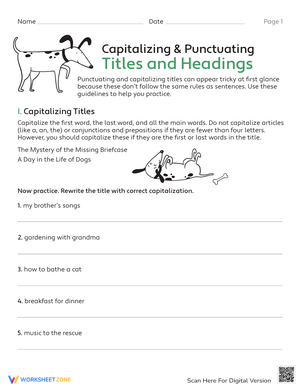
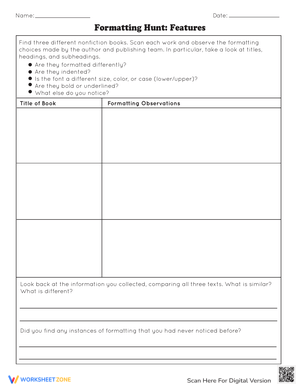
Printable Title-Building Practice for 5th Grade Writers
These 5th grade creating a title printable worksheets give teachers a diagnostic window that other revision tools rarely open: when a student cannot produce a fitting title for a completed draft, the problem is usually the draft's organization, not the title itself. A student who writes three paragraphs about water conservation but labels the piece My Essay is telling you the controlling idea hasn't landed yet. This set addresses that directly, with exercises across opinion, informational, and narrative writing so the skill appears in every genre students produce at grade 5.
What Students Practice Across the Set
The worksheets target three distinct moves. First, students match a title to the main idea — not the broadest possible category, but the specific angle or claim of a particular piece. Second, they adjust tone across genres: an informational title about volcanoes reads differently from a narrative title about a camping trip, even when both pieces are similar in length. Third, they revise weak titles by identifying what information is missing and adding specificity.
Task formats vary deliberately. Some worksheets ask students to read a short passage and select the most accurate title from a set of options, then write one sentence explaining the choice — a step that turns title selection into a main-idea reasoning task. Others ask students to rewrite generic titles like My Story or About Dogs by naming the specific event, claim, or subject. The most demanding format asks students to generate three possible titles for a passage — one broad, one specific, and one that signals the writing type — then compare them in writing. That comparison exercise is the one worth keeping handy during writing conferences: if a student struggles with it, you're likely looking at a weak central idea, not just a weak title. The reason 5th grade creating a title printable worksheets stay useful across a full school year is that these formats fit different points in instruction rather than repeating the same narrow task.
Student Errors These Worksheets Help You Catch
The most common error at grade 5 isn't a capitalization slip — it's overgeneralization. Students write titles that name a category rather than the content: Animals instead of How Sea Otters Stay Warm, or A Problem at School instead of Why Our Cafeteria Needs a Second Lunch Line. The too-broad title tells you the student knows the rough topic but hasn't distilled the controlling idea. That's a draft-level problem worth knowing about before final copies go home.
Narrative writing produces a specific pattern worth watching: students default to setting as the title. At the Park or My Grandmother's Kitchen — accurate as far as they go, but they give readers no sense of what happened or why it mattered. When you ask those students to write a title that signals the central problem or moment of change, they often pause longer than expected. That pause is information: the narrative doesn't yet have a clear turning point.
Opinion writing brings a third error — the undecided title. A student asked to argue a position writes Is Screen Time Good or Bad? That framing signals the student is still weighing the issue rather than staking a claim. It's a revision target worth catching early, because it usually means the body paragraphs are presenting both sides without resolution rather than building a sustained argument.
Building These Worksheets Into Your Writing Block
The most productive placement is during revision, not as a finishing touch after the draft is "done." Before students touch their introductions or check conventions, ask them to write two or three possible titles at the top of their draft. That ten-minute step often reveals more about a student's grasp of the piece than a line-by-line conference — and it takes far less time. Teachers who already fold 5th grade creating a title printable worksheets into their revision routines tend to run these as a pre-conference warm-up: students write title options, swap drafts with a partner, and discuss which title fits best before the teacher sits down with them.
Short title-matching worksheets also hold focus during the five minutes before a class transitions out — those minutes when attention fragments and longer tasks fall apart. Students can work independently, and the worksheets scan quickly for formative data without needing written comments to be useful.
- Monday warm-ups: a passage with a blank title line gets students reading closely before instruction begins
- Literacy centers: especially effective when passages connect to current science or social studies content
- Small-group reteaching: useful after a draft review shows students choosing generic or off-topic titles
- Substitute plans: a worksheet that asks students to read, title, and defend their choice in one sentence keeps work substantive without requiring the sub to run new instruction
Standard Alignment
Title selection maps to CCSS.ELA-LITERACY.W.5.4, which asks grade 5 students to produce writing appropriate to task, purpose, and audience. A title is the first signal a reader receives about all three of those dimensions, which is why treating it as a revision target — rather than a last-minute addition — fits the standard's intent more accurately than many teachers initially expect.
The work also connects to CCSS.ELA-LITERACY.W.5.5, which addresses strengthening writing through planning, revising, and editing. Writing multiple title options and comparing them is a specific, observable revision behavior that standard describes. When students explain why one title fits better than another, they're reasoning about audience and purpose in a concrete, assessable way — which makes this an easy skill to document in conferring notes or writing portfolios.
Adjusting the Worksheets for Different Skill Levels
For students still developing their understanding of main idea, the matching and selection tasks are the right entry point. Having the title options provided reduces enough cognitive load to make the reasoning visible — you can hear whether the student understands why a title fits, rather than watching them freeze at a blank line. Once they can consistently explain their choices, the rewriting tasks become accessible.
Students working above grade level benefit most from the three-title comparison format. Asking them to write one title aimed at a general reader and one aimed at a subject expert opens a conversation about rhetorical purpose that extends the skill without requiring a separate activity. It also creates a richer product to discuss in conference.
For English learners, oral rehearsal before writing pays off. Having a student say a possible title aloud, then compare it to the passage, lets you hear whether the concept has landed before writing becomes the barrier. The tasks in 5th grade creating a title printable worksheets are short enough that multilingual students can complete each one in a single sitting without the multi-step direction load that causes attention to drift. When a student produces a title that is accurate in meaning but phrased unconventionally, that response deserves credit for the comprehension it shows — the phrasing is a separate instructional target.
Frequently Asked Questions
Do the worksheets cover all three writing genres?
Yes. The set includes exercises across opinion, informational, and narrative writing. That matters at grade 5 because title conventions shift between genres — an opinion title that names the claim reads differently from a narrative title that hints at a central moment — and students benefit from seeing those differences in practice rather than only hearing about them in a mini-lesson.
How long does a typical worksheet take to complete?
Most of the worksheets take between eight and fifteen minutes for grade-level students. Matching and selection tasks run closer to eight minutes. Passage-based rewriting tasks, where students read carefully before they write, run closer to fifteen. That range makes them workable as warm-ups, writing-block practice, or homework without much adjustment on the teacher's end.
Can these be used without a writing assignment currently in progress?
Yes. The worksheets use original passages, so students don't need a draft in front of them to complete most tasks. That makes them useful during a reading-focused week, as a stand-alone literacy center, or any time you want focused main-idea practice that also reinforces writing habits.
Are there tasks appropriate for students who already write strong titles?
The three-title comparison and audience-aware rewriting tasks challenge students who have already mastered basic title accuracy. Asking a student to write one title for a peer reader and one for an adult unfamiliar with the topic introduces rhetorical thinking in a way that extends the skill without requiring a separate worksheet entirely.
Clear All