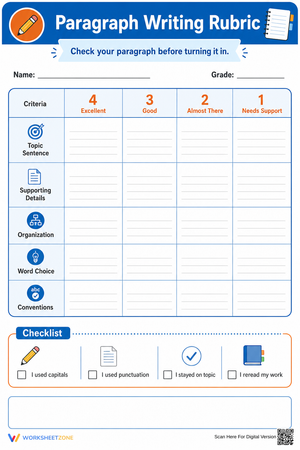
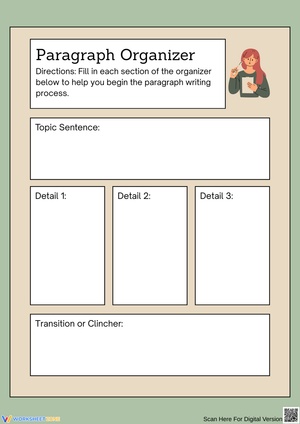
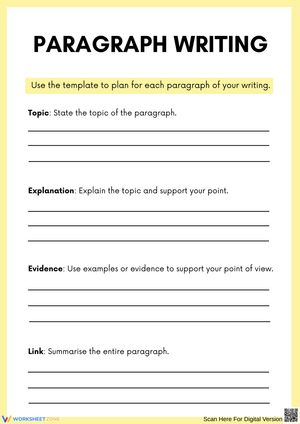
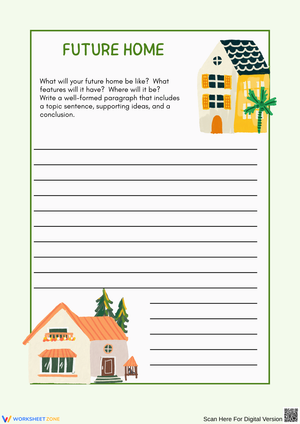
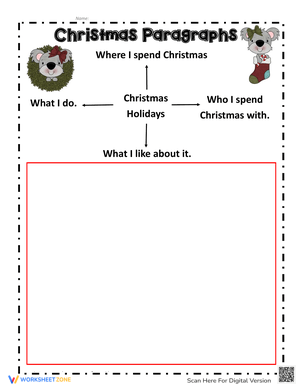
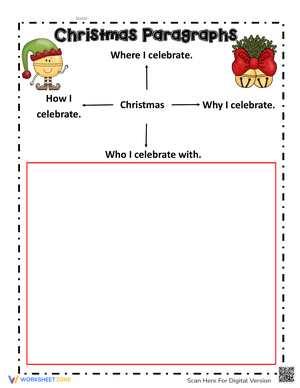
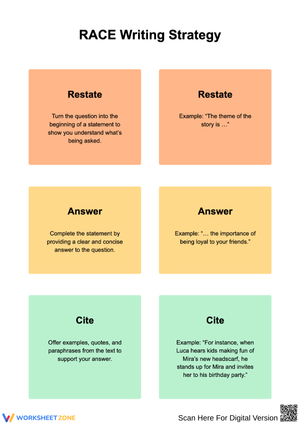
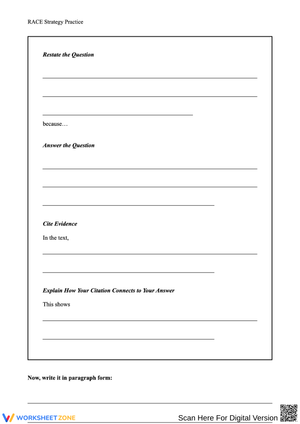
Paragraph structure worksheets for 5th grade address something that shows up in student writing across every content area — the paragraph that starts with a reasonable idea and then loses its shape by the third sentence. Most fifth graders can generate ideas without much prompting. The harder task is organizing those ideas into a paragraph that holds together from the opening claim to the closing thought, especially under the time pressure of classwork or a constructed-response task.
The Specific Skills These Worksheets Target
The organizational moves that hold a paragraph together are teachable, and each worksheet in the set isolates them one at a time. Skills practiced across the set include:
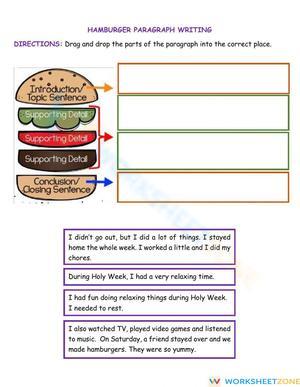
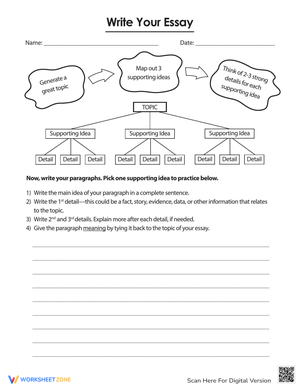
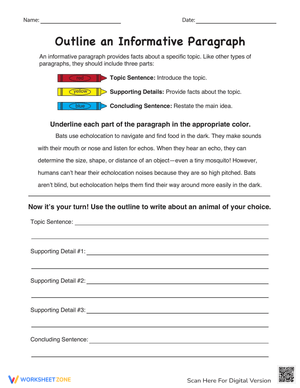
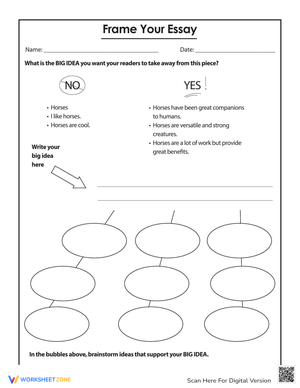
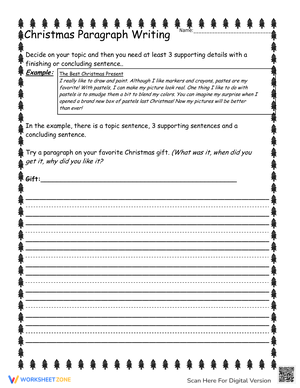
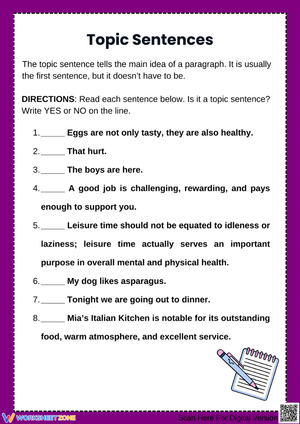
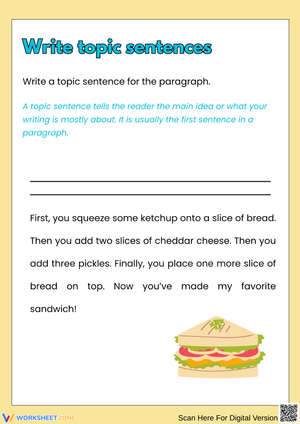
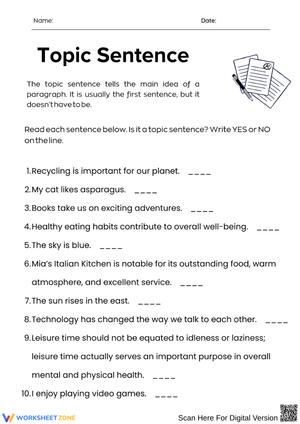
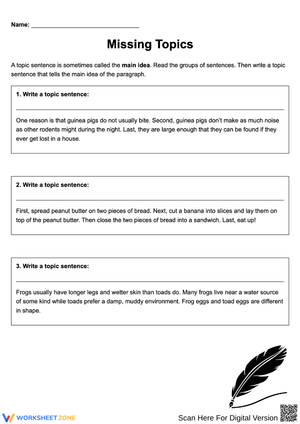
- Writing focused topic sentences — stating the main idea in a way that tells the reader exactly what the paragraph will explain or argue, not just naming a broad subject
- Selecting relevant supporting details — deciding which facts, examples, or events belong and which ones pull the reader off topic
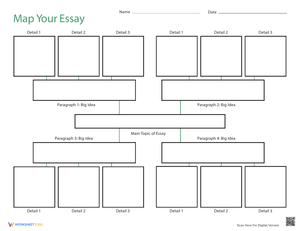
- Arranging details in a logical order — time order for narrative, order of importance for opinion, grouped ideas for informative writing
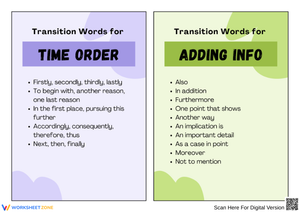
- Using transitions and linking words — connecting sentences so the paragraph moves forward rather than jumping between ideas
- Writing conclusions that close the idea — not restating the topic sentence word for word, but wrapping up the paragraph's thinking in a way that feels complete
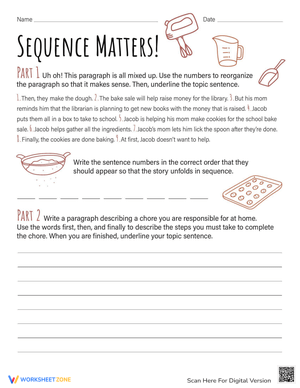
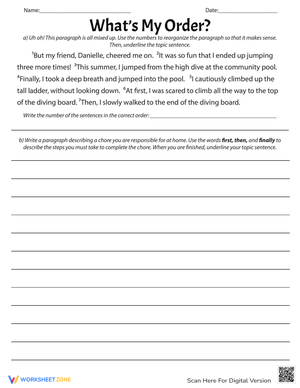
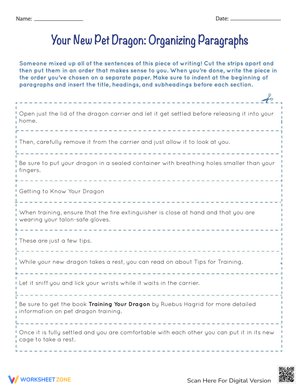
Tasks across the set move through three stages: recognition, revision, and original writing. Students first identify topic sentences in completed paragraphs, then sort relevant and irrelevant details, reorder scrambled sentences, and revise weak conclusions — and only after enough practice with those moves do they write paragraphs from scratch. That progression matters because it gives students repeated decision-making practice before they face an empty first line.
Frequent Student Errors Worth Watching For
The most persistent pattern at this grade level is the paragraph that reads like a list. A student writes a topic sentence about the importance of rainforests, then adds five facts about rainforests in no particular order, and ends with "So that is why rainforests are important." Every sentence is technically on topic, but nothing connects to anything else. Tasks that ask students to arrange details so each sentence builds on the one before it force them to think about order and relationship, not just content — and that is where these worksheets push hardest.
A second predictable error involves detail selection. Fifth graders writing about animal adaptations will include the sentence "Polar bears also have cute cubs" inside a paragraph about survival strategies. The detail is about the topic — polar bears — but it does not support the paragraph's actual claim about survival adaptations. Worksheets that ask students to cross out the sentence that does not belong, then explain why, build that distinction in a way that transfers into independent writing better than a circled comment on a returned draft does.
Concluding sentences are where many students fall back on repetition. A student who opens with "Dogs make good pets" will often close with "That is why dogs make good pets." Practicing with mentor sentences that model real wrap-up moves — drawing a brief implication, connecting back to an original question, or ending with an observation that extends the idea — helps students break that pattern faster than correction comments alone.
Fitting These Worksheets Into the Writing Week
These worksheets work best when matched to a specific instructional purpose rather than used as generic writing time. A short topic-sentence worksheet can follow a five-minute mini-lesson — students hear the teaching point, then apply it immediately while the idea is fresh. That same-day application is where the learning tends to take hold.
A simple weekly rhythm works well for building fluency with paragraph parts. One day targets topic sentences, the next focuses on selecting and ordering details, the third covers transitions, and the fourth works on conclusions. By day five, students draft their own paragraph using the full structure they have practiced all week. Content can shift — science summaries one week, opinion responses the next — while the structural focus stays consistent. That kind of spaced practice gives enough repetition for real growth without making the work feel like drill.
Small-group reteaching is another strong use. When a handful of students consistently write off-topic or list details without any connections between them, one worksheet pulled for a fifteen-minute guided session gives the teacher a clear teaching target and gives the student a success point that is actually reachable. That moment of recognition — "I can see how this paragraph works now" — tends to be worth more than another round of revision comments on a draft that has already been submitted.
Standard Alignment
These worksheets align to several fifth-grade writing standards under the Common Core State Standards for English Language Arts. W.5.2b expects students to develop informative topics with facts, definitions, and concrete details — the detail-selection and paragraph-unity tasks in this set directly support that work. W.5.2c and W.5.1b address using linking words and phrases to connect ideas within a piece, which maps directly to transition practice. W.5.4 calls for clear and coherent writing appropriate to task and purpose, and consistent paragraph structure practice is one of the most direct ways to build that coherence at this grade level.
Paragraph structure worksheets for 5th grade fit most naturally into the organization strand of writing instruction — where, at Grade 5, students are expected to move beyond simply having details and toward structuring those details so they build toward a point. That shift is where the set does its clearest work, and it positions these resources well for use both before and during formal writing units.
Adjusting the Worksheets for a Range of Learners
Students working below grade level often need more support before they can attempt revision tasks independently. Providing a paragraph frame with sentence starters — "One reason..." / "For example..." / "This shows that..." — alongside the worksheet keeps their attention on organizational decisions rather than on finding words. The task stays the same; the added frame reduces the language load without changing the learning target.
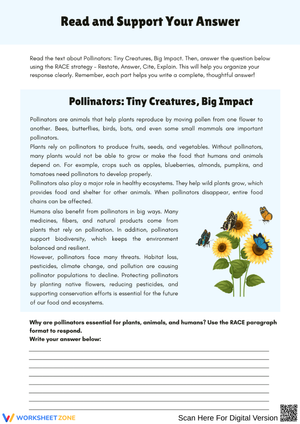
On-grade students work well with the standard tasks — identifying, sorting, reordering, revising. Students who are ready for more challenge can be asked to compare two versions of a full paragraph and write a short explanation of which one is better organized and why. That evaluative move asks them to articulate the reasoning behind good organization, which builds understanding more durably than producing another correct paragraph on their own does.
Paragraph structure worksheets for 5th grade also transfer well across content areas for students who need additional challenge. A student who has mastered paragraph organization in ELA can apply the same skills to a science summary or a social studies constructed response — and watching whether that transfer happens tells a teacher a great deal about whether the learning is fully internalized or still tied to a single writing context.
Frequently Asked Questions
What paragraph organization skills should 5th graders have before starting these worksheets?
Students should be able to write several connected sentences on a topic and have a working sense that a paragraph has a beginning, middle, and end — even if they cannot execute that structure independently yet. These worksheets are built for students who understand the concept but lose focus when writing. Students who are not yet producing connected sentences will need more foundational writing work before these tasks are productive.
Do these worksheets cover only informative paragraphs, or do they include opinion and narrative writing as well?
The organizational skills addressed in the set apply across writing types. Topic sentences, supporting details, transitions, and conclusions appear in informative, opinion, and narrative paragraphs, and the tasks draw from all three. Students practice the same structural moves across different writing contexts — which is exactly the kind of transfer that helps the skills show up in independent writing later.
How do I use these when some students are clearly behind and others are ready to move forward?
The revision and detail-selection tasks work well for students at different levels at the same time. Students who are behind can use a paragraph frame alongside the worksheet; students who are ready for more can write a brief explanation of their revision choices rather than just marking the correction. Both groups work on the same core task, which keeps instruction manageable during independent or small-group practice.
Can these be used for test prep before state writing assessments?
The skills these worksheets build — clear topic sentences, relevant and ordered details, transitions, coherent conclusions — are the same organizational moves assessed in most state constructed-response tasks at Grade 5. Paragraph structure worksheets for 5th grade used consistently in the weeks before an assessment help students practice the habits of organization under time pressure, so those habits become more automatic when students write independently on test day.












 Interactive Worksheet Maker
 Quiz Maker
 Word Search Maker
 Crossword Puzzle Maker
 Word Scramble Generator
 Sentence Scramble Generator
 Handwriting Worksheet Generator
 Name Tracing Generator
 Fill In The Blank Generator