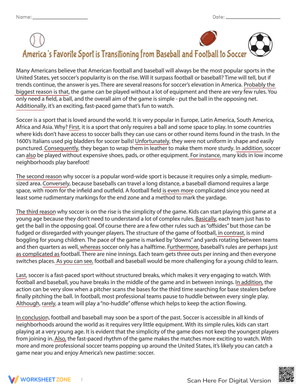
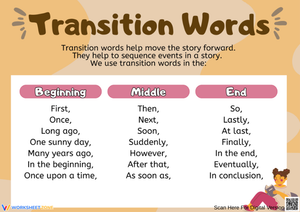
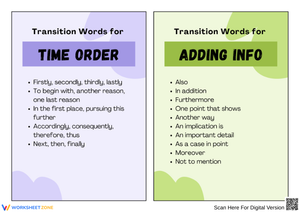
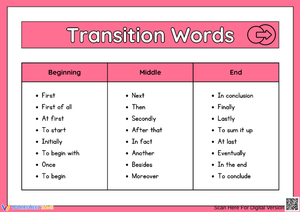
These 5th grade transition words worksheets resources give teachers decision-making practice at the sentence and paragraph level — not word lists students memorize and forget by the next unit. Fifth graders typically recognize first and next by the time they finish fourth grade, but choosing consequently over so in an opinion paragraph is a different skill entirely, and that gap is exactly what this set addresses.
What the Set Covers
Each worksheet focuses on one transition category rather than presenting twenty words at once. That narrowed focus isn't limiting — it's strategic. Students who see every transition type in a single exercise tend to reach for the three words they already know. Keeping the practice categorical lets teachers match each worksheet to the writing unit currently in progress.
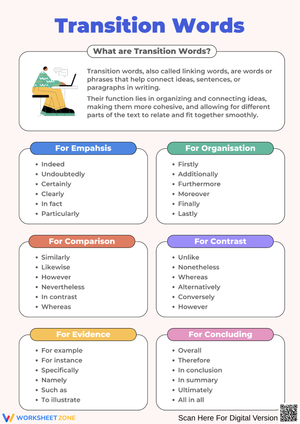
- Sequence transitions — first, then, afterward, meanwhile, finally — applied in both narrative and procedural contexts
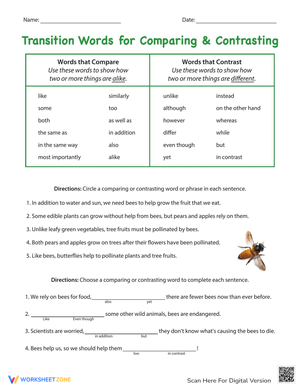
- Compare-and-contrast language: similarly, in contrast, on the other hand, unlike
- Cause-and-effect connections: because, therefore, as a result, consequently
- Conclusion signals — in summary, overall, clearly — placed in opinion and informational writing contexts
- Revision tasks where students replace overused or vague transitions with more precise choices
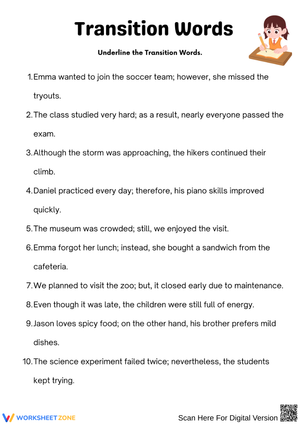
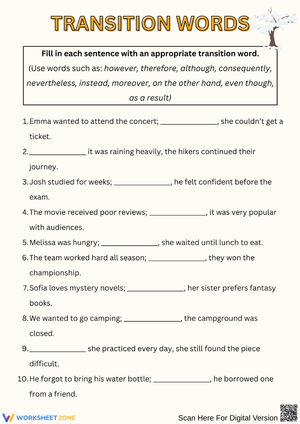
The clearest evidence of understanding surfaces at the paragraph-revision level. When a student chooses between however and although at the start of a sentence and has to explain why one fits better, a teacher can see whether the student grasps the logical relationship the transition signals or is simply substituting words. Sentence-level fill-in practice builds confidence; paragraph editing shows transfer. The most useful 5th grade transition words worksheets sets move through both levels within the same unit so teachers can collect evidence at each stage.
Lesson-Planning Strategies That Get Real Use From These Worksheets
The most reliable placement in a writing unit is right before drafting. A brief whole-class warm-up — projecting one worksheet under a document camera and thinking aloud about which transition fits — gives students a shared reference before independent writing starts. That five minutes of discussion surfaces confusion early, rather than during conferencing when the draft is already finished.
Small-group instruction is the other strong fit. Students who write choppy informational paragraphs often treat each sentence as a separate thought with no logical connection to the one before it. Pulling that group with two focused worksheets — one on cause-and-effect language, one on explanation transitions — gives targeted reteach without removing them from the full class lesson. The worksheets also hold up as exit tickets: asking students to revise one transition in a short paragraph at the end of a lesson tells teachers quickly who is ready to draft independently and who still needs more guided support before moving on.
One timing note worth flagging: the paragraph-revision work in a strong 5th grade transition words worksheets set frustrates students who are still building sentence fluency. Those students are better served starting with sentence-level tasks — even if classmates are ready to move ahead — because asking them to manage flow across multiple ideas before they can reliably manage one idea per sentence adds too much at once. Running both formats simultaneously within a small group is straightforward since each worksheet stands alone.
Standard Alignment
Transition instruction belongs in all three major writing standards at grade 5, not just narrative writing. W.5.1.c calls for words, phrases, and clauses that link opinions and reasons in argumentative writing. W.5.2.c requires the same structures to create cohesion in informational writing. W.5.3.c specifically targets words and phrases that manage event sequence in narratives — a standard teachers often underemphasize when the lesson focus is on plot or description rather than craft.
In practical classroom terms, W.5.3.c is where the clearest evidence of missed instruction shows up. Students drafting personal narratives write "Then we left. Then we got there. Then it was over." That is not a creativity problem — it is a transition problem. The standard expects students to control sequence with more precision: by the time we arrived, not long after, later that evening. This set gives teachers a direct resource for addressing that pattern during narrative units, when transition work can easily get overlooked in favor of plot discussion.
Transition Errors Worth Catching Before They Reach the Final Draft
The most common problem in fifth-grade writing is not missing transitions — it is the wrong transition used confidently. Students who know however signals contrast will still write "I like reading. However, I also like art." That sentence does not contrast anything; it adds. The error matters because it signals the student has learned transition words as vocabulary items rather than as markers of logical relationship.
Cause-and-effect transitions produce a parallel problem. Students frequently use therefore as a synonym for then, sequencing an event instead of naming a consequence: "I finished my homework. Therefore, I watched TV." Academic language used incorrectly can obscure a student's thinking more than simple language would. These worksheets address that error directly by asking students to identify what kind of relationship the transition creates — not just where it belongs in the sentence.
Adapting the Set for Mixed-Ability Writers
For students who struggle with writing fluency, the sentence-level worksheets are the right starting point. Narrowing the task to one transition category at a time — sequencing only for a week or two — keeps the cognitive load at a workable level. These students do not need fewer words to learn; they need one category practiced deeply before the next one is introduced.
Stronger writers benefit most from the comparison and revision tasks: given two possible transitions, which one fits and why? That task has no process-of-elimination answer built in, so students have to reason about meaning rather than match words to blanks. A productive extension is to hand advanced students a well-written paragraph, remove the transitions, and ask them to restore and defend their choices. That uses one worksheet and a few minutes of prep but produces richer thinking than any fill-in exercise will.
Frequently Asked Questions
What transition categories should fifth graders be able to use independently by the end of the year?
By the end of grade 5, students should handle sequencing, cause-and-effect, compare-and-contrast, elaboration, and conclusion transitions with some independence. The key development at this grade level is moving beyond familiar words — first, also, but — toward more precise options like consequently, in contrast, and for instance, chosen based on what the sentence is actually doing rather than what sounds academic.
How do these worksheets connect to state writing assessments?
Most state writing assessments at grade 5 score organization as a separate trait, and transition use is one of the most visible markers of organizational control. Students who write opinion responses with clear reason-to-evidence links consistently outscore students whose writing reads as a list. Practicing transition choice in context — selecting the right word for the logical relationship rather than any linking word — gives students tools they can apply under timed conditions, when there is no time to think through a memorized list.
Can these worksheets be assigned as homework without a class introduction first?
The sentence-level work in any solid 5th grade transition words worksheets set is self-contained enough for homework — the directions and examples carry the task. The paragraph-revision worksheets are better used in class first, because students benefit from talking through their choices before committing them in writing. Sending a revision worksheet home before students have tried the format together tends to produce guessing rather than genuine reasoning, and the resulting work gives teachers little useful information about what students actually understand.
Is there a logical sequence for introducing transition categories across the year?
Sequencing first, then cause-and-effect, then compare-and-contrast follows the natural order of most fifth-grade writing units. Opinion writing typically arrives early and draws on cause-and-effect and conclusion language. Informational writing pulls in comparison and elaboration. Narrative writing returns to sequencing but with more precision than students used in earlier grades. Following that unit order keeps worksheet practice directly connected to writing students are producing rather than treating transition work as a separate grammar topic.












 Interactive Worksheet Maker
 Quiz Maker
 Word Search Maker
 Crossword Puzzle Maker
 Word Scramble Generator
 Sentence Scramble Generator
 Handwriting Worksheet Generator
 Name Tracing Generator
 Fill In The Blank Generator