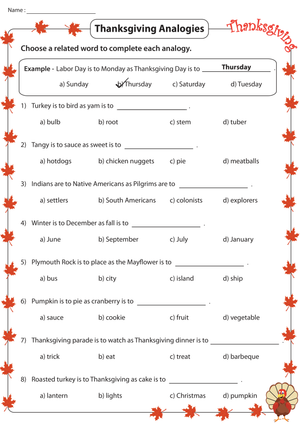
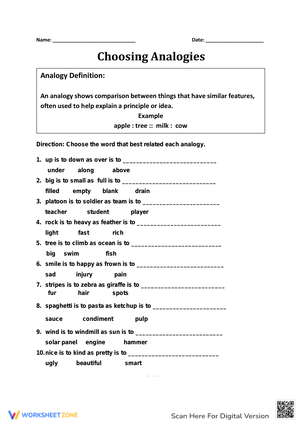
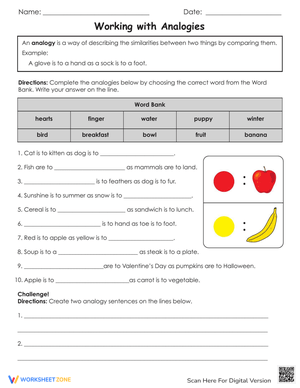
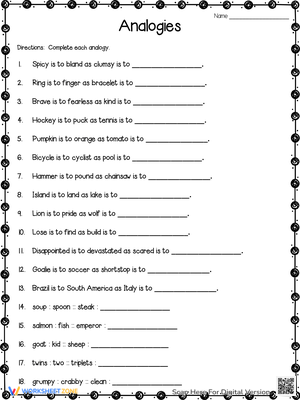
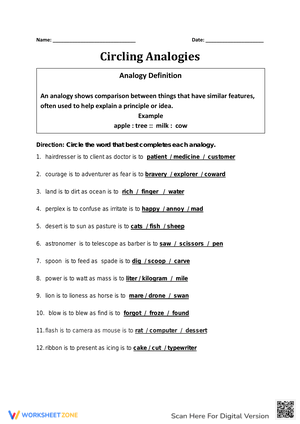
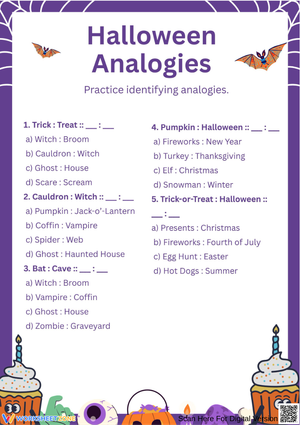
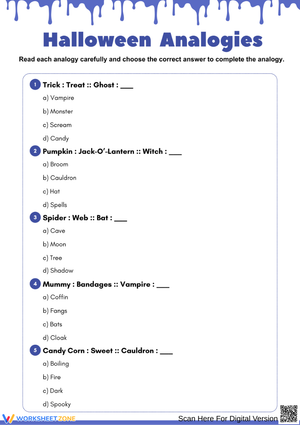
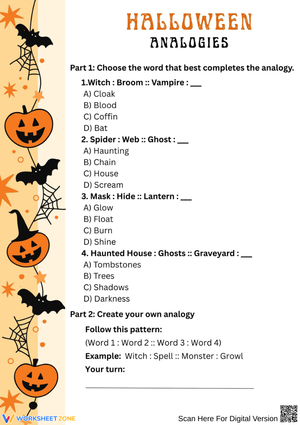
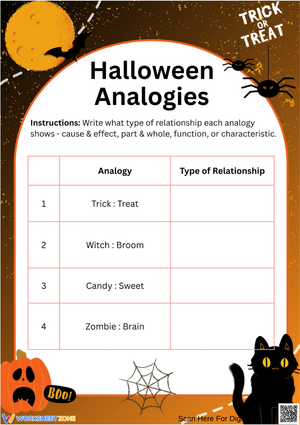
These 5th grade analogies printable worksheets give language arts teachers a focused, reusable tool for building the kind of word knowledge that goes past memorized definitions — asking students to notice how two words relate, name that relationship, and apply the same logic to a new pair. That sequence of thinking is harder than it looks. Fifth graders who can define ancient and modern correctly will still miss the analogy if they haven't practiced treating "opposite" as a named relationship category rather than just a feeling. Each worksheet in the set makes that reasoning process visible and correctable.
The Relationship Types Students Work Through
The items across this set cover six relationship categories, moving from concrete to more inferential as students gain experience with the format. Earlier worksheets group items by type and label each group. Later worksheets mix several types in a single unlabeled set — and that shift is where you learn the most about whether students have internalized these patterns or simply recognized category names printed above each group.
- Synonym: glad : pleased — students compare shades of meaning rather than treating both words as identical
- Antonym: rigid : flexible — polarity relationships that require students to recognize conceptual opposites
- Category: sparrow : bird — one word belongs to the class the other word names
- Function: compass : navigate — the first word names an object; the second names what it does
- Part-whole: rung : ladder — students connect a component to the larger structure it belongs to
- Cause-effect: drought : famine — one condition produces the other, requiring logical inference alongside vocabulary knowledge
Students who move through labeled sets with ease sometimes slow noticeably when the labels disappear and they must determine the relationship type on their own before solving the item. That shift from guided to mixed unlabeled practice is where the real analytical demand kicks in.
Common Student Errors to Anticipate Before You Hand These Out
Relationship reversal is the most predictable error in analogy work at this grade. A student who knows that a rung is part of a ladder will still write "ladder : rung" for the completing pair if the stem pair moves from part to whole. They have the vocabulary right but the direction wrong. This shows up in roughly a third of papers the first time a class works through part-whole items. A brief class discussion that externalizes the error — "Did we flip the order on this one?" — usually resolves it faster than assigning another worksheet to retry independently.
A subtler pattern: students default to synonyms. When two words in the stem look vaguely related, some fifth graders reach immediately for a synonym pair in the answer choices, even when the actual relationship is function or location. This tends to happen with students who have a strong synonym vocabulary but haven't been explicitly asked to name other relationship types. Seeing this choice repeated across several items tells you more about what that student needs next than any single wrong answer does.
Where These Worksheets Fit in Your Weekly ELA Routine
A three-step routine works well with any worksheet in the set: model two or three items with the class, release students to work through five to seven items independently, then spend two minutes having partners name the relationship they identified before comparing answers whole-group. That sequence runs about ten minutes — enough to surface confusion without consuming a full ELA block.
In center rotations, place each worksheet alongside a highlighter and a short direction card asking students to underline the relationship type in the first pair before looking at answer choices. That one step forces students to commit to a category before scanning options. Without it, many fifth graders read choices by sound and familiarity rather than logic — and occasionally land on a correct answer for entirely the wrong reason.
The format also holds up well in sub plans. 5th grade analogies printable worksheets are self-contained enough that students who have had a single lesson on analogy structure can work through a set without additional modeling. For homework, that same quality applies: a student can walk a family member through the task without those adults needing any background instruction in the format.
Standard Alignment
CCSS L.5.5c asks students to "use the relationship between particular words (e.g., synonyms, antonyms, homographs) to better understand each of those words." Analogy tasks are among the most direct classroom applications of that standard because the format requires students to identify a specific relationship — not simply notice that two words are connected. When a student correctly classifies a cause-effect pair and selects the appropriate completing term, the paper gives you direct evidence of L.5.5c thinking in a way that a traditional vocabulary quiz over definitions rarely provides.
In classroom terms, this standard sits at the intersection of vocabulary instruction and reading comprehension. Students who regularly practice naming word relationships read more precisely in science and social studies, where cause-effect and part-whole constructions appear constantly in expository prose and rarely get named explicitly by the text.
Adjusting These Worksheets Across Student Readiness Levels
For students who need more structure, begin with worksheets that sort and label items by relationship type. Working within a single category at a time removes the additional step of determining the relationship type before solving the item, which lets students focus on the matching logic until it feels reliable. A sentence frame — "A is to B as C is to D because they share a ___ relationship" — gives students language to use aloud before marking an answer on paper.
On-level students work through mixed sets where the relationship type is unlabeled. Keeping vocabulary within grade range while varying relationship types across the worksheet pushes students to re-examine each item rather than applying the same reasoning on autopilot. That re-examination is one of the harder cognitive demands at fifth grade, and it's worth building in regularly.
For students ready for a genuine challenge, 5th grade analogies printable worksheets that include open-ended production prompts — "Write your own analogy using this relationship type" — move the task from recognition to construction. Asking those students to justify their analogy in one sentence produces something worth reading and discussing in class. It's also a genuinely harder task to fake than a correct multiple-choice answer, which makes it more revealing as a formative check.
What Makes a Strong Set Worth Using
The best 5th grade analogies printable worksheets sequence items with intention — accessible examples first, mixed practice in the middle, and one or two open-ended or harder items at the end. Directions should be clear and brief: find the relationship in the first pair, apply that same relationship to complete the second. When the format is clean and instructions are direct, students spend their energy on language reasoning rather than decoding the task itself.
Vocabulary choice across each worksheet matters just as much as format. Items that are too easy become rote completion work. Items built around unfamiliar or obscure words before students have practiced the relationship types cause students to shut down before you can learn what they actually know. Each worksheet that starts with accessible vocabulary and ends with one or two genuine stretch items gives you a fuller picture of student understanding than a uniformly easy or uniformly difficult set ever will.
Frequently Asked Questions
What relationship types should fifth graders practice in analogy work?
Synonym, antonym, category, function, part-whole, and cause-effect relationships all appear at this grade level. The most useful sequence is to begin with concrete types — category and part-whole — before moving into cause-effect items, which require logical inference alongside word knowledge. Mixed practice across all types should come after students have worked within each category at least once.
How do these worksheets fit into center rotations or morning work?
Short sets work well as bell ringers, center tasks, and early-finisher activities. In centers, a direction card asking students to underline the relationship type in the first pair before choosing an answer adds a purposeful step that prevents guessing by elimination. In morning work, a familiar and stable format lets students begin without instruction and lets teachers review answers quickly during transition time.
Are these worksheets appropriate for intervention, review, or independent practice?
All three, with some adjustment. For intervention, group items by relationship type and work through each category before mixing types together. For review, use unlabeled mixed sets and ask students to annotate the relationship type on each item as they go. For independent practice mid-unit, sort collected papers into three groups — students who understood the relationship, students who made vocabulary errors, students who need more format exposure — and use that sorting to shape the next lesson.
How does analogy work build vocabulary and reasoning skills at the same time?
Analogy tasks push students to treat vocabulary as a system of relationships rather than a list of isolated definitions. When students classify a relationship type, compare pairs, and defend their choice, they are doing the same analytical work that supports close reading, precise writing, and content-area comprehension. That combination — word knowledge plus relational reasoning — is what separates this format from a straightforward vocabulary matching task.












 Interactive Worksheet Maker
 Quiz Maker
 Word Search Maker
 Crossword Puzzle Maker
 Word Scramble Generator
 Sentence Scramble Generator
 Handwriting Worksheet Generator
 Name Tracing Generator
 Fill In The Blank Generator