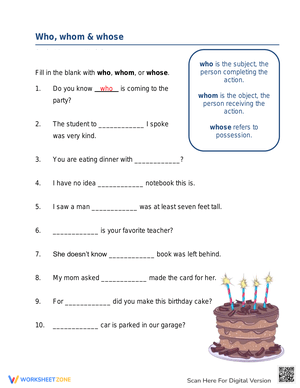
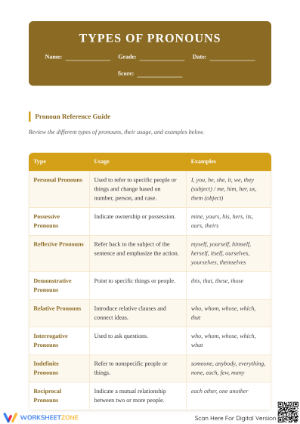
Relative pronouns printable worksheets for 5th grade do the most useful work when students are already drafting paragraphs and need to tighten how they connect ideas — in opinion responses, informational writing, or reading reactions. This set covers who, whom, whose, which, and that across several task types, moving from identifying the pronoun in context to combining sentences and revising clauses that obscure meaning. Teachers come away with real evidence of whether students control these words or simply recognize them in a word bank.
The Specific Skills Each Worksheet Targets
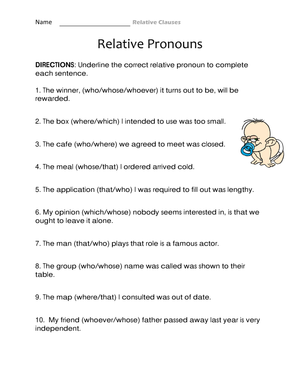
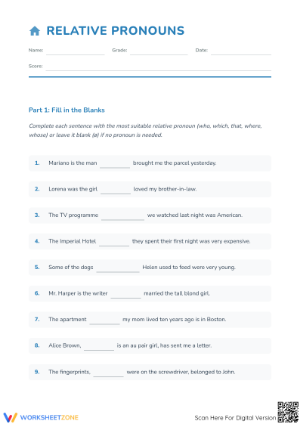
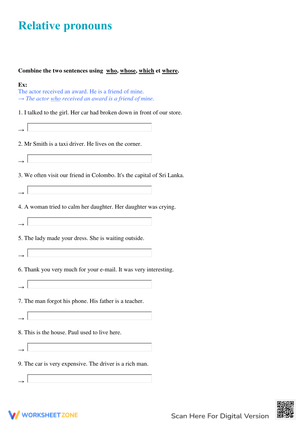
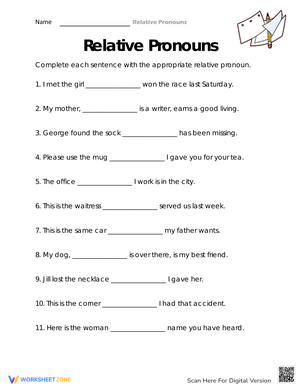
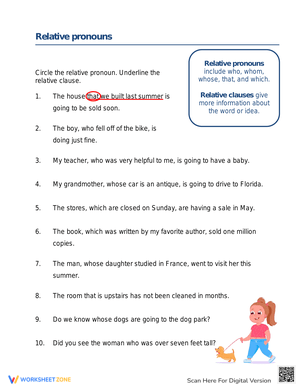
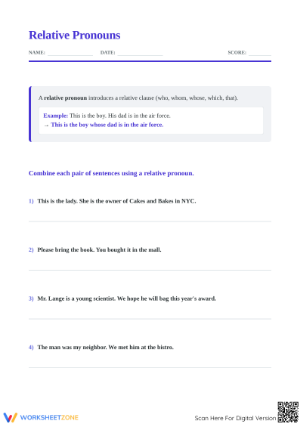
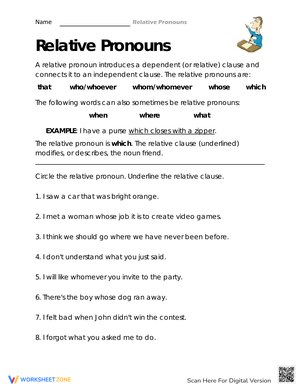
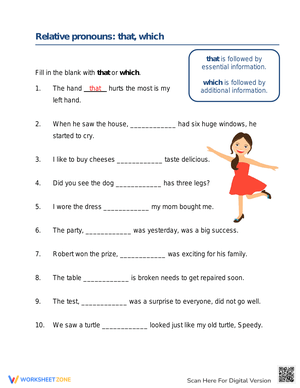
The worksheets build a progression most grammar resources skip: recognition first, then application, then revision. Students start by marking the relative pronoun in a sentence and drawing an arrow to the noun it modifies. That one step separates students who understand the grammatical relationship from those who can spot the word by feel. Tasks then shift to completing relative clauses — students finish a sentence frame that specifies a person, object, or place — and ultimately to sentence combining, where two short sentences become one cleaner one with a well-formed clause.
The revision tasks are where the set earns its place during a writing unit. Students are given sentences that use relative clauses incorrectly — a pronoun that mismatches the noun, a clause that restates information rather than adds it — and they rewrite. That is harder than filling a blank, and the patterns that show up in student work during this task tell teachers more than the identification items ever could.
- Identify the relative pronoun and trace it back to the noun it modifies.
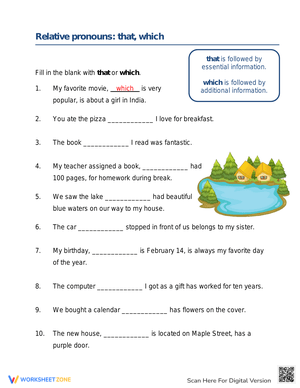
- Distinguish people from things when choosing between who and which.
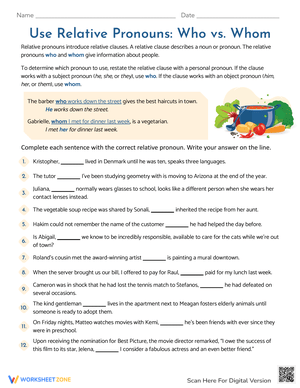
- Complete sentence frames so each clause adds specific, useful information.
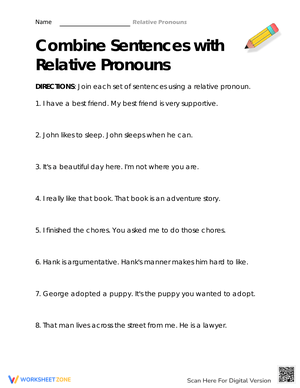
- Combine two short sentences into one using a relative clause that flows naturally.
- Revise sentences with vague, repeated, or mismatched clauses.
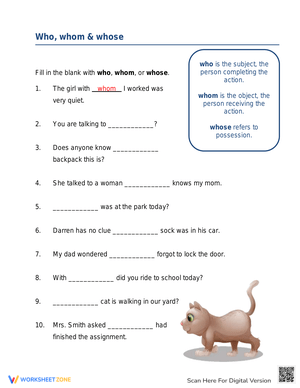
- Practice whose separately — possession is the pattern students most consistently underuse.
Frequent Student Errors Worth Catching Before They Stick
The most persistent mistake is a pronoun-noun mismatch: the report card who showed improvement, or the author which wrote the series. Students who know the general rule — people get who, things get which or that — still slip when writing quickly, especially when the sentence has more than one noun and the relative clause appears mid-sentence rather than at the end. Catching that on a worksheet is far easier than catching it during a conference.
Whose is the other consistent trouble spot. Students understand it shows possession, but they fall back on that has or with the constructions rather than using whose directly. A sentence like the student whose project won first place gets rewritten as the student that had the project that won first place — technically not wrong, but a syntactic habit that makes writing feel clumsy over paragraphs.
The subtler error shows up in revision tasks: students attach a clause that restates what the noun already implies. They write the library, which is a place where books are kept instead of adding new detail. This points to a gap in understanding what relative clauses are meant to do — not just describe, but specify. Relative pronouns printable worksheets for 5th grade that include editing tasks give teachers a direct way to address that confusion before it migrates into student essays.
Standard Alignment
These worksheets address CCSS.ELA-LITERACY.L.4.1a, which asks students to use relative pronouns (who, whose, whom, which, that) and relative adverbs. That standard is introduced in fourth grade, but fifth-grade teachers frequently revisit it during grammar review, writing mini-lessons, and revision conferences — particularly when student writing shows clause errors that weren't caught or corrected the previous year. Using this set at the start of a writing unit, or during the first week of intervention, puts the skill in front of students when the transfer context is immediately available: they are about to write a multi-paragraph response and need these tools working.
Working These Worksheets Into Your Lesson Week
The set fits most naturally in the ten minutes before a writing block, when students need a grammar warm-up that connects directly to what they are about to do. A sentence-combining worksheet on a Tuesday, followed by a revision task on Thursday, primes students to look at their own drafts differently during Friday's peer review. That rhythm — short practice, then immediate writing application — is what keeps these from becoming forgettable busywork.
For teachers running literacy centers, one worksheet per rotation works well, particularly if the task is identification or sentence completion that students can tackle independently after a brief group model. The revision tasks are better suited to teacher-led small groups, where you can ask why a student changed the clause rather than just checking whether the answer matches the key. For sub plans or after-assessment days, the identification and matching worksheets are clear enough that students can work through them without teacher introduction.
- Use a sentence-combining worksheet as a warm-up on the day you introduce a writing assignment.
- Pull the revision tasks for a small-group lesson on students whose drafts show chains of short, choppy sentences.
- Assign an identification worksheet as homework before a mini-lesson so you know where the group stands before you teach.
- Keep a clean copy on hand for a quick formative check during editing week.
Adjusting the Set for Different Readiness Levels
Students who are still uncertain about what a relative pronoun does should work the identification and matching tasks first. Give them a reference card listing the five pronouns alongside a two-column chart — people on one side, things on the other — so they can verify their choice before writing. That kind of printed reference keeps the cognitive focus on the pronoun decision rather than on recalling terminology from memory.
For students who have the basics down, skip straight to the sentence-combining and revision worksheets. Those tasks demand real judgment: the sentence has to sound right, the clause has to add something new, and the pronoun has to fit the noun. A stronger writer who breezes through identification will slow down when asked to revise a clause that is technically correct but contributes nothing. That is where relative pronouns printable worksheets for 5th grade push students past surface-level grammar knowledge into the kind of thinking they will need during actual composition.
Teachers working with English language learners may want to read two or three model sentences aloud before students begin completion tasks. The syntactic pattern of a relative clause — noun, pronoun, verb phrase — is a structure some students have heard infrequently in spoken English, and hearing it a few times before writing grounds the task in something familiar rather than purely abstract.
Connecting Worksheet Practice to Student Drafts
Grammar practice loses its value quickly if it stays confined to the worksheet. After students finish any task in this set, a one-sentence transfer prompt is worth three minutes of class time: Find a sentence in your notebook writing where you could add a relative clause to make the meaning more specific. Students who can do that are using the skill. Students who stare at their notebooks and cannot locate an entry point are telling you the connection needs to be made more explicitly before the next lesson.
During writing conferences, the five relative pronouns become a diagnostic shorthand. Three sentences in a row beginning with The book... is a which problem. A mention of a person's belongings buried in a clumsy prepositional phrase is a whose opportunity. The relative pronouns printable worksheets for 5th grade handle the upfront practice; the writing conference is where that practice gets applied to actual decisions on the page.
Frequently Asked Questions
Are these worksheets appropriate for 4th graders or for reteaching in 6th grade?
Yes. The anchor standard these worksheets address — CCSS.ELA-LITERACY.L.4.1a — is introduced in fourth grade, so the set works for direct instruction or end-of-year review at that level. In sixth grade, teachers use these for reteaching or intervention when clause errors surface in student writing. The sentence-combining and revision tasks are the most valuable at both grade levels because they require application, not just recognition.
Which tasks in the set work best for students who need more guided practice?
Start with the identification tasks and any worksheet that prints the pronoun choices above the blank. That structure lets students focus on the pronoun decision without also managing sentence construction from scratch. Once they show consistent accuracy there, move to completion tasks, then to revision and sentence combining. Skipping steps tends to produce guessing rather than reasoning — and guessing in grammar practice builds exactly the kind of unreliable habits you are trying to correct.
How do I know when a student is ready to move past this practice?
The clearest signal is unprompted use in writing — when a student's draft contains a well-formed relative clause they chose on their own, not one prompted by a sentence frame. On the worksheets themselves, accuracy on the revision tasks is a stronger readiness indicator than accuracy on identification. A student who can fix a poorly written clause demonstrates far more than a student who can circle the correct word from a list.
Should these be used before a grammar lesson or after one?
Almost always after. These worksheets assume students have seen relative pronouns introduced — through a mentor text, a shared writing activity, or a direct-instruction segment. Used cold, the identification tasks will feel arbitrary to students who have never encountered the term. Used after even a short anchor lesson, the practice sticks faster, and the error patterns you see in student work are more instructionally useful for planning your next step.












 Interactive Worksheet Maker
 Quiz Maker
 Word Search Maker
 Crossword Puzzle Maker
 Word Scramble Generator
 Sentence Scramble Generator
 Handwriting Worksheet Generator
 Name Tracing Generator
 Fill In The Blank Generator