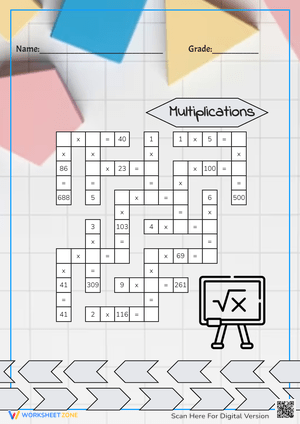
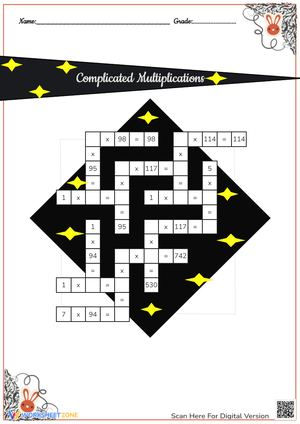
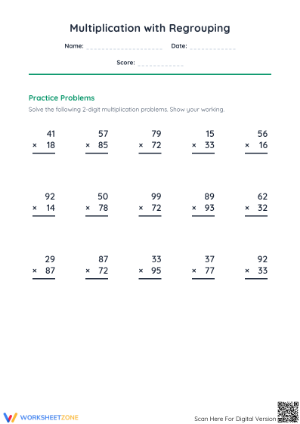
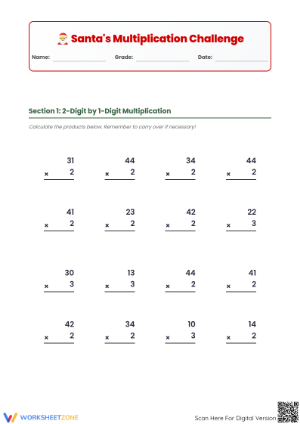
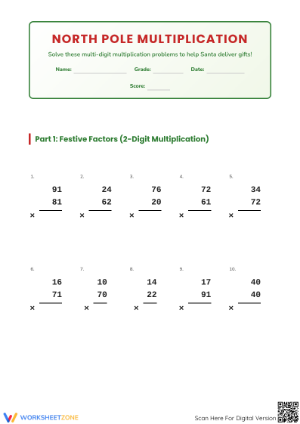
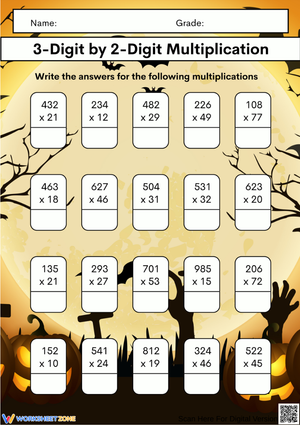
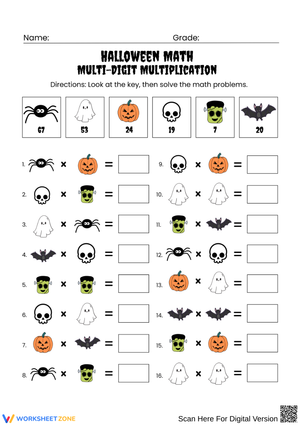
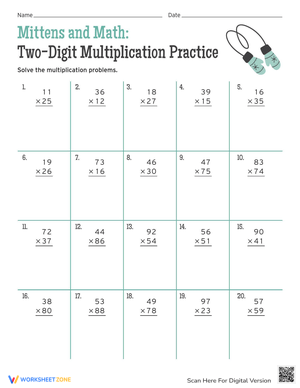
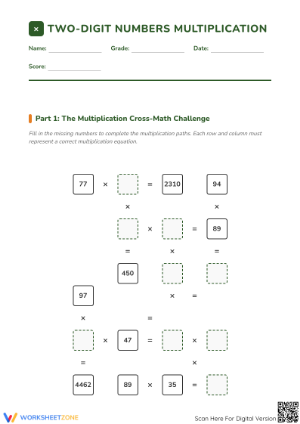
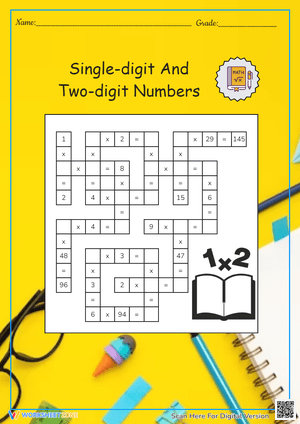
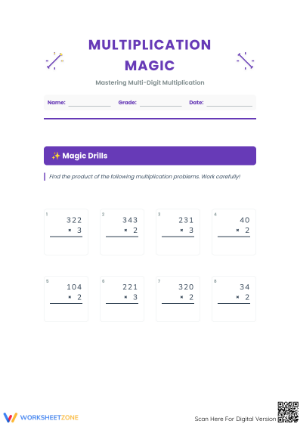
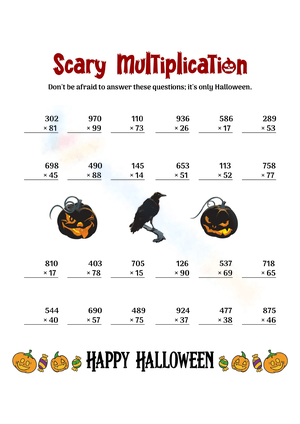
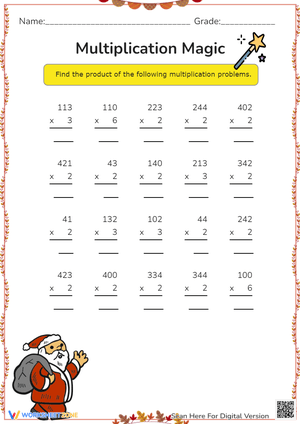
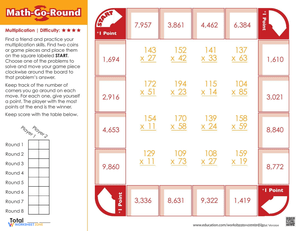
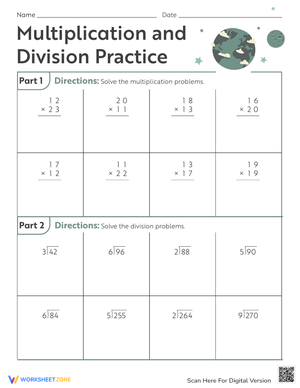
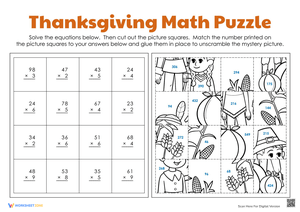
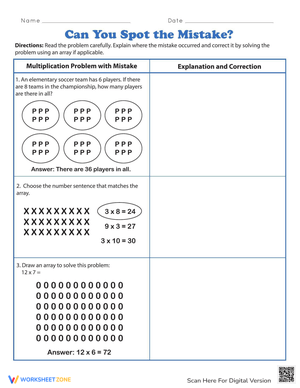
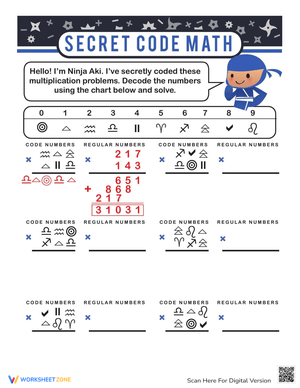
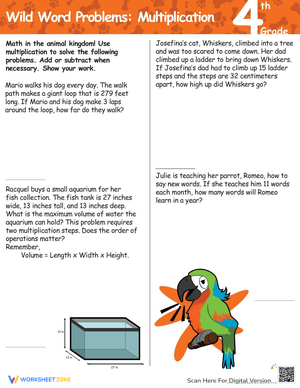
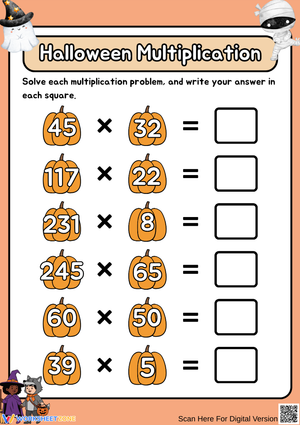
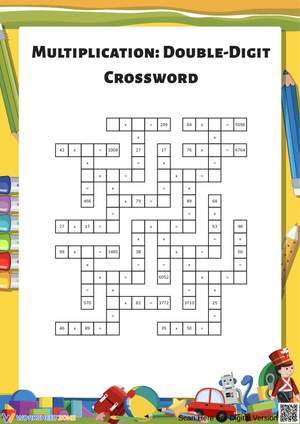
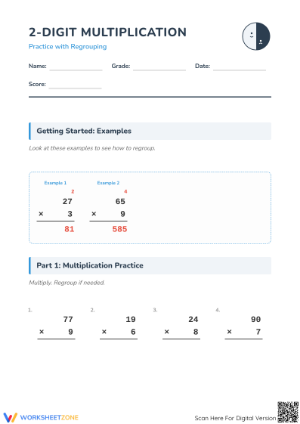
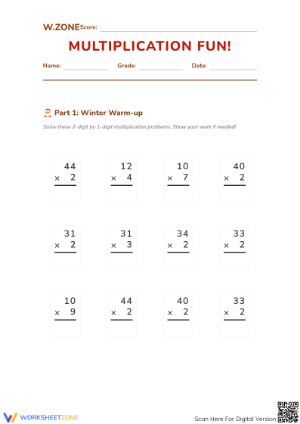
These multi digit multiplication pdf worksheets for 4th grade cover the full range of CCSS 4.NBT.B.5 — from two-digit by one-digit computation up through two-digit by two-digit multiplication — organized by strategy type so teachers can match practice to wherever instruction currently stands. The set includes area model worksheets, partial products practice, standard algorithm drills, and applied word problems, all print-ready without any formatting setup required.
The Specific Skills These Worksheets Build
Each worksheet in this set of multi digit multiplication pdf worksheets for 4th grade targets one step in the progression rather than mixing skill levels on the same sheet. The sequence runs in the order most classrooms actually teach it: two-digit by one-digit multiplication with regrouping, then three-digit and four-digit numbers multiplied by a one-digit factor, and finally two-digit by two-digit problems addressed through three separate strategy formats.
The decision to give each strategy its own focused practice matters more than it looks at first glance. When students are learning the area model, placing partial products problems on the same worksheet splits attention and muddies the method they are trying to internalize. That separation keeps cognitive load manageable at the point when students are building new procedures rather than applying automated ones.
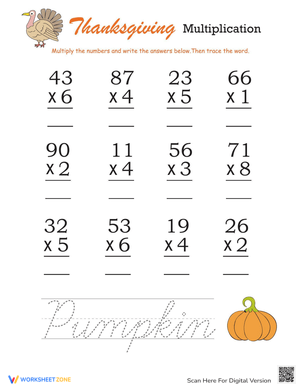
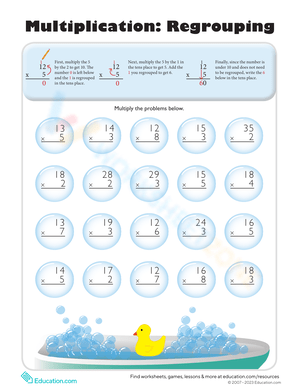
- Two-digit × one-digit multiplication with regrouping
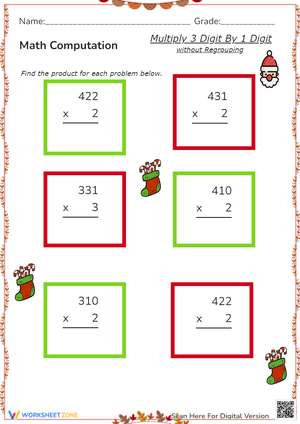
- Three-digit and four-digit numbers × one-digit numbers
- Area model practice for two-digit by two-digit multiplication
- Partial products method with explicit place value recording
- Standard algorithm with multi-step regrouping
- Word problems requiring students to identify the operation before computing
Student Errors Worth Anticipating Before You Hand These Out
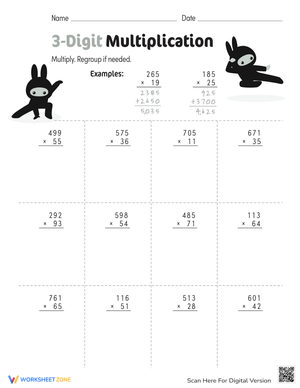
The most consequential error in two-digit by two-digit multiplication using the standard algorithm is the missing placeholder zero. A student solving 34 × 27 will correctly multiply 34 × 7 to get 238, then multiply 34 × 2 to get 68 — and add 238 + 68 = 306 instead of the correct 918. The second partial product was computed using the tens digit but never shifted left to represent tens. Students who make this error are not confused about multiplication facts; they are missing an understanding of what the 2 in 27 actually represents. It reads as a surface arithmetic mistake, but it is a place value misconception.
In the area model, a different error dominates. Students correctly draw the box and label the factors across the top and side, then write 3 instead of 30 and 2 instead of 20 when decomposing 34 × 27 into its place value parts. They multiply 3 × 2 instead of 30 × 20, and the resulting product is small enough to seem plausible rather than obviously wrong. That plausibility is exactly what makes the error hard to self-catch. Worksheets that require students to write the expanded form of each factor before filling in the area model boxes force that step into the visible work, so the error surfaces early enough to correct.
Fitting These Worksheets Into Your Lesson Planning
The clearest use for these resources is during the independent rotation of math workshop. When a small group pulls to the teacher table for direct instruction on the standard algorithm, the rest of the class needs work they can move through without continuous support. These worksheets do that job — directions are unambiguous, layouts are uncluttered, and problems are organized so students know immediately what method they are applying.
For morning warm-up, a single worksheet with six to eight targeted problems takes about eight minutes and produces written work teachers can scan during the transition to whole-group instruction. That scan is often more informative than an exit ticket: partial products written out, crossed-out attempts, and area model boxes either sized reasonably or crammed into a corner all tell a story about where each student actually is. Friday review is another natural fit, particularly when the week's instruction introduced a new strategy. Sending students home having independently practiced it once — not just watched a demonstration — closes the week more usefully than an assignment they will stare at blankly over the weekend. The multi digit multiplication pdf worksheets for 4th grade in this set work especially well in that slot because each one stays focused on a single method.
Standard Alignment
CCSS 4.NBT.B.5 — Multiply a whole number of up to four digits by a one-digit whole number, and multiply two two-digit numbers, using strategies based on place value and the properties of operations. Students illustrate and explain the calculation using equations, rectangular arrays, and area models.
In classroom terms, this standard typically lands in the first half of fourth grade — after students have worked through place value understanding in 4.NBT.A and before division work begins in 4.NBT.B.6. One developmental reality worth knowing before sequencing these worksheets: students who still hesitate on facts like 7 × 8 or 6 × 9 will struggle with multi-digit computation not because the new procedure is too demanding, but because basic fact retrieval is consuming working memory that the procedure itself needs. A short facts pre-assessment will tell teachers quickly whether the class is ready to focus on multi-digit methods or whether a brief fluency review first will make the whole unit move faster.
Adjusting the Worksheets for Students at Different Points in the Progression
For students still working toward fluency with single-digit facts, providing a multiplication reference chart alongside any worksheet in the set shifts the cognitive demand to place value decomposition rather than stalling on basic recall. The goal at that stage is building procedural understanding of how multi-digit multiplication works, and the reference chart keeps that goal reachable without removing the complexity students need to practice. Pre-drawn area model boxes serve a similar function — students who understand the concept but get disoriented setting up the structure from scratch benefit from a drawn frame that reduces the number of decisions required before the actual multiplication begins.
Students who move through the grade-level worksheets without difficulty are well-served by the word problems in the set, particularly those that embed multiplication inside a two-step context: a problem where multiplication finds a subtotal and addition or subtraction reaches the final answer. That problem type asks students to identify the operation rather than just execute a stated one — a distinct skill, and one that appears on state assessments far more often than naked computation problems do.
One honest limitation worth naming: students who freeze when facing a word problem built around an unfamiliar context — a recipe scaling scenario, for example, for a student who has never cooked — sometimes stall before the math starts. Previewing the word problems before assigning and swapping out one or two for contexts more familiar to the specific class is a reasonable adjustment that takes about two minutes of prep.
Frequently Asked Questions
Which worksheet should I start with if students are still unsteady on 3rd-grade multiplication facts?
Start with the two-digit by one-digit worksheets that use partial products rather than the standard algorithm. Partial products records each multiplication step on a separate line, so fact errors are visible rather than buried in column work — students can trace back and find exactly where the calculation went wrong. Placing students into three-digit by one-digit problems before that clarity is established means errors compound across more steps and become harder for anyone to diagnose.
Can these worksheets function as formative assessment rather than just practice?
The completed multi digit multiplication pdf worksheets for 4th grade give teachers diagnostic information that a simple right/wrong answer cannot. When students show area model boxes or written-out partial products, the work reveals where the procedure broke down — whether it was a fact error, a place value error, or a misalignment in the final addition step. Reviewing that intermediate work is more actionable than checking only final answers, and it tells teachers exactly where reteaching needs to focus.
Do the worksheets address all three strategies — area model, partial products, and standard algorithm — or just one?
Each strategy has its own dedicated worksheets in the set. Mixing the area model and standard algorithm on one worksheet asks students to switch cognitive frames mid-practice, which tends to create confusion about both methods for students who have not yet internalized either one. Once students are solid on each strategy separately, the set includes mixed-method practice for consolidation.













 Interactive Worksheet Maker
 Quiz Maker
 Word Search Maker
 Crossword Puzzle Maker
 Word Scramble Generator
 Sentence Scramble Generator
 Handwriting Worksheet Generator
 Name Tracing Generator
 Fill In The Blank Generator