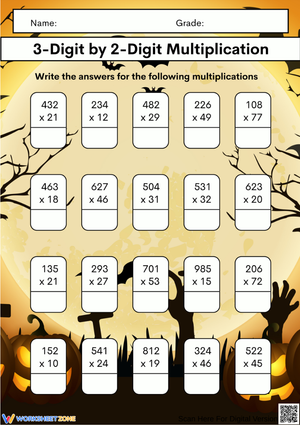
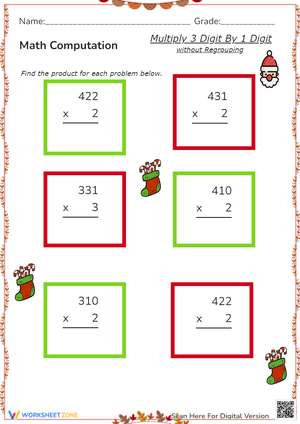
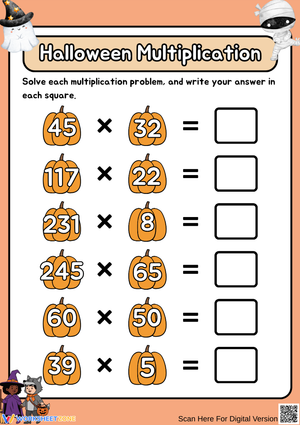
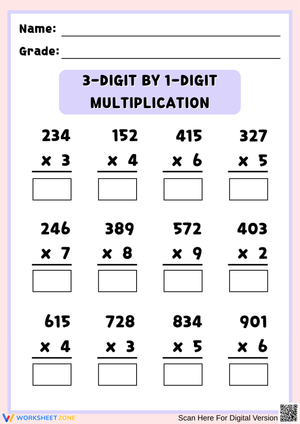
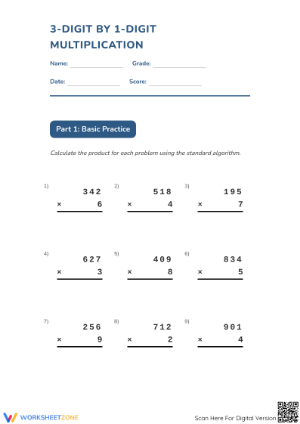
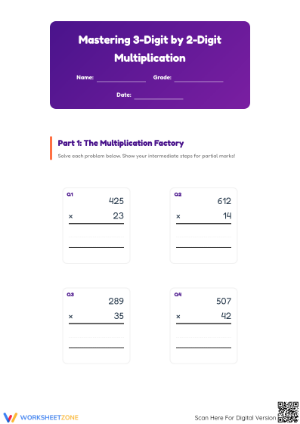
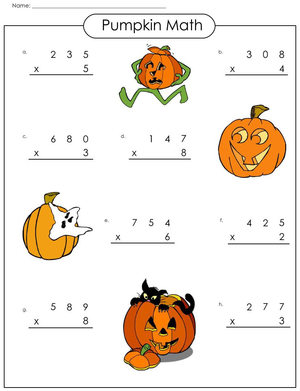
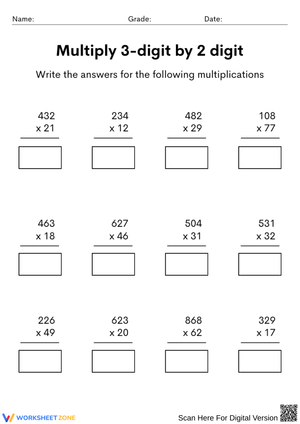
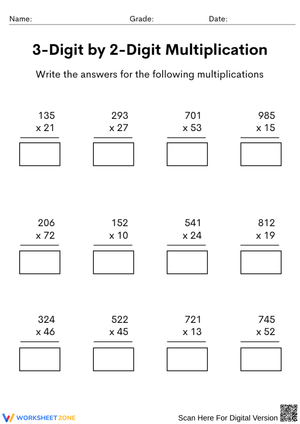
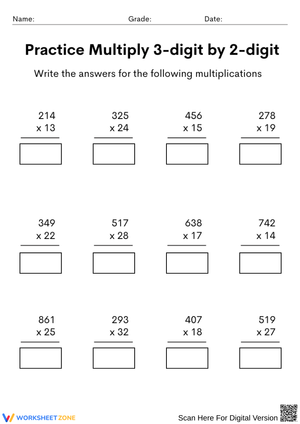
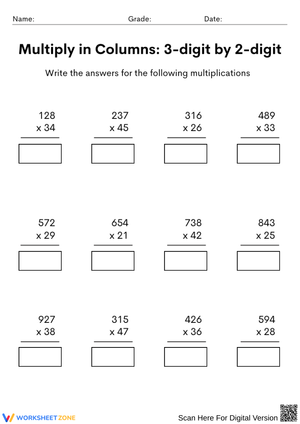
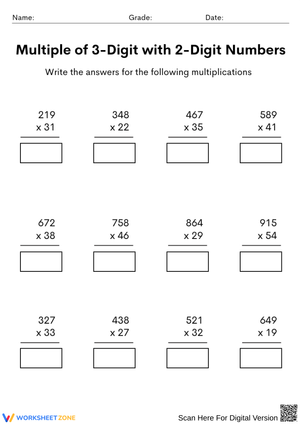
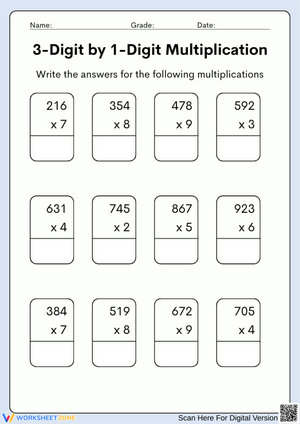
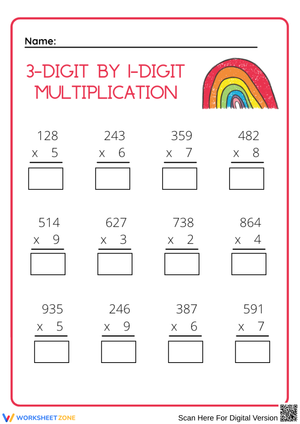
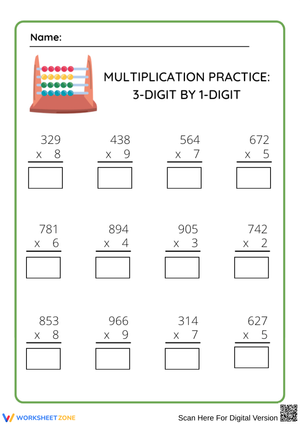
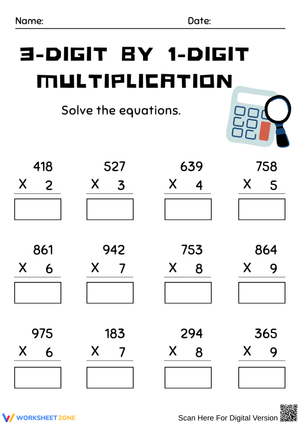
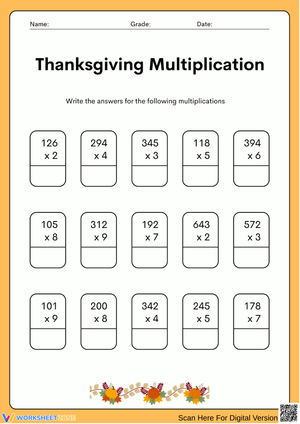
These 4th grade 3 digit multiplication worksheets give teachers a clear instructional sequence — area models first, then partial products, then the standard algorithm — with each worksheet targeting one strategy rather than mixing methods in a way that overloads students still building procedural confidence. The set spans problems without any regrouping through multi-carry problems that require carrying across both the tens and hundreds positions.
Skills These Worksheets Build
Each worksheet targets a single approach to three-digit by one-digit multiplication, which matters because students at this stage need repetition within one method before layering in another. Area model worksheets present pre-drawn rectangles partitioned into hundreds, tens, and ones sections — students fill in each partial product and find the sum. Partial products worksheets give students lined space to write the expanded multiplication in full: for 213 × 4, they record 4 × 3 = 12, 4 × 10 = 40, and 4 × 200 = 800, then add all three. Standard algorithm worksheets include clearly separated place value columns and a small box above each digit for regrouped values, which keeps students from writing carry digits in ambiguous positions.
Beyond strategy-specific practice, the set includes word problems that ask students to identify what to multiply before computing — a meaningfully different task than a bare equation. These problems range from single-step scenarios to two-step problems where three-digit multiplication is one part of a larger calculation, giving teachers a way to assess whether students can apply the procedure in context, not just execute it on a prepared equation.
Where Students Go Wrong at Each Stage of Three-Digit Multiplication
The most persistent error is place value collapse in the standard algorithm. A student can work through partial products correctly — fully grasping that the 4 in 348 represents 40 — and still misapply the algorithm. The breakdown usually looks like this: they multiply 4 × 6 = 24, write the 4, carry the 2, then multiply the next digit and add the carry — but they've lost the mental connection between that carry digit and its actual value. They're executing steps rather than reasoning about place value. Worksheets that ask students to write partial products alongside their standard algorithm work make that disconnect visible before it compounds into a more serious gap.
A second consistent pattern shows up in student work as stopping too soon. When solving 345 × 6, a student multiplies the ones digit, carries, multiplies the tens digit, carries — and stops there, leaving the hundreds digit untouched. This happens when students are tracking column count rather than tracking digits, so they think they've reached the left edge of the number when one digit still remains. Worksheets with labeled place value columns above each digit address this by requiring students to fill in all three positions before a problem is complete.
A third error is harder to catch from a final answer alone: adding the carry digit before multiplying instead of after. A student working 345 × 6 carries 3 from the ones step, then adds 3 to the tens digit — getting 7 — before multiplying by 6, arriving at 42 for the tens position. Because a student making this mistake will sometimes land near the correct answer by coincidence, worksheets that require intermediate steps rather than only a final product are far more diagnostic.
Where These Worksheets Fit in Your Daily Math Routine
Area model worksheets work well as the whole-group introduction problem for the first lesson on a new strategy — displayed on the board, completed together, then used as independent follow-up practice. Partial products worksheets fit naturally in math centers once students have had two or three days with visual models. The standard algorithm worksheets run well alongside partial products so students solve the same problem both ways, which keeps the connection between methods alive rather than treating the algorithm as an unrelated new procedure.
One reliable classroom use: pull a single standard algorithm worksheet for a five-minute bell-ringer at the start of the period. A teacher can scan the room in under two minutes and see exactly which students are placing carry digits incorrectly before any new instruction begins. These 4th grade 3 digit multiplication worksheets also serve well as a Friday formative check — assign one worksheet, collect it, and use the results to plan Monday's small group work. Students who missed carries across both the tens and hundreds positions need a different starting point than students who finished correctly but slowly.
Standard Alignment
These worksheets align with Common Core standard 4.NBT.B.5, which requires fourth graders to multiply a whole number of up to four digits by a one-digit whole number using strategies based on place value and properties of operations. The three-digit by one-digit problems here sit squarely within that standard. One thing worth noting in planning terms: 4.NBT.B.5 explicitly includes illustrating and explaining calculations — not just arriving at a correct answer — which is why area model and partial products work carry more instructional weight than algorithm practice alone. The 4th grade 3 digit multiplication worksheets in this set address that explanatory requirement by building in written work space across all three strategy formats, making it easier for teachers to assess reasoning, not just accuracy.
Making These Worksheets Work Across Different Readiness Levels
For students who are still unsteady on basic multiplication facts — a real issue in classes where fact fluency wasn't consolidated in 3rd grade — the area model worksheets reduce processing load by breaking each problem into smaller, isolated multiplications. A student who can compute 6 × 5, 6 × 40, and 6 × 300 separately can handle 345 × 6 on an area model even without any feel for the standard algorithm. That's a meaningful entry point, not a shortcut around the real work.
For students who move through the standard algorithm quickly, the productive challenge isn't more problems of the same type — it's method comparison. Ask them to solve the same problem using all three approaches and write two sentences explaining which method they'd use on a timed test and why. That metacognitive task is within reach for most 4th graders and pushes well beyond answer-getting. For students who struggle with spatial organization, color-coding place value columns — ones, tens, and hundreds each in a different color — cuts down on column misalignment more reliably than general reminders to line up digits. The 4th grade 3 digit multiplication worksheets in this set include pre-formatted grid columns that make this technique easy to implement without extra materials.
Frequently Asked Questions
My students do partial products correctly but fall apart on the standard algorithm. What's happening?
Partial products keep place value visible — students write 800, 40, and 12 separately, then add. The standard algorithm compresses that work into carry digits, which requires students to hold place value reasoning in their heads with no written reminder. Have students complete both methods side by side for the same problem and then identify where each carry digit corresponds to a step in their partial products work. The 3 carried above the tens column, for example, is the tens portion of the ones-place multiplication. Pointing to that connection directly usually closes the gap faster than re-teaching either method from the beginning.
How early in 4th grade should students see the standard algorithm?
Most teachers introduce area models and partial products in the first weeks of the multiplication unit and hold off on the standard algorithm until students can explain what a carry digit represents — not just where to write it. If a student can look at 345 × 6 and tell you that the 3 carried to the tens column represents 30, they're ready for the condensed format. If they're still describing the carry as "the number you write at the top," they need more time with partial products before the algorithm will stick as anything more than memorized steps.
Should students show all their work, or is a correct final answer enough at this stage?
At this stage, requiring shown work is worth the enforcement cost. A correct answer on 312 × 3 doesn't reveal whether a student understands the procedure or arrived at a reasonable number through flawed reasoning. If a student skips the hundreds digit entirely but adjusts other numbers to land somewhere plausible, that misunderstanding will compound when they encounter four-digit multiplication or two-digit-by-two-digit work later in the year. Intermediate steps are the evidence teachers actually need to make useful instructional decisions.













 Interactive Worksheet Maker
 Quiz Maker
 Word Search Maker
 Crossword Puzzle Maker
 Word Scramble Generator
 Sentence Scramble Generator
 Handwriting Worksheet Generator
 Name Tracing Generator
 Fill In The Blank Generator