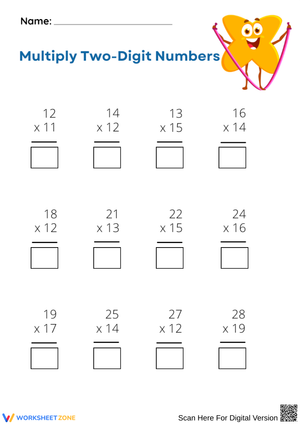
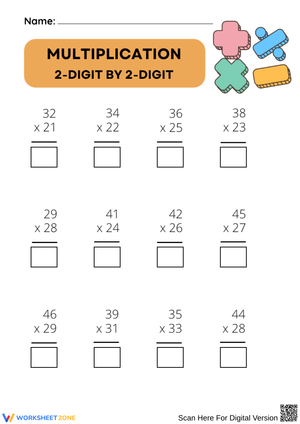
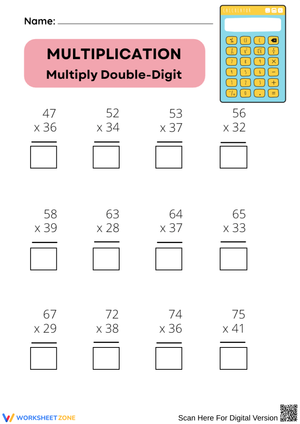
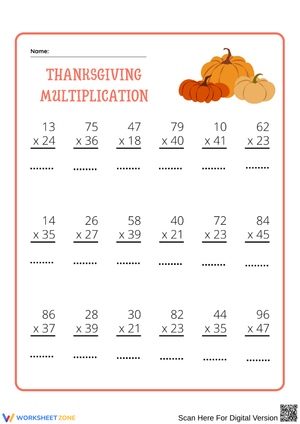
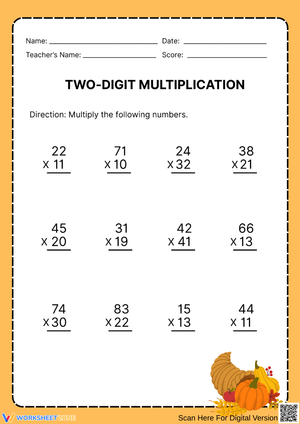
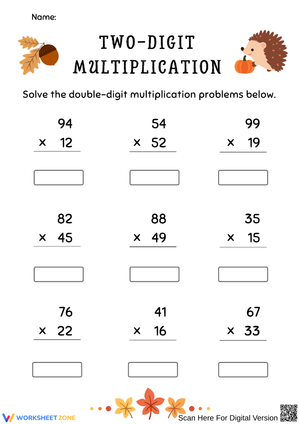
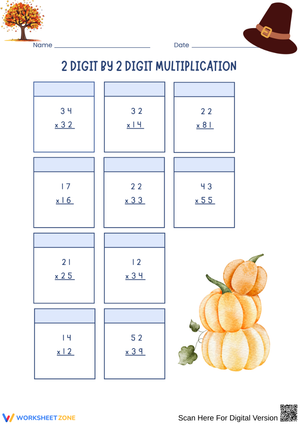
These 2 digit multiplication worksheets for 4th grade give teachers a practice set built around the full strategy arc — from the area model through partial products to the standard algorithm — rather than skipping straight to the algorithm and expecting fluency. Each worksheet addresses one specific phase of that progression, so there's no guessing about where a given resource fits in a unit.
What Each Worksheet in the Set Addresses
The 2 digit multiplication worksheets for 4th grade in this collection divide into three distinct strategy groups, each serving a different point in the learning progression.
Area model worksheets give students a pre-drawn four-section rectangle. They write the decomposed tens and ones for each factor along the outside edges — 34 becomes 30 and 4 — then fill in the four interior partial products and add them. Early worksheets in this group provide the decomposed numbers already labeled; later ones give students only the original two-digit factors and expect them to set up the model themselves. That shift in demand mirrors the gradual release teachers use during instruction, and it's intentional.
Partial products worksheets drop the rectangle but keep the place-value breakdown intact. Students list all four products vertically — ones × ones, ones × tens, tens × ones, tens × tens — then add them in a column. The visible listing reveals exactly where errors enter, which the box format sometimes obscures. This is why the partial products step belongs between the area model and the algorithm rather than as an afterthought.
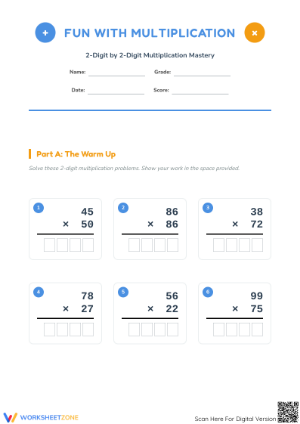
Standard algorithm worksheets include grid-line backgrounds with column labels printed above each cell. One worksheet in the set features a pre-printed zero placeholder in the second row of every problem — a small design choice that addresses one of the most reliable 4th-grade errors before it has a chance to become a habit.
Where Student Work Falls Apart — and What to Watch For
The zero-placeholder error is the most consistent mistake to anticipate when students transition from partial products to the standard algorithm. They understand conceptually that 34 × 27 involves multiplying by the 2 in the tens place — but they write the result in the ones column instead of shifting left. A student who arrives at 918 using partial products will produce 238 using the algorithm and have no instinct that something went wrong, because the individual multiplication steps felt correct. Pre-printed placeholders on the worksheet don't eliminate this error immediately, but they create a visible prompt at the exact moment the shift needs to happen.
The addition step at the end of the algorithm produces its own trouble. Students who have strong multiplication facts will still regroup incorrectly when summing two three-digit partial products under time pressure. Teaching students to estimate before computing — "43 × 28 has to fall somewhere between 40 × 20 = 800 and 50 × 30 = 1500, so if my answer is 254, something broke down" — gives them a self-correction tool that works whether or not a teacher is standing nearby.
Standard Alignment
Standard 4.NBT.B.5 requires fourth graders to multiply two two-digit numbers using strategies based on place value and the properties of operations, and to illustrate and explain calculations using rectangular arrays and area models. The area model and partial products worksheets address the illustrate-and-explain clause directly — students aren't computing in isolation, they're showing where each partial product comes from and why the numbers are the size they are. The algorithm worksheets address the procedural side of the standard. Most 4.NBT.B.5 practice materials emphasize one end or the other; this set moves through both, which matters because the standard calls for both.
Building These Worksheets Into Your Rotation
Projecting one area model worksheet on the board during whole-group instruction and working through two problems aloud — "34 becomes 30 and 4, and I write those along the outside edges" while actually writing — gives students a clear model before they attempt the rest independently. Teacher-led first two problems, then independent practice on the remainder, is a natural structure for any worksheet in this set.
These 2 digit multiplication worksheets for 4th grade fit equally well into small-group rotations during a math workshop block. One group works independently on the strategy they're consolidating while the teacher pulls a second group for direct instruction on the next strategy in the progression. Because each worksheet is self-contained, different groups work on genuinely different skills without complicated packet management or color-coded cover sheets.
For a low-prep warm-up during the five to eight minutes before specials, put one partial products problem on the board and have students solve it independently while you take attendance. Students who finish early locate the specific partial product where their work diverges from the board — the step-by-step format makes that comparison straightforward in a way that a single-step computation wouldn't allow.
Making the Set Work Across Different Entry Points
Students still building multiplication fact fluency use the area model worksheets with a multiplication chart available on their desk. The chart removes the fact-recall barrier so those students can focus on the place-value reasoning the area model actually teaches. Pulling the chart is a simple next step once fact fluency catches up — it doesn't require a different worksheet.
For students who move through the standard algorithm quickly, 2 digit multiplication worksheets for 4th grade that include multi-step word problems push the work further without introducing a new operation. A student who can compute 43 × 58 without hesitation still needs to decide whether multiplication is the right operation when reading a scenario — that judgment is a skill the computation-only worksheets don't reach.
Students who consistently struggle with spatial organization on the page benefit from working the standard algorithm on graph paper alongside the printed worksheet, even when the worksheet itself doesn't include a grid. Large-cell graph paper beside the worksheet, where students transfer and solve each problem, eliminates most column-alignment errors. It takes about thirty seconds of setup and requires no modified materials.
Frequently Asked Questions
Why do some students keep returning to the area model even after they've learned the standard algorithm?
This is expected behavior during a unit, not a sign something went wrong. The area model makes place value visible in a way the algorithm doesn't — students can point to the exact cell where 30 × 20 = 600 lives. Under any kind of pressure, students return to the method that makes conceptual sense to them. The goal is for the algorithm to become equally transparent, which takes repeated exposure over several weeks. Pushing students off the area model before the algorithm feels intuitive tends to increase errors, not reduce them.
What is the difference between the area model and the box method?
They refer to the same strategy. "Area model" is the academic term used in 4.NBT.B.5 and most curriculum documents. "Box method" is what teachers and students typically say during class. Both involve decomposing two-digit factors into tens and ones, placing them along the outside edges of a rectangle divided into four cells, and computing the interior partial products. Using both terms interchangeably during instruction helps students recognize them as synonyms when one or the other appears on an assessment or in a different resource.
How often should students complete worksheets from this set during a unit?
Two to three worksheets spaced across a week builds retention better than completing the same number in a single block. One worksheet on Monday, one on Wednesday, one on Friday takes advantage of spaced retrieval — students have to reconstruct the strategy each time rather than executing it on automatic while it's still fresh. The Friday worksheet functions naturally as a quick formative check: consistent place-value errors on a Friday partial products page signal that the student needs more time with that strategy before moving to the algorithm, which is exactly the information worth having before planning next week.













 Interactive Worksheet Maker
 Quiz Maker
 Word Search Maker
 Crossword Puzzle Maker
 Word Scramble Generator
 Sentence Scramble Generator
 Handwriting Worksheet Generator
 Name Tracing Generator
 Fill In The Blank Generator