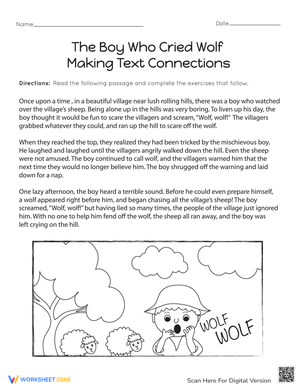
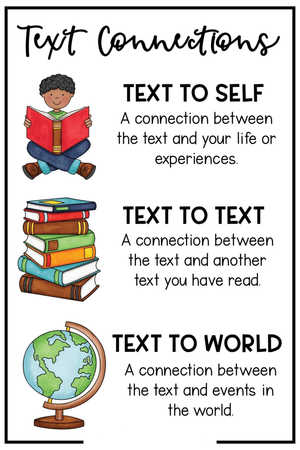
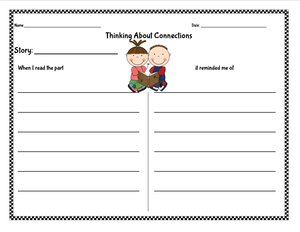
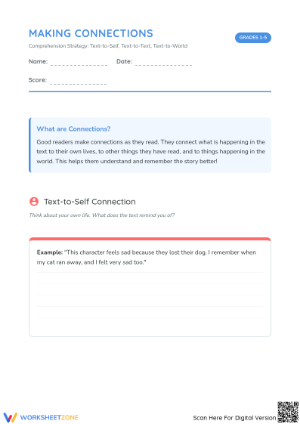
Making connections in reading printable worksheets for 4th grade give teachers a structured entry point into one of the harder comprehension strategies to assess: students can always produce a connection, but determining whether that connection actually deepens understanding is the real challenge. These worksheets break the strategy into three types—text-to-self, text-to-text, and text-to-world—and push students to explain how each connection helps them read more clearly, not just that one exists.
The Three Connection Types and What Each One Demands
By fourth grade, most students have heard "make a connection" many times. The problem is that many have learned to produce shallow connections that feel successful but don't move comprehension forward. A student who writes "This reminds me of when I had a dog" after reading about a character losing a pet has technically made a connection—but hasn't touched the character's grief or the story's theme. The shift from that kind of response to one that explains why the connection matters is exactly what fourth grade instruction has to address.
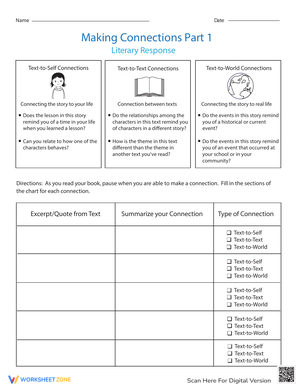
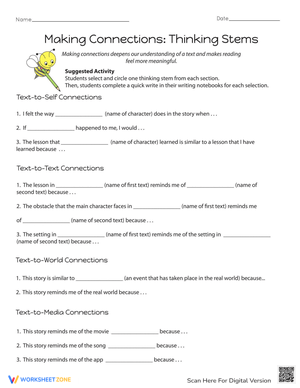
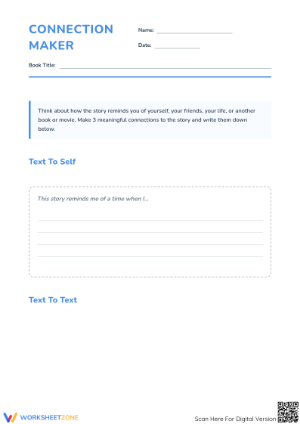
Each worksheet in the set targets one connection type explicitly. Text-to-self worksheets ask students to identify a personal experience and then write a sentence explaining how it helps them understand a character's reaction or motivation. Text-to-text worksheets pair a short reading with a previously read story or article and ask for a thematic or structural comparison—not just a note that both texts share a topic. Text-to-world worksheets push students to connect a passage to history, science, or real events, which challenges students the most because it draws on background knowledge rather than personal memory. Each worksheet closes with a follow-up prompt asking students to explain the so what—how the connection changes or strengthens their reading of the passage.
Frequent Student Errors These Worksheets Help You Catch
The most common error isn't a wrong answer—it's a disconnected one. A student reading a passage about the Boston Tea Party might write, "This connects to the world because taxes are still around today." Technically true, but it tells you nothing about why colonists were angry or what the event meant historically. The connection exists; it does no reading work. A related pattern shows up on text-to-text worksheets: students write two separate summaries side by side and call that a comparison. Pushing them toward a shared theme—"both stories show that standing up for what you believe in has real consequences"—is the move that separates analysis from summary.
A practical fix is the two-part answer stem: "I connect this part to… This helps me understand…" That second sentence keeps responses anchored to the text rather than the student's personal story. When teachers use this frame during modeling and students practice it before independent work, response quality improves noticeably within the same week.
Fitting These Worksheets Into Your Planning Without Losing the Routine
The sequence that produces the most consistent results is short: a five-minute think-aloud, ten to fifteen minutes of worksheet practice, and a brief share at the end. The share matters. When four or five students read their connections aloud, the class hears how different readers used different connections to understand the same passage—and starts to notice which responses actually support comprehension and which drift into personal territory.
Making connections in reading printable worksheets for 4th grade also fit naturally into small-group instruction. Pull students who are producing disconnected responses, read the passage together, and work through the worksheet with guided questions before anyone writes. These students often need to say their connection aloud first—to hear whether it relates to the text—before they can write it cleanly.
- Monday warm-up: Open a new unit with a text-to-self worksheet tied to the week's theme while students settle in after morning meeting.
- Literacy centers: Pair each worksheet with a familiar passage students have already read so the cognitive load stays on making the connection, not decoding new text.
- Exit ticket: Use the last eight minutes of a reading block—one connection, one sentence explaining how it helped them understand the passage.
Adapting the Set Across Different Reading Levels
Tiered use doesn't require separate materials. For students who need more processing time or language support, shorter passages and sentence starters—"This reminds me of…" or "This connects to the world because…"—lower the entry barrier without removing the thinking. A graphic organizer with three labeled boxes (text detail, my connection, how this helps me understand) gives students a visible structure to follow instead of a blank response space. For multilingual learners especially, a short oral rehearsal with a partner before writing often produces more complete responses than going straight to the worksheet.
For students reading above grade level, push in the other direction: ask them to identify which connection type is most useful for a given passage and write a short defense of that choice. That task moves from strategy use into strategy evaluation—the kind of thinking that prepares students for the comparative analysis work ahead in fifth and sixth grade.
Standard Alignment
These worksheets address CCSS.ELA-LITERACY.RL.4.1, which asks students to refer explicitly to the text when explaining what it says and drawing inferences. The follow-up prompt on each worksheet—asking how a connection supports understanding—is the direct classroom application of that standard. Text-to-text worksheets also address RL.4.9, which asks fourth graders to compare and contrast the treatment of similar themes across stories. RL.4.9 tends to appear in late-spring writing assessments, which makes structured practice with text-to-text comparison earlier in the year worth planning for deliberately. Students who have worked through that comparison in a structured format repeatedly tend to write more focused responses when the standard shows up in a less guided context.
Frequently Asked Questions
What are the three types of reading connections?
Text-to-self, text-to-text, and text-to-world. Each type asks students to link what they are reading to a different source of prior knowledge—personal experience, another text, or something from the wider world—and then explain how that link supports their understanding of the passage.
How should I introduce this strategy before handing out a worksheet?
Model with a short read-aloud and a think-aloud. Read a paragraph, pause, and narrate your reasoning: "This part reminds me of another story where the character had to choose between loyalty and honesty—that connection tells me this character is probably facing the same kind of pressure." Then have students try one connection orally with a partner before moving to the worksheet. The oral step lets students hear whether their connection is actually doing reading work before they commit it to writing.
What should a useful making-connections worksheet include?
Making connections in reading printable worksheets for 4th grade work best when they include a short focused passage, a clearly named connection type, space for a specific text detail, and a follow-up prompt asking how the connection improves understanding. Worksheets that ask only for a personal response—without the evidence and explanation—produce answers that are hard to assess and easy to fake. The follow-up prompt is the piece most often missing from weaker resources.
Can these worksheets function as informal assessments?
They can, and they are more useful for that purpose than many teachers expect. Scan responses for three things: Is the connection relevant to the passage? Does the student include a specific text detail? Does the second sentence explain a comprehension gain? A student who consistently meets all three is ready to apply the strategy during independent reading. One who makes relevant connections but skips the explanation still needs more guided practice with the "how this helps me understand" step. Making connections in reading printable worksheets for 4th grade collected over two or three weeks also give a clear picture of whether students are growing in strategy use or stuck at the surface level.












 Interactive Worksheet Maker
 Quiz Maker
 Word Search Maker
 Crossword Puzzle Maker
 Word Scramble Generator
 Sentence Scramble Generator
 Handwriting Worksheet Generator
 Name Tracing Generator
 Fill In The Blank Generator