


























Views
Downloads
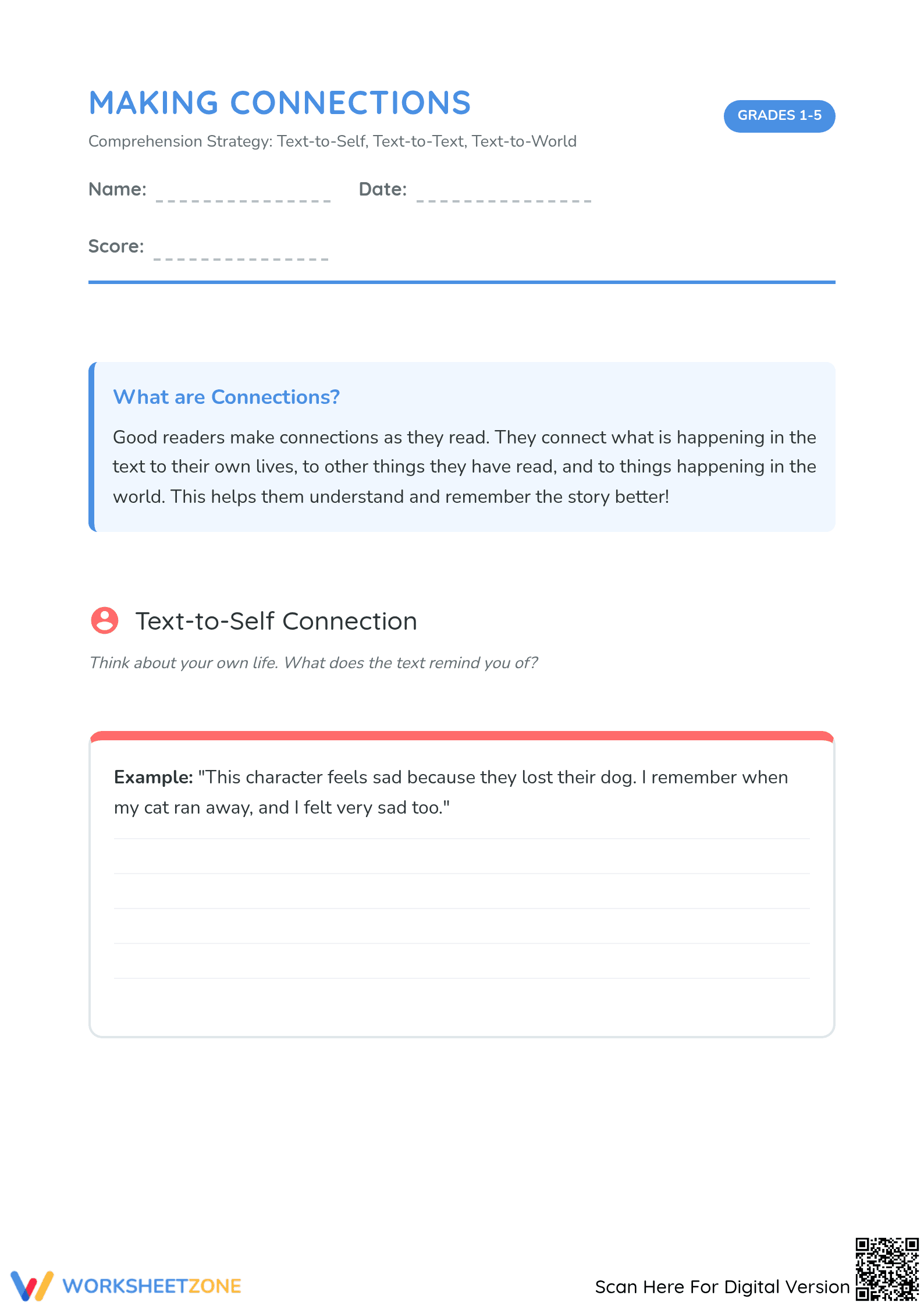


Essential Making Connections Worksheet | Grades 1-5 ELA
Paste this activity's link or code into your existing LMS (Google Classroom, Canvas, Teams, Schoology, Moodle, etc.).
Students can open and work on the activity right away, with no student login required.
You'll still be able to track student progress and results from your teacher account.
This worksheet helps students deepen their reading comprehension by making meaningful connections between the text and their own lives, other books, or the world around them. By practicing these three core strategies, learners improve their ability to relate to characters and retain information across different genres. It transforms abstract reading concepts into concrete writing exercises.
At a Glance
- Grade: 1-5 · Subject: ELA / Reading Comprehension
- Standard:
CCSS.ELA-LITERACY.RL.2.1— Ask and answer questions about key details to demonstrate understanding of a text- Skill Focus: Making Connections (Self, Text, World)
- Format: 3 pages · 4 problems · Open-ended responses · PDF
- Best For: Literacy centers and independent reading response
- Time: 20–30 minutes
What's Inside: The three-page PDF includes dedicated sections for text-to-self, text-to-text, and text-to-world connections. Each section provides a clear definition and a modeled example to guide students through the thought process. The resource concludes with a Practice Activity featuring a short story titled "The Community Garden," where students apply a connection strategy of their choice to a new text.
Zero-Prep Workflow
This resource is designed for immediate classroom implementation with minimal teacher oversight. First, print the three-page packet (30 seconds). Second, distribute to students during your literacy block or as a guided reading accompaniment (1 minute). Third, review student connections during small-group share time or use the open-ended prompts for a quick formative check (5 minutes). This streamlined approach makes it an ideal choice for substitute folders or last-minute comprehension reinforcement.
Standards Alignment
The primary alignment is to `CCSS.ELA-LITERACY.RL.2.1`, which requires students to demonstrate understanding by referring to the text. By linking personal experiences or external knowledge to the narrative, students satisfy the requirement to engage deeply with textual evidence. This standard code can be copied directly into lesson plans, IEP goals, or district curriculum mapping tools to ensure all instructional minutes remain focused on core proficiency benchmarks.
How to Use It
Use this worksheet as a post-reading activity after a whole-class read-aloud to model the different types of connections. During independent reading time, students can use the frames to record their internal dialogue as they encounter relatable characters or familiar themes. For a formative assessment, observe if students can distinguish between a "surface" connection and a "deep" connection that actually aids their understanding of the plot. Completion typically takes 25 minutes depending on the complexity of the chosen text.
Who It's For
This packet is optimized for elementary students in grades 1 through 5, with scaffolds that support developing writers while remaining rigorous enough for upper elementary analysis. It is particularly effective for English Language Learners who benefit from the sentence starters and modeled examples. Pair this resource with a diverse picture book or a short informational passage to maximize the potential for world-wide connections and cultural relevance.
Fisher & Frey (2014) emphasize that making connections is a foundational element of metacognition that allows readers to bridge the gap between decoding and deep meaning. This Grade 1-5 worksheet operationalizes the CCSS.ELA-LITERACY.RL.2.1 standard by providing a structured framework for students to practice text-to-self, text-to-text, and text-to-world strategies. Research from the NAEP highlights that students who frequently use connection strategies demonstrate higher levels of overall reading proficiency and better performance on inferential questioning tasks. By offering modeled examples and a concluding application story, the resource ensures that students are not just identifying similarities but are using those links to enhance their textual analysis. This evidence-based approach supports the gradual release of responsibility, moving students from guided observation to independent comprehension mastery in any instructional setting.


