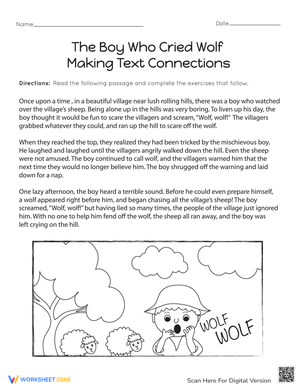
Making Connections in Fiction Printable Worksheets for Grade 4
Making connections in fiction printable worksheets for 4th grade put structure around a skill that fourth graders often do loosely — connecting a story to their own experiences, to other texts, and to the wider world, then explaining what that thinking actually reveals about the fiction. Each worksheet pairs a short passage or story-response prompt with a sequence of questions requiring students to identify the triggering story detail, name the connection type, and write an explanation of how the link deepens understanding of a character, event, conflict, or theme. That last step is what separates these resources from a typical "I can relate" journal entry.
The Specific Skills Each Worksheet Targets
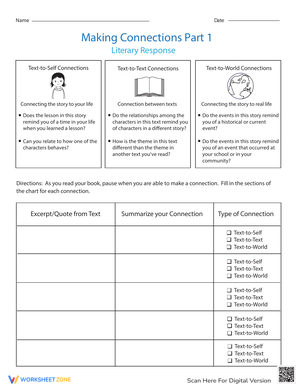
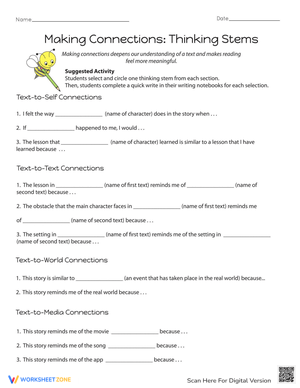
The work on these worksheets moves through three connection types — text-to-self, text-to-text, and text-to-world — with prompts built to keep student responses grounded in the fiction rather than drifting into personal narrative. Students underline the story detail that triggered the connection, label the connection type, and then write an explanation of how that link sharpens their reading of a character's motivation, a plot decision, or a story's central message. The most important prompt across the set is the one that requires students to close the loop: "This connection helps me understand ___ because ___." Without that return-to-the-text requirement, fourth graders almost always default to talking about themselves.
The set targets these specific skills:
- Identifying and labeling text-to-self, text-to-text, and text-to-world connections within a fiction passage
- Selecting concrete story evidence — dialogue, character action, setting detail — to support the connection
- Writing multi-sentence explanations that tie a personal or external reference back to story meaning
- Comparing two connection types for the same passage and deciding which provides stronger insight into character or theme
- Recognizing how a connection shifts across a story's arc as a character changes
Frequent Student Errors Worth Catching Before They Become Habits
The most common problem fourth graders show on connection worksheets is writing a true personal statement that never returns to the text. A student will write, "My brother and I argue the same way these characters do," and consider that a complete response. That is not a reading comprehension answer — it is a memory. The error is not the personal detail itself; the error is the missing explanation of what that detail reveals about the character's feelings, the author's message about conflict, or the way the dispute moves the plot forward. When you see responses that read like personal anecdotes with no story evidence, the student needs a direct conversation about what "understanding the story" means, not just a correction note in the margin.
A second pattern is worth watching for in text-to-text work: students often produce comparisons that are accurate but stop short. They will write, "Both books have a character who feels left out," without explaining how recognizing that parallel helps them predict this character's behavior or interpret the theme more precisely. Pointing students back to the sentence-stem prompt usually fixes this quickly — it is a framing problem more than a thinking problem, and the structure on the worksheet addresses it directly.
Building These Worksheets Into Your Reading Block
Making connections in fiction printable worksheets for 4th grade fit at multiple points in the reading block, and the entry point that works best depends on where students are in the learning sequence. Early in a unit, use one worksheet as a shared think-aloud: project the fiction passage, model the connection process aloud — naming the triggering detail, labeling the type, explaining the effect — and complete the organizer together before moving students to independent work. That first shared experience sets the response standard clearly. Later in the unit, the same worksheet format becomes a quiet accountability tool during independent reading: students stop at a marked passage and record one evidence-based connection before continuing.
During literacy center rotations, a worksheet paired with a short fiction passage runs well in the 15 to 20 minutes when the teacher is working with a small group. The familiar response structure means students can begin without waiting for instructions, which matters when attention is split. On Fridays, a focused 10-minute connection response tied to the week's read-aloud reinforces the skill without requiring a full lesson. The goal is to make evidence-based connection-writing a regular habit, not a special occasion.
One specific classroom move worth building in: after students finish writing, have them read their response to a partner and ask the partner to say whether the explanation clearly shows how the connection changes their reading of the text. This takes about three minutes and catches vague responses before they settle as complete work.
Adjusting the Worksheets for a Range of Readers in the Room
Making connections in fiction printable worksheets for 4th grade adapt well across readiness levels because the response structure stays consistent while the level of demand shifts. For students who need more support, shorten the fiction passage to six or eight sentences and highlight two or three story details in advance. Add sentence starters — "This part of the story reminds me of…" and "This helps me understand the character because…" — and build in a partner-talk step before writing. Students who rehearse their response aloud first produce noticeably stronger written explanations.
For students ready for greater challenge, assign the same passage but ask them to write responses for two different connection types, then argue in a closing sentence which one gives a more useful insight into the story's theme. A stronger extension is asking students to track how their text-to-self connection evolves across the story's arc — does their personal experience still align with the character's situation once the conflict deepens, or has the gap between them grown? That kind of comparative thinking moves toward the text-evidence reasoning expected in Grade 5 without requiring a different worksheet format.
One limitation worth naming: the sentence-stem version of these worksheets can produce formulaic responses from students who are already confident writers. For those students, removing the stems entirely and requiring a paragraph-length explanation without structural support is a more productive version of the task.
Standard Alignment
For teachers mapping making connections in fiction printable worksheets for 4th grade to specific standards, the primary alignment is CCSS.ELA-LITERACY.RL.4.1, which requires students to refer to details and examples from a text when explaining what it says and when drawing inferences. Every response on these worksheets requires story evidence, placing the practice directly inside that standard's expectation. The set also supports CCSS.ELA-LITERACY.RL.4.9, which asks students to compare and contrast stories with similar themes or topics — the natural structure of text-to-text connection work. Because RL.4.1 functions as a recurring anchor standard throughout most Grade 4 ELA curriculum maps, these worksheets fit any fiction unit across the year rather than only a dedicated making-connections lesson.
Frequently Asked Questions
What separates a surface-level connection from one that actually improves comprehension?
A surface-level connection stops at the resemblance: "I've felt nervous before, just like this character." A comprehension-building connection goes further: "I've felt nervous before a big performance, which helps me understand why the character's hands are shaking in the audition scene — the author is showing that fear, not lack of preparation, is what makes the character hesitate." The second response uses personal experience as a lens, not as the subject. These worksheets push students toward that second kind through prompts that require both text evidence and an explanation of the connection's effect on understanding.
Should students practice all three connection types in a single sitting?
For most fourth graders, one connection type per sitting is enough — especially early in instruction. Asking students to generate all three types for a single passage at once increases cognitive load without adding proportional comprehension benefit. Introduce text-to-self first, model it thoroughly, then move to text-to-text, then text-to-world. By mid-year, students who have worked through that sequence can compare connection types on a single worksheet without the task becoming unwieldy.
Do these worksheets work with class read-alouds, or only with the short passages printed on each worksheet?
They work well with chapter book read-alouds — and in many cases better. Students with more story context tend to write more precise connections and cite more specific evidence. Use a worksheet at a natural stopping point in the read-aloud, after a key character decision or a shift in the plot, and ask students to record one connection to what was just read. The connection type can be assigned or left to student choice depending on where the class is in the teaching sequence.
How do you grade these worksheets without making it feel punitive for students still developing the skill?
A three-point rubric keeps feedback specific and manageable: one point for a relevant connection, one point for a story detail cited as evidence, and one point for an explanation that links the connection back to character, theme, or event meaning. Students who score two out of three almost always have the connection and the evidence but skip the explanation — that is the most common gap and the most teachable one. Reading a few anonymous responses aloud as a class and scoring them together builds student judgment faster than written comments in the margin.
Clear All